


On this page
- Shopify vs WooCommerce: Which Is Better?
- The Core Difference Between Shopify and WooCommerce
- Shopify vs WooCommerce Pricing
- Transaction Fees
- Pakistan, the US and the UAE
- Ease of Use and Maintenance
- Shopify vs WooCommerce for SEO
- Apps, Extensions and Customization
- Small Business and Dropshipping
- How to Choose
- Key Takeaways
- Frequently Asked Questions
In short
Shopify is a hosted store builder you rent by the month. WooCommerce is a free WordPress plugin you host and maintain yourself. Shopify is easier and safer to run; WooCommerce is cheaper and more flexible. In Pakistan the balance tilts toward WooCommerce for card-heavy stores, because Shopify Payments isn’t available there and Shopify adds a 0.6% to 2% fee on every order paid through a local gateway.
A Karachi clothing brand takes Rs 500,000 a month in card and wallet payments through a local gateway. On Shopify’s Basic plan, that brand pays Shopify an extra Rs 10,000 every month on top of the gateway’s own charges. On WooCommerce, the same orders cost it nothing extra.
That one line item settles the debate for some stores and is irrelevant to others.
Most Shopify vs WooCommerce comparisons are written for US or UK merchants, where Shopify’s own payment processor removes that fee entirely. The picture changes once you sell in Pakistan, where the processor isn’t offered, or in the UAE, where both platforms’ payment products work but with conditions. This guide compares the two platforms on price, fees, effort, SEO and flexibility, using each platform’s own pricing and help pages read in October 2026, and converts dollar prices to rupees at the State Bank of Pakistan rate. Digital Lamar builds and markets online stores for businesses in Pakistan, the US and the UAE, so the comparison is organised around the decisions store owners in those three markets actually face.
Shopify vs WooCommerce: Which Is Better?
Shopify is better if you want a store running quickly with no server work and you sell where Shopify Payments is available, such as the US or UAE. WooCommerce is better if you want low running costs, full control of the code and data, or you take most payments through a local gateway in Pakistan, where Shopify charges an extra fee. For build, hosting and domain prices in PKR, see website cost in Pakistan.
Neither platform is better in general. Each one is better for a particular kind of store, team and market, and the rest of this guide shows you which kind you are.
Shopify vs WooCommerce at a Glance
| Factor | Shopify | WooCommerce |
|---|---|---|
| What it is | Hosted, all-in-one store builder (SaaS) | Free, open-source plugin for WordPress |
| Software cost | From USD 19/month billed yearly (Basic) | Free core plugin |
| Hosting | Included | You buy it (from about Rs 12,000/year in Pakistan) |
| Updates and security | Handled by Shopify | Your job, or your developer’s |
| Extra fee with an outside gateway | 2% Basic, 1% Grow, 0.6% Advanced | None |
| Own payment processor | Shopify Payments (not in Pakistan) | WooPayments (not in Pakistan) |
| Cash on delivery | Yes, as a manual payment method | Yes, built into the core plugin |
| Best for | Non-technical teams, fast launches, US/UAE stores | Content-led stores, tight budgets, custom needs, PK card-heavy stores |
What Is the Difference Between Shopify and WooCommerce?
The difference is ownership. Shopify is a hosted service: you pay a monthly subscription and Shopify runs the servers, software, security and checkout. WooCommerce is software you install on your own WordPress site: the plugin is free, but you choose the host and handle updates, backups and security yourself or through a developer.
Both are mature. W3Techs’ usage survey (29 October 2026) puts WooCommerce on 47.4% of ecommerce sites it can identify and Shopify on 32.4%, roughly four in five stores between them.
How Shopify Works
Shopify works like renting a fully fitted shop. You sign up, choose a theme, add products and connect a payment method, all from one dashboard in the browser. There is no server to buy or software to update, and Shopify’s pricing FAQ says the platform is certified Level 1 PCI DSS compliant, which covers card-data security for you.
The trade-off is that you work inside Shopify’s rules: its checkout, its theme language, its app store and its fee schedule.
How WooCommerce Works
WooCommerce works like owning the building. You buy hosting, install WordPress, add the free WooCommerce plugin, then choose a theme and extensions. You control every file and every database row, and you can change anything a developer can code. You are also responsible for keeping the whole stack updated, backed up and secure.
Shopify vs WooCommerce Pricing: What Each Costs per Year
Shopify costs a fixed subscription, from USD 19 a month billed yearly, plus app fees and, in some countries, a per-order fee. WooCommerce costs nothing to download, but you pay for hosting, a domain, any premium extensions and developer time. For a small store, WooCommerce’s yearly bill is usually lower; Shopify’s is more predictable. All rupee figures below use the State Bank of Pakistan’s M2M revaluation rate of PKR 276.77 per US dollar, as on 28 October 2026.
Shopify Plans and Pricing in 2026
Shopify has four main plans, according to Shopify’s pricing page (October 2026). New stores get three days free, then pay USD 1 a month for the first three months.
| Shopify plan | Billed yearly (per month) | Billed monthly | Per year, billed yearly (PKR) | Third-party gateway fee |
|---|---|---|---|---|
| Basic | USD 19 (about Rs 5,259) | USD 25 | about Rs 63,104 | 2% |
| Grow | USD 49 (about Rs 13,562) | USD 65 | about Rs 162,743 | 1% |
| Advanced | USD 299 (about Rs 82,755) | USD 399 | about Rs 993,064 | 0.6% |
| Plus | From USD 2,300 a month | n/a | 0.2% | |
Basic includes no staff accounts beyond the owner. Grow adds 5 and Advanced adds 15, which matters once a team of packers, marketers and customer-service staff needs its own logins.
What Does WooCommerce Really Cost?
WooCommerce itself is free, with no subscription and no revenue share. WooCommerce’s own pricing page (2026) puts hosting at USD 25 to 350 a month for most stores, and paid extensions at USD 29 to 299 a year each. Those hosting figures assume US-style managed hosting, so Pakistani stores usually pay far less.
In Pakistan, local hosts sell WooCommerce-ready plans in rupees. HostBreak’s WP Commerce plan, for example, costs Rs 12,000 billed yearly (Rs 2,000 a month on monthly billing), as listed on its site in October 2026. Add a .pk domain at Rs 2,100 a year from PKNIC, and a small WooCommerce store can be online for about Rs 14,100 a year before any premium theme, extension or developer work. The hidden cost is labour. Somebody has to apply WordPress, plugin and theme updates, test that checkout still works afterwards, and restore a backup when something breaks. If that somebody is a paid developer, budget for it every month, not just at launch.
Is WooCommerce Cheaper Than Shopify?
Yes, on running costs WooCommerce is cheaper for most small stores. In Pakistan, hosting plus a .pk domain comes to about Rs 14,100 a year, against about Rs 65,204 for Shopify Basic billed yearly plus the same domain. Shopify narrows the gap by bundling hosting, security and updates you would otherwise pay someone to handle.

Year-one platform and hosting cost only. Themes, apps, extensions and build work come on top for both.
The comparison flips for stores that would need many paid WooCommerce extensions, a managed host and a developer on retainer. At that point Shopify’s single bill can be the cheaper option, especially in the US and UAE where no extra per-order fee applies. If you would rather have the store built and set up for you on either platform, that is what our Web design & development service covers.
Shopify vs WooCommerce Transaction Fees
WooCommerce charges no transaction fee of its own; you only pay your payment gateway. Shopify charges no extra fee when you use Shopify Payments, but adds 2% on Basic, 1% on Grow, 0.6% on Advanced and 0.2% on Plus to every order paid through a third-party gateway, on top of that gateway’s own charges.
When Does Shopify Charge a Third-Party Transaction Fee?
Shopify charges its third-party transaction fee whenever an order is paid through an outside payment provider instead of Shopify Payments. Shopify’s help centre says the fee applies to all transactions processed through third-party and alternate gateways. In countries where Shopify Payments isn’t offered, including Pakistan, that means every online-paid order.
The maths is simple and it scales with revenue. On a Rs 5,000 order paid by a domestic card through Safepay, whose pricing page lists 2.9% plus Rs 30 per successful charge, the gateway takes Rs 175. Shopify Basic then adds Rs 100, Grow adds Rs 50 and Advanced adds Rs 30. WooCommerce adds nothing.

The Shopify fee sits on top of the gateway’s own charges and grows with every rupee of online-paid revenue.
Rs 120,000 a year
What Shopify Basic’s 2% third-party fee adds for a Pakistani store taking Rs 500,000 a month through a local gateway. Upgrading to Grow halves it to Rs 60,000, but the plan itself costs about Rs 99,600 more per year.
That is why the upgrade question is not obvious. Grow saves 1% of online sales and costs USD 30 more a month billed yearly, so it only pays for itself in fees once online-paid sales pass roughly Rs 830,000 a month. Below that, staying on Basic is cheaper even with the higher percentage. Running these numbers for your own sales mix takes ten minutes with the right inputs. If you’d like a second pair of eyes, book a free 30-minute call with Digital Lamar and we’ll model both platforms against your actual order volume and payment split.
Does Shopify Charge Fees on Cash on Delivery Orders?
No. Shopify treats cash on delivery as a manual payment method, and its help centre states that you aren’t charged third-party transaction fees for manual payments. A Pakistani store where most orders are COD therefore pays Shopify’s subscription but little or no per-order fee, which shrinks WooCommerce’s cost advantage considerably.
Check your own split before choosing. A store that is 80% COD and a store that is 80% card face very different Shopify bills.
Shopify vs WooCommerce in Pakistan, the US and the UAE
The right platform depends partly on where your business is registered, because each platform’s built-in payment processor only works in certain countries. Both Shopify Payments and WooPayments are available in the US and the UAE. Neither is available in Pakistan, so Pakistani stores rely on local gateways and cash on delivery on either platform.

Payment availability by market, from Shopify’s and WooCommerce’s own country lists, October 2026.
Shopify vs WooCommerce for Pakistani Stores
For Pakistani stores, WooCommerce is usually the cheaper choice and Shopify the easier one. Shopify Payments isn’t on Shopify’s list of supported countries (October 2026), so online payments go through a local gateway and attract Shopify’s third-party fee. WooCommerce has no such fee.
Local gateways support both platforms. Safepay, for example, lists a WordPress and WooCommerce integration alongside two Shopify payment apps on its pricing page, and launched a Shopify app for Raast payments from local banks and wallets on 16 September 2026, according to its Shopify App Store listing. Before you commit, confirm that your chosen gateway has a current, maintained integration for your platform, and ask what its settlement times are. Cash on delivery works on both platforms without extra software.
Currency is the other practical detail. Shopify prices its plans in US dollars on its pricing page, so a weaker rupee raises your subscription in PKR terms. WooCommerce hosting from a Pakistani host is billed in rupees. If your team will also run paid campaigns and SEO alongside the store, working with a digital marketing agency in Pakistan that knows both platforms keeps the build and the marketing aligned.
Shopify vs WooCommerce in the US
In the US, Shopify’s per-order fee disappears when you use Shopify Payments, which removes WooCommerce’s biggest cost advantage. WooCommerce can use WooPayments, which its pricing page lists at about 2.50% to 2.90% plus 30 cents per transaction, or another processor. The choice in the US comes down to effort, flexibility and total running cost, not fees.
Shopify vs WooCommerce in the UAE
UAE businesses can use Shopify Payments, and WooCommerce’s WooPayments country list (2026) includes the UAE with one condition: businesses there don’t have access to the Individual account type, so you need a registered business. With both processors available, UAE merchants weigh the platforms much as US merchants do. For a Dubai-based build, see our web design company in Dubai page.
Outside Pakistan, in other words, the fee argument mostly disappears.
Is Shopify Easier to Use Than WooCommerce?
Yes. Shopify is easier for most store owners because everything sits in one hosted dashboard and there is nothing to install or update. WooCommerce asks you to set up hosting, WordPress, the plugin, a theme and extensions, then keep them compatible with each other. Owners comfortable with WordPress find WooCommerce manageable; first-time sellers usually find Shopify faster.
Who Handles Hosting, Security and Updates on Each Platform?
On Shopify, Shopify handles hosting, security patches, checkout uptime and PCI compliance. On WooCommerce, you or your developer handle them: choosing a host, applying WordPress, plugin and theme updates, running backups, installing an SSL certificate and monitoring for malware. Good hosts automate parts of this, but responsibility stays with the store owner, and a WooCommerce store nobody maintains will eventually break or get hacked.
Shopify sells convenience. WooCommerce sells control.
Shopify vs WooCommerce for SEO: Which Is Better?
Both platforms can rank well, and neither ranks a store by itself. WooCommerce gives more control because it runs on WordPress, where SEO plugins and full template access let you change almost any on-page element. Shopify covers the basics automatically and is easier to keep clean, but enforces fixed URL paths such as /products/ and /collections/.
Shopify’s help centre confirms that every Shopify store generates a sitemap.xml file automatically, so search engines can find new products without setup. WooCommerce sites get a sitemap from WordPress or an SEO plugin, plus deeper control over structured data, redirects and content layout. That control matters most for content-led stores. Still, platform choice is a small part of the result: product page quality, category structure, internal links, site speed and content decide rankings far more than the platform underneath. If you want the full playbook, our guide to ecommerce SEO covers what to fix first on either platform, and our SEO (Search Engine Optimization) service takes it on for you.
Shopify Apps vs WooCommerce Extensions: Which Is More Flexible?
WooCommerce is more flexible. Because it is open source and runs on WordPress, a developer can change any part of the store, from checkout fields to database structure. Shopify is extended through its app store and theme code, which covers most needs but stops at the limits Shopify sets, for example on how far you can change the checkout. Cost works differently too. WooCommerce extensions are mostly priced per year, at USD 29 to 299 each according to WooCommerce’s pricing page, while many Shopify apps are monthly subscriptions. Five or six paid apps can add more to a Shopify bill than the plan itself, so total them before you compare platforms.
Shopify vs WooCommerce for Small Business and Dropshipping
For a small business with no developer, Shopify is usually the safer start because setup, hosting and security are handled. For a small business that already runs a WordPress site, has technical help, or sells mainly by card through a Pakistani gateway, WooCommerce usually costs less. Dropshippers often prefer Shopify for its app ecosystem.
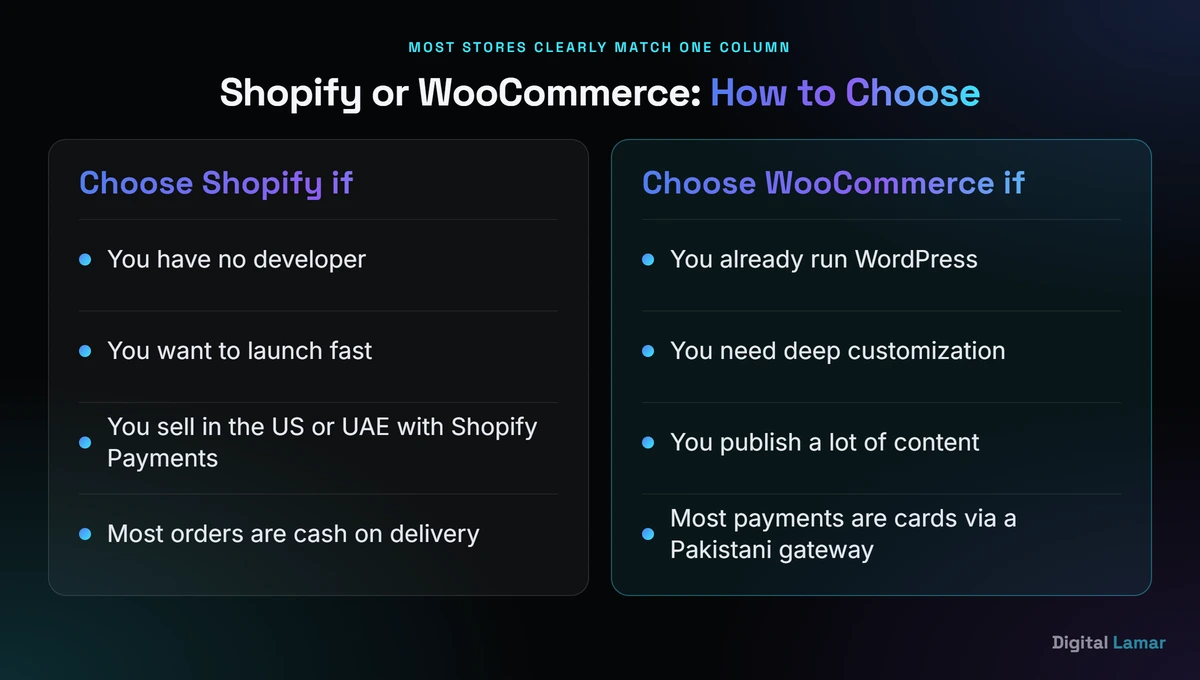
Most stores clearly match one column. If yours splits evenly, total cost of ownership decides it.
When Shopify Is the Better Choice
Shopify is the better choice when speed and reliability matter more than control. That covers first-time sellers, small teams without a developer, stores selling in the US or UAE with Shopify Payments, Pakistani stores taking mostly cash on delivery, and brands that expect traffic spikes from campaigns and don’t want to manage servers through them. For the fundamentals of identity and positioning, see what branding is.
When WooCommerce Is the Better Choice
WooCommerce is the better choice when cost and control matter more than convenience: an existing WordPress site, unusual product logic, content-heavy brands, or a Pakistani store paid mostly by card through a local gateway.
How to Choose Between Shopify and WooCommerce
Choose by answering four questions in order: where you sell and which payment processors work there, how your customers pay, who will maintain the store, and how much you need to customise. Those answers usually point to one platform. If they don’t, compare three-year total cost, including apps, extensions, hosting and maintenance labour.
- Check your market. If you sell in the US or UAE, Shopify Payments removes the per-order fee. In Pakistan it doesn’t exist.
- Check your payment split. Pull three months of orders and separate COD from online-paid. Shopify’s fee only hits the online-paid share.
- Name your maintainer. If nobody on your team will update and back up WordPress every month, budget for a developer or choose Shopify.
- List your must-have features. Find the app or extension for each, and add up their yearly cost on both platforms.
- Compare three years, not one. Include the build, the subscription or hosting, add-ons and maintenance.
Digital Lamar’s ecommerce marketing agency team settles the platform before quoting a build, because the platform sets your running costs for years.
Can You Migrate From WooCommerce to Shopify Later?
Yes. Products, customers and order history can be moved from WooCommerce to Shopify, and the reverse is also possible, using import tools or a migration app. The harder parts are preserving URLs with redirects so search rankings carry over, rebuilding custom features, and retraining your team, so plan a migration as a project, not a weekend task.
Key Takeaways
- Shopify is a hosted subscription from USD 19 a month billed yearly; WooCommerce is a free WordPress plugin you host and maintain yourself.
- WooCommerce runs on 7.8% of all websites and Shopify on 5.3%, with 47.4% and 32.4% of the ecommerce-system market (W3Techs, 29 October 2026).
- Shopify adds 2% (Basic), 1% (Grow) or 0.6% (Advanced) to orders paid through a third-party gateway, but nothing on cash on delivery.
- Shopify Payments and WooPayments both work in the US and UAE; neither works in Pakistan.
- In Pakistan, a small WooCommerce store’s hosting and .pk domain cost about Rs 14,100 a year, against about Rs 65,204 for Shopify Basic plus a domain.
- Choose by market, payment split, maintenance capacity and customisation needs, then compare three-year total cost.
Not Sure Which Platform Fits Your Store?
Book a free 30-minute call with Digital Lamar. We’ll look at your market, payment split and growth plans, then recommend Shopify or WooCommerce with the yearly cost of each in your currency.
Book a free 30-min strategy callFrequently Asked Questions
Is Shopify available in Pakistan?
Yes, Pakistani businesses can open and run Shopify stores, but Shopify Payments isn’t available in Pakistan. Stores take online payments through a local gateway such as Safepay, and Shopify then adds a third-party transaction fee of 2% on Basic, 1% on Grow or 0.6% on Advanced. Cash on delivery orders don’t carry that fee.
Is WooCommerce really free?
The WooCommerce plugin is free, with no subscription or revenue share. Running a store still costs money: hosting, a domain, any premium theme or extensions, and someone’s time to maintain it. In Pakistan, hosting and a .pk domain start at about Rs 14,100 a year before any premium add-ons.
Can you use WooCommerce without WordPress?
No. WooCommerce is a WordPress plugin, so it needs a WordPress site to run on. That is also its advantage: your store and your blog or content pages live in the same system, which suits brands that publish guides, lookbooks or category content alongside their products.
Is Shopify more secure than WooCommerce?
Shopify is easier to keep secure, because Shopify manages the servers, patches and checkout, and states it is certified Level 1 PCI DSS compliant. WooCommerce can be just as secure, but only if the host is good and WordPress, plugins and themes are updated promptly. Plugin updates are the part most often skipped, so assign them to a named person.
Is Shopify or WooCommerce better for a small business?
Shopify suits a small business without technical help that wants to launch quickly and avoid maintenance. WooCommerce suits a small business on a tight budget, one that already uses WordPress, or a Pakistani store taking most payments by card through a local gateway, where Shopify’s extra percentage adds up.
Which is better for dropshipping, Shopify or WooCommerce?
Shopify is the more common choice for dropshipping because supplier apps connect to it with little setup and the store needs no server management. WooCommerce can dropship too, through extensions, and costs less to run, but you take on the integration and maintenance work yourself.