
On this page
In short
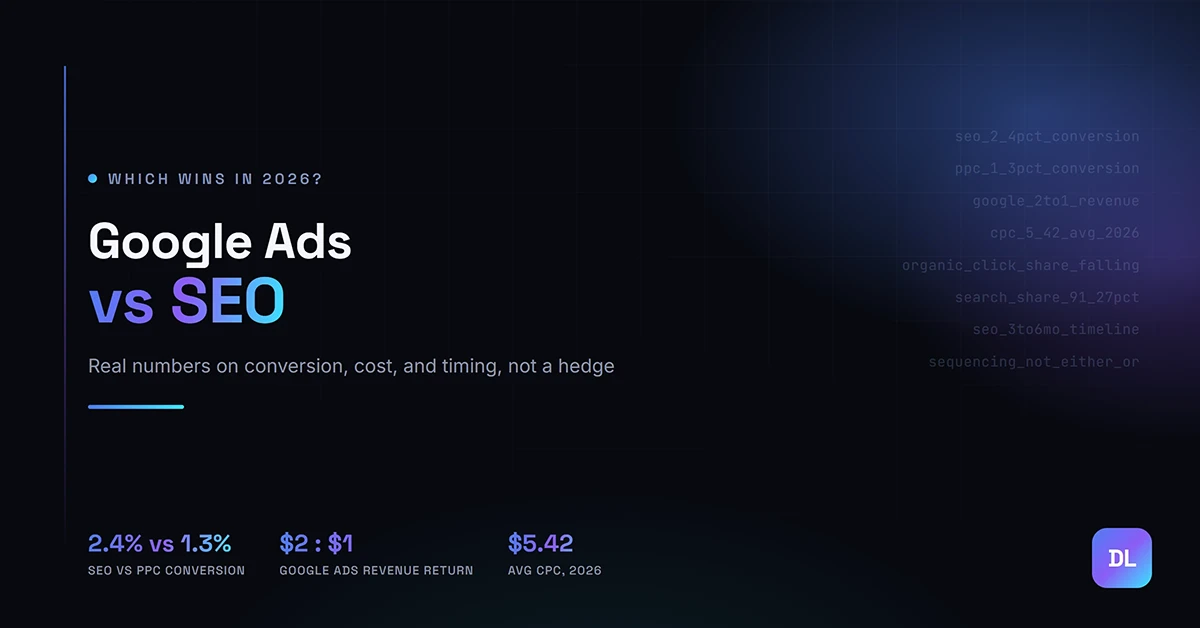
Google ads vs SEO isn’t really an either/or question, but the honest sequencing answer depends on budget, timeline, and how much organic authority a site already has. SEO converts at 2.4% versus PPC’s 1.3% (First Page Sage, 2025), yet Google Ads still returns $2 in revenue for every $1 spent (Google Economic Impact) and can generate leads the same week. The real shift worth knowing about: a January 2026 study shows paid click share climbing sharply against organic in under a year. This guide breaks down the SEO vs PPC decision with real numbers, a realistic timeline, and a sequencing plan for businesses that can’t afford to fund both channels at once.
Every click on Google Ads now costs $5.42 on average in 2026, more than double the $2.32 it cost a decade ago (WordStream, 2026). SEO, meanwhile, costs nothing per click and converts at nearly double the rate. So why does the Google Ads vs SEO argument still dominate nearly every marketing planning meeting?
Because the honest answer isn’t “SEO is better” or “Google Ads is better.” It’s a sequencing question, and the right sequence depends on how much budget exists today, how quickly the business needs leads, and how much organic authority the site already has. Most guides on this topic land on “you need both,” which is technically true and practically useless for an owner staring at a spreadsheet trying to decide where the next dollar goes.
This guide skips the hedge. It works through the real conversion numbers, what each channel actually costs in 2026, a realistic payoff timeline for each, and a sequencing plan for businesses that can’t fund SEO and paid search at full strength simultaneously.
Google Ads vs SEO: The Core Differences
Two channels, two different jobs. The mistake is treating them as interchangeable.
Google Ads buys placement. SEO earns it. That single distinction explains almost every other difference between the two channels.
With Paid advertising (PPC), a business pays for every click, and the moment the budget stops, the traffic stops with it. There’s no ranking to protect and no algorithm update to worry about, only a bid and an ad rank score. With SEO (Search Engine Optimization), a business earns a position through relevance, technical health, and authority signals accumulated over time, and that position keeps producing traffic without a per-click bill. The tradeoff is speed: paid search can start sending traffic within hours of launch, while SEO typically needs months to show meaningful movement. Neither weakness is fatal, but ignoring either one is how budgets get wasted.
How Each Channel Actually Works
Google Ads runs on an auction. Advertisers bid on keywords, Google scores each ad on bid amount and quality (expected click-through rate, ad relevance, landing page experience), and the highest-scoring combination wins the top placements. Pause the campaign and the placement disappears immediately, regardless of how well it performed.
SEO runs on relevance signals instead of bids. Search engines crawl a site, index its content, and rank pages based on hundreds of factors: technical performance, content depth, backlink authority, and user engagement among them. There’s no daily auction to win. A well-optimized page that ranks on page one can hold that position for months with minimal maintenance, which is exactly why SEO’s return compounds while paid search’s return resets to zero the day spending stops.
SEO vs PPC: Which Converts Better?
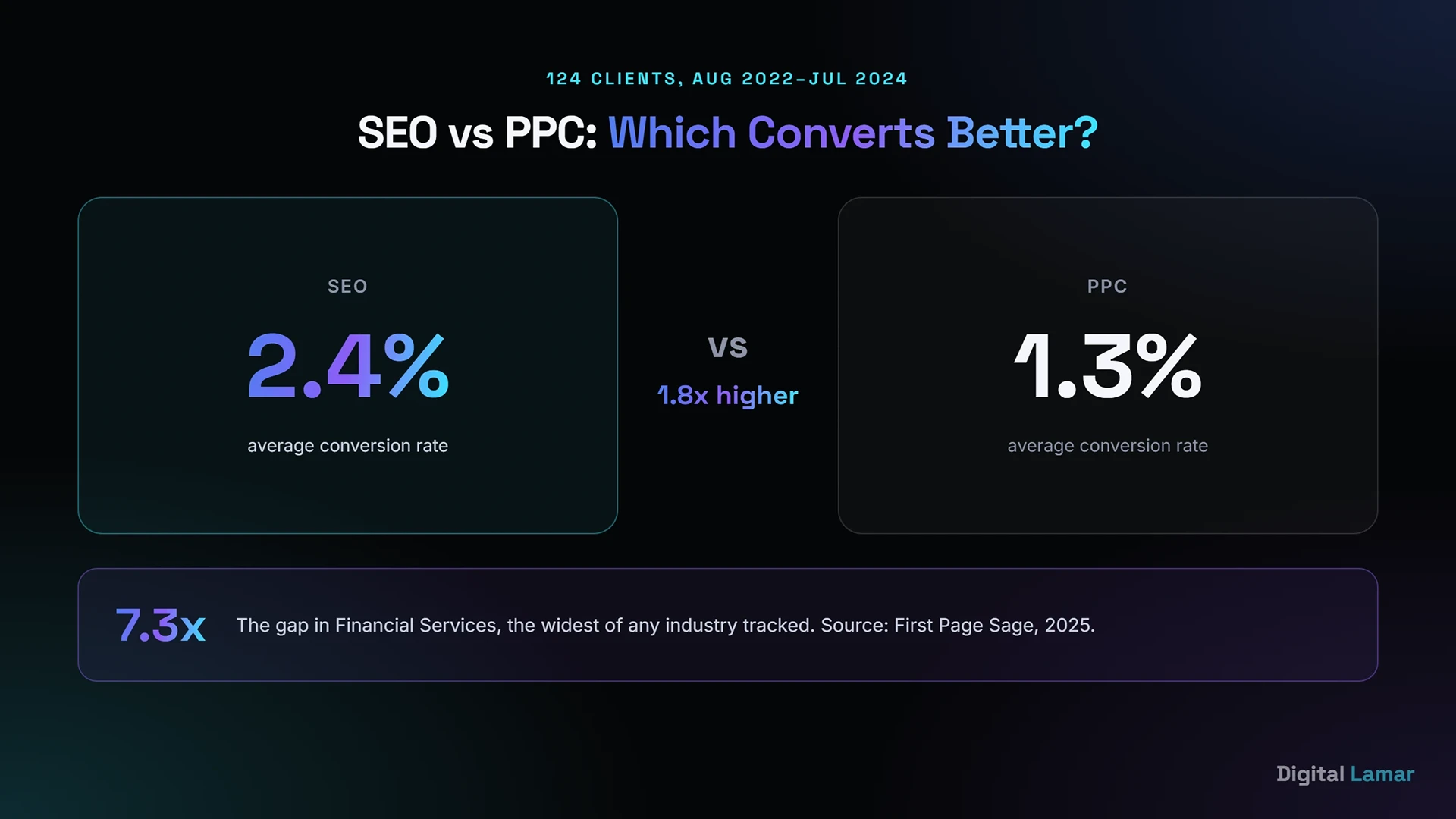
Organic visitors convert almost twice as often as paid ones, on average.
Did you know
Across 124 clients tracked between August 2022 and July 2024, SEO converted at an average of 2.4%, compared to 1.3% for PPC, roughly 1.8 times higher. The gap was even larger in specific verticals: financial services saw SEO convert at 7.3 times the rate of PPC.
Source: First Page Sage, 2025The conversion gap in the SEO vs PPC comparison makes intuitive sense once you consider who’s clicking what. Someone who clicks an ad knows it’s an ad, and a meaningful share of searchers actively skip paid results in favor of organic ones. Someone who clicks an organic result has effectively been pre-vetted by the search engine’s own ranking algorithm, which filters for relevance before the click ever happens. That’s not a knock on paid search. It’s simply a different kind of trust being transferred at the moment of the click.
None of this means Google Ads underperforms. A 1.3% conversion rate on high-intent commercial traffic can still be extremely profitable, especially when the alternative is having zero visibility while SEO slowly builds. The conversion-rate gap is a reason to prioritize SEO for the long run, not a reason to skip paid search in the short run.
What Each One Actually Costs
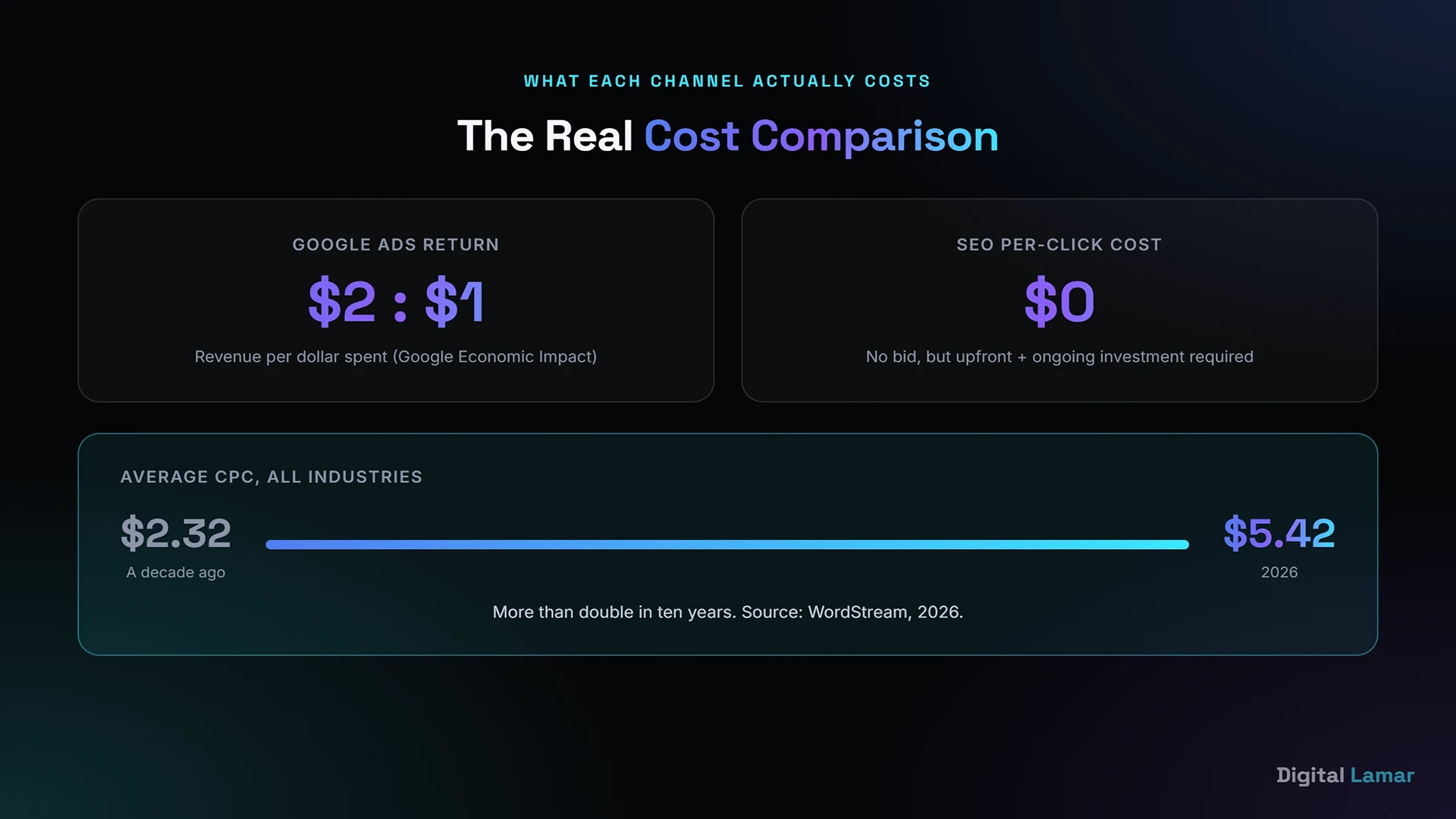
Google’s own Economic Impact research puts the average return at $2 in revenue for every $1 spent on Google Ads, a baseline many advertisers beat and some don’t reach, depending on industry and execution. That $2 figure is a direct-spend number, separate from the additional organic click value Google sometimes layers on top in its broader economic modeling.
SEO’s cost structure looks completely different. There’s no per-click charge, but there is an upfront and ongoing investment: content production, technical fixes, and the time it takes for a search engine to trust a new or improved page. Businesses often compare these costs unfairly, measuring Google Ads by cost-per-click and SEO by a flat monthly retainer, without normalizing either one to cost-per-lead. Once cost-per-lead is the shared unit, SEO very often wins on a long enough timeline, precisely because the per-click cost drops toward zero as rankings mature while Google Ads’ cost-per-click keeps climbing industry-wide.
Budget reality matters here too. A business running both channels at once needs enough budget to fund SEO’s slow build while paid search covers the gap, and businesses that split a thin budget evenly across both often end up with mediocre results in each rather than strong results in one.
How Long Until Each One Pays Off
Google Ads can generate its first leads within days of launch. That’s the entire appeal: a business can test messaging, pricing, and offers almost in real time, and turn the budget off the moment it stops making sense.
SEO moves on a different clock entirely. Early technical improvements and initial indexing show up within weeks, but meaningful ranking movement on competitive terms typically takes three to six months, and the strongest compounding returns usually arrive somewhere between six and twelve months in. That timeline frustrates business owners used to paid media’s instant feedback loop, but it’s also exactly why SEO’s returns keep growing long after the initial work is paid for, while a paused Google Ads account produces nothing the next day.
Why This Decision Is Getting Harder
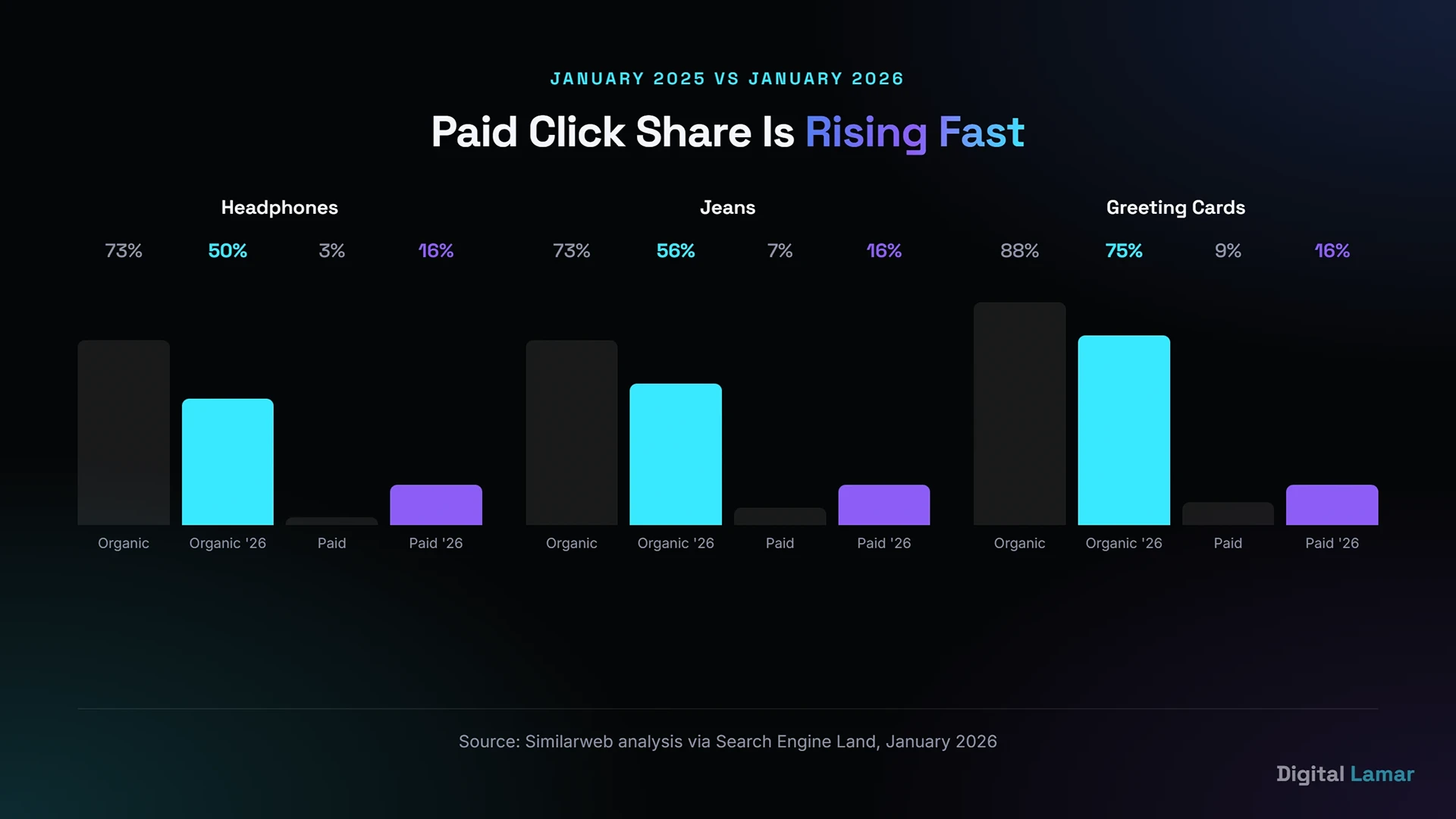
The ground under this decision moved measurably in the last twelve months.
The Google Ads vs SEO decision isn’t static, and the landscape shifted meaningfully in the past year. A January 2026 Similarweb analysis of top U.S. search queries across several categories found organic click share falling sharply while paid text ads and product listing ads gained ground, in some categories by double digits within a single year.
Google now also holds 91.27% of worldwide search engine market share as of June 2026, which means nearly every dollar and every hour spent on either channel is still, functionally, a bet on one company’s platform. That concentration cuts both ways: it makes the SEO vs PPC decision higher-stakes than it would be in a fragmented search market, and it means AI-driven changes to Google’s own results pages (AI Overviews chief among them) can reshape both organic and paid click behavior at once, sometimes within a single algorithm update.
When to Start With SEO vs. Google Ads First
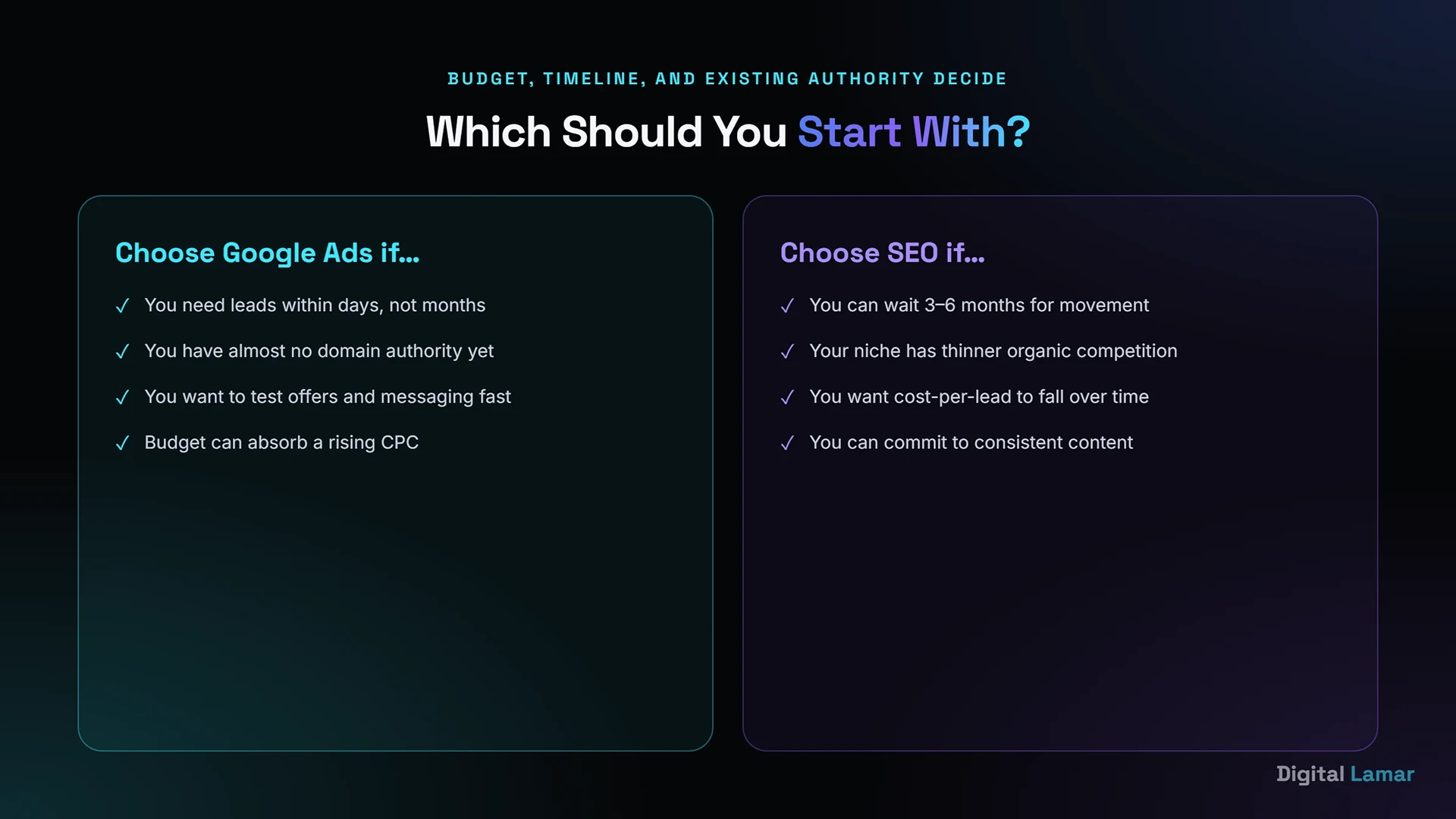
Business type and market context matter more than most generic advice admits.
A new business with almost no domain authority, launching in a competitive category, often needs Google Ads first simply to generate any revenue while SEO builds in the background. A business in a lower-competition niche with a founder willing to write consistently can sometimes skip paid search almost entirely and let SEO carry the load from month one. In Pakistan and the UAE specifically, where Google Ads CPCs in competitive categories can rival or exceed US pricing while local SEO competition is often thinner than in saturated Western markets, SEO frequently offers a faster path to genuinely affordable customer acquisition than the CPC math above would suggest for a US-only audience. In the US, where SEO competition is fiercest in almost every profitable category, a blended approach from day one is usually the more realistic starting point.
The businesses that get this decision wrong tend to share one trait: they pick a channel based on which one a competitor is using, rather than their own budget, timeline, and starting authority.
Can You Run Both?
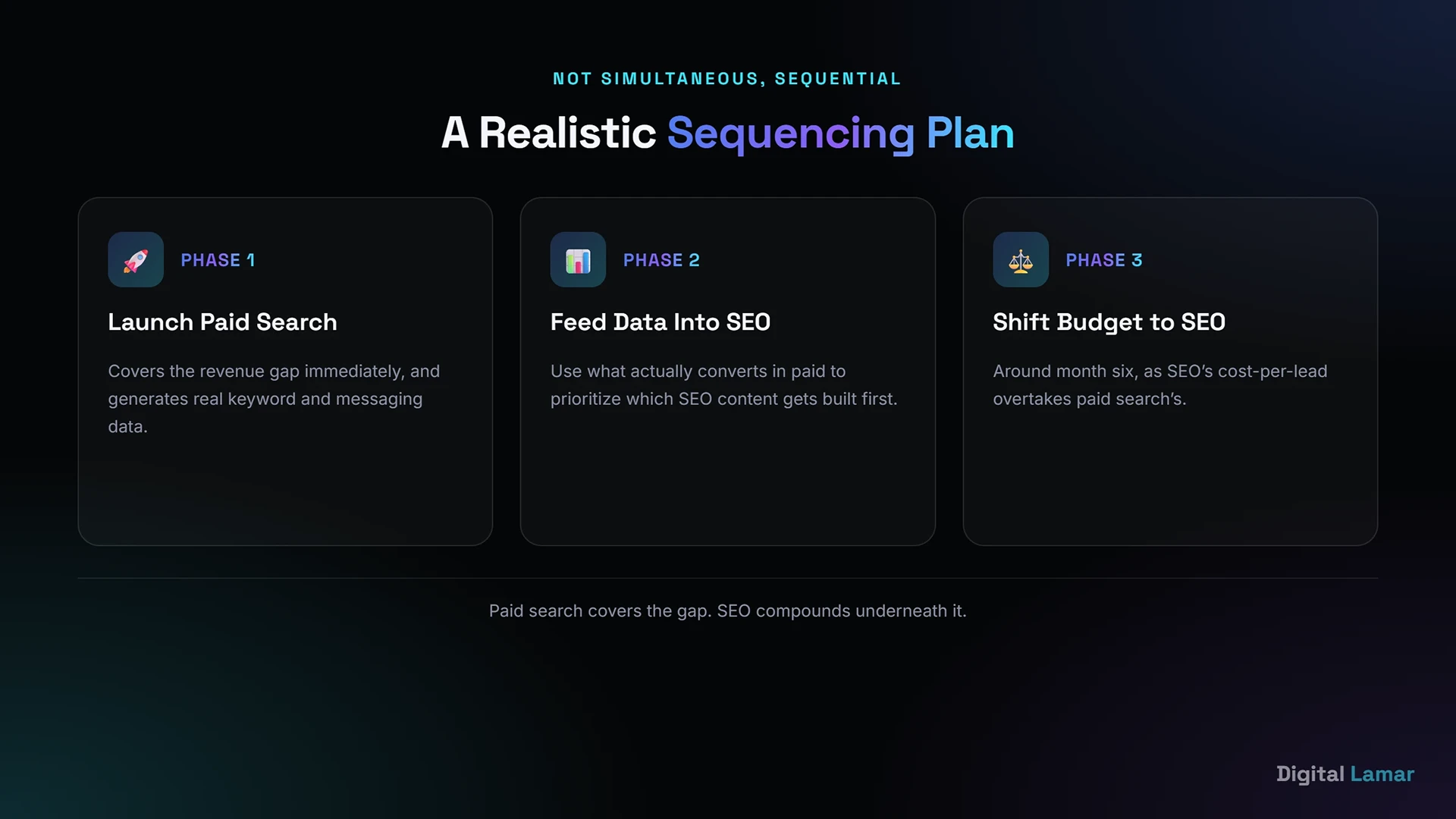
Yes, and for most established businesses, running both eventually is the right answer, just not necessarily on day one. The realistic sequencing plan looks like this: launch paid search first if the budget allows it, using the early data (which keywords convert, what messaging resonates, what the actual cost-per-lead looks like) to inform the SEO content strategy that follows. Let paid search cover the revenue gap during SEO’s first several months, then gradually shift budget toward SEO as organic rankings mature and its cost-per-lead drops below paid search’s.
Not sure which channel your specific budget and timeline should start with? Book a free 30-minute strategy call and we’ll work through the sequencing using your actual numbers rather than industry averages.
If the sequencing question is really a bigger “should I handle this myself or bring in help” question, that’s worth answering honestly before picking a channel at all. We covered that exact decision in how to choose a digital marketing agency, and the vetting framework there applies whether the agency’s first job is SEO, paid search, or both.
Key Takeaways
- SEO converts at 2.4% versus PPC’s 1.3%, roughly 1.8 times higher, across 124 clients tracked through mid-2024 (First Page Sage, 2025).
- Google Ads returns an average $2 in revenue per $1 spent (Google Economic Impact), and average CPC has more than doubled in a decade, from $2.32 to $5.42 in 2026 (WordStream).
- Paid click share is rising sharply against organic in the past year alone, per a January 2026 Similarweb analysis, making this decision more time-sensitive than it used to be.
- Google Ads can produce leads within days; SEO typically needs three to six months for meaningful movement and six to twelve months for its strongest compounding returns.
- Google holds 91.27% of worldwide search share (StatCounter, June 2026), so both channels are ultimately bets on the same platform.
- The realistic answer for most budgets is sequencing, not simultaneity: paid search first to cover the revenue gap, SEO second as its cost-per-lead overtakes paid search’s.
Want a sequencing plan built around your actual budget, not a generic “do both” answer?
Book a free 30-min strategy callFrequently Asked Questions
Is Google Ads better than SEO?
Neither is universally better. Google Ads wins on speed, generating leads within days, while SEO wins on cost-efficiency and conversion rate over time, converting at roughly 1.8 times PPC’s rate (First Page Sage, 2025). The right choice depends on how quickly the business needs revenue versus how much budget exists to wait for compounding returns.
Is SEO better than PPC for small businesses?
Often, yes, once a business can absorb several months without immediate results, since SEO’s cost-per-lead tends to fall over time while PPC’s cost-per-click has been rising industry-wide. Businesses needing revenue immediately, or entering an extremely competitive category with zero existing authority, usually need PPC to bridge the gap first.
Can I do SEO and Google Ads at the same time?
Yes, and for most established businesses that’s the eventual goal. The realistic sequencing plan is to launch paid search first if budget allows, use its data to inform SEO content decisions, and gradually shift spend toward SEO as its cost-per-lead overtakes paid search’s, typically starting around month six.
Which converts better, SEO or Google Ads?
SEO, on average. Organic traffic converted at 2.4% versus 1.3% for PPC across 124 clients tracked through mid-2024, nearly double, with the gap reaching over 7 times in some industries like financial services (First Page Sage, 2025).
How much does Google Ads cost compared to SEO?
Google Ads charges per click, averaging $5.42 across industries in 2026, more than double the $2.32 average from a decade ago (WordStream). SEO has no per-click charge but requires upfront and ongoing investment in content and technical work, with cost-per-lead typically falling as rankings mature.
How long does it take to see results from SEO versus Google Ads?
Google Ads can generate leads within days of launch. SEO typically shows meaningful ranking movement in three to six months, with the strongest compounding returns arriving between six and twelve months, and continuing to build from there.