

On this page
- Why This Decision Deserves More Than a Google Search
- Step 1: Get Clear on What You Actually Need
- Step 2: Shortlist on Proof, Not Promises
- Step 3: Ask These 8 Questions
- Step 4: Understand How Agencies Price
- Step 5: Read the Contract Like It Matters
- Step 6: Judge Their Communication Before You Sign
- Step 7: Start Small, Scale on Results
- Warning Signs to Walk Away From
- Choosing an Agency in Pakistan, the UAE & the US
- Key Takeaways
- FAQ
In short
Choosing a digital marketing agency comes down to seven steps: define what you need, shortlist on proof (not promises), interview with the right questions, understand their pricing model, read the contract for ownership and exit terms, evaluate how they communicate, and start with a scoped 90-day engagement before committing long-term. The agencies to avoid announce themselves early — guaranteed rankings, vague reporting, and contracts you can’t leave are all signals to keep looking.
Most businesses don’t choose a digital marketing agency badly because they’re careless. They choose badly because they’ve never been shown what to compare. Every agency website says roughly the same thing — results-driven, data-led, full-service — so the real differences only show up if you know where to look: in the questions they ask you, the contracts they offer, and the way they report.
This guide is the framework we’d want a friend to use — including on us. It assumes you already know what a digital marketing agency does; now the job is picking the right one. Seven steps, in the order they should happen.
Why This Decision Deserves More Than a Google Search
Marketing is not a small line item. According to Gartner’s 2026 CMO Spend Survey, companies allocate an average of 7.8% of total revenue to marketing. For a business doing $1M a year, that’s $78,000 — money that either compounds into a growth engine or quietly evaporates into monthly reports nobody reads.
The wrong agency doesn’t just cost you the retainer. It costs you the six months you spent finding out, the rankings a competitor built while you waited, and — in the worst cases — cleanup work when their shortcuts get your site penalized. The right one, by contrast, gets cheaper over time: the strategy compounds, the content ranks, and every month of work builds on the last. That asymmetry is why the selection process deserves actual rigor.
Step 1: Get Clear on What You Actually Need
Agencies quote against what you ask for. Walk in vague, and you’ll get a vague (and usually padded) proposal. Before you contact anyone, write down three things:
- The business outcome — not “more marketing,” but “30 qualified leads a month” or “rank for the services we sell in Dubai.”
- The channels you think you need — SEO, paid ads, social, web design — while staying open to being corrected. A good agency will challenge this list; a bad one will just sell you all of it.
- A realistic budget range — you don’t have to reveal it in the first call, but you need to know it, because it determines whether you need a freelancer, a specialist agency, or a full-service partner.
One honest self-check: if you can’t name the outcome you want, you’re not ready to hire an agency — you’re ready for a strategy conversation, which is a different (and usually free) first step.
Step 2: Shortlist on Proof, Not Promises
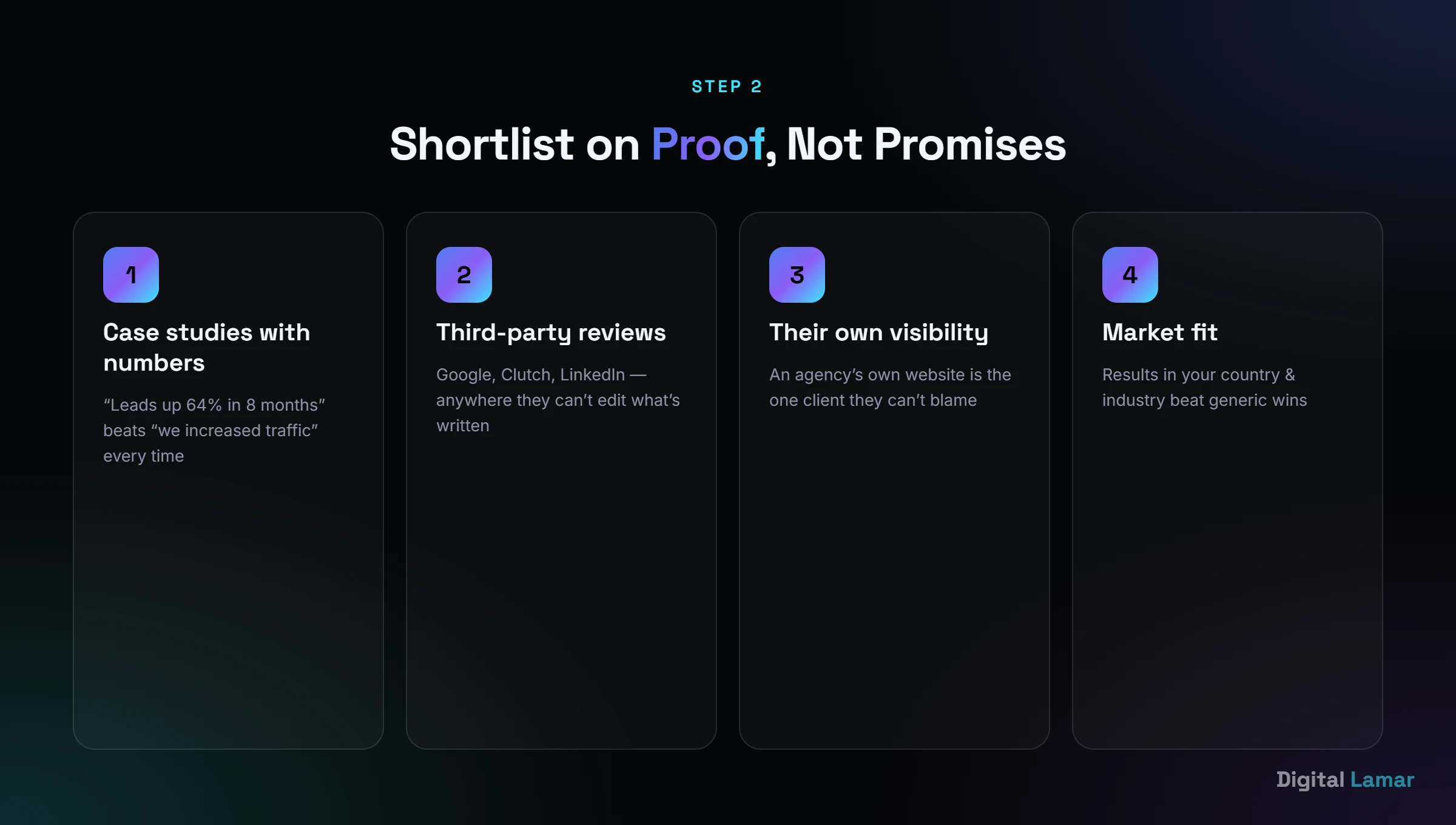
Four kinds of proof that matter more than any sales pitch.
Build a shortlist of three to five agencies, and let evidence do the filtering:
- Case studies with numbers. “We increased traffic” means nothing. “Organic leads up 64% in eight months, here’s the client” means something. Look for results in businesses roughly your size — an agency whose case studies are all enterprise brands will treat your account as a rounding error.
- Third-party reviews. Google reviews, Clutch, LinkedIn recommendations — anywhere the agency can’t edit what’s written about them.
- Their own visibility. This one filters ruthlessly: if an SEO agency doesn’t rank for anything itself, ask why. An agency’s own website is the one client they can’t blame.
- Familiarity with your market. Results in your country or industry beat generic ones — a point we’ll come back to for Pakistan, the UAE, and the US below.
Step 3: Ask These 8 Questions (and Listen for How They Answer)
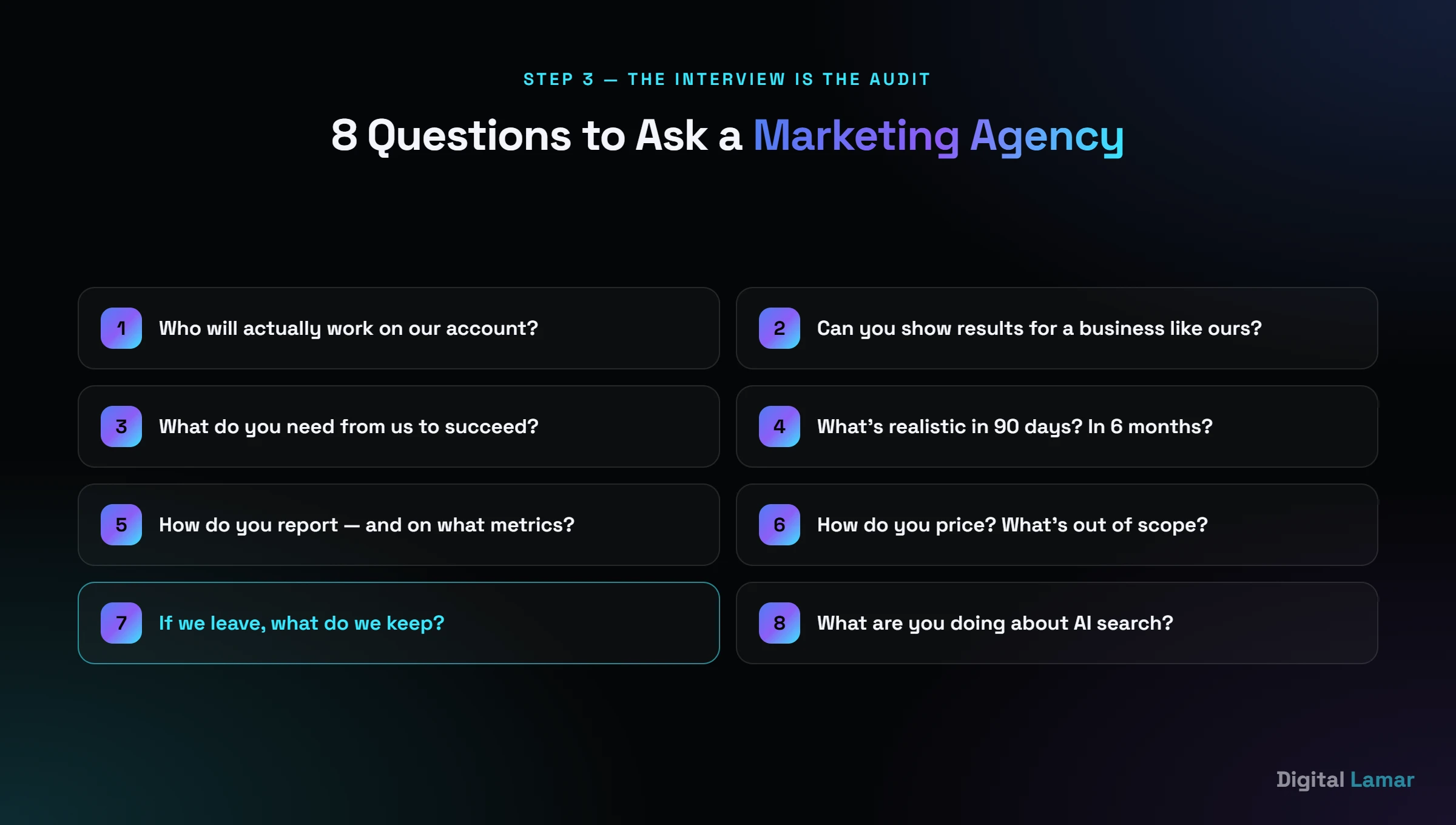
The interview is the audit. These questions do the work.
The questions to ask a digital marketing agency aren’t trick questions — they’re pressure tests. Confident agencies answer them directly; the other kind get vague:
- “Who will actually work on our account?” The people in the sales call are often not the people doing the work. Ask to meet the actual team lead.
- “Can you show results for a business like ours?” Similar size, similar market, similar goal.
- “What do you need from us to succeed?” The correct answer is a list — access, approvals, subject-matter input. An agency that needs nothing from you is planning to do generic work.
- “What’s realistic in the first 90 days? In six months?” Honest agencies talk in phases and ranges. If SEO is involved, anyone promising page-one rankings in weeks is lying — Google’s own guidance on hiring SEO help says four months to a year is the normal window for results.
- “How do you report, and on what metrics?” Ask to see a real (anonymized) client report. Leads and revenue should appear in it, not just rankings and impressions.
- “How do you price, and what’s out of scope?” Surprises live in the out-of-scope column.
- “If we leave, what do we keep?” Your website, ad accounts, analytics, and content should be yours, full stop. Some agencies build everything inside accounts they own — leaving means starting over. This single question kills more bad deals than any other.
- “What are you doing about AI search?” Buyers increasingly ask ChatGPT and Google’s AI results before they ever click a website. An agency with no answer on AI search optimization is optimizing for how people searched five years ago.
Step 4: Understand How Agencies Price
There’s no universal price list, but there are four standard models — and knowing them stops you comparing apples to oranges:
| Model | How it works | Best for | Watch out for |
|---|---|---|---|
| Monthly retainer | Fixed fee for an agreed scope of ongoing work | SEO, content, ongoing programs | Vague scopes that shrink over time |
| Project-based | One-time fee for a defined deliverable | Website builds, audits, rebrands | Change-request costs after kickoff |
| % of ad spend | Management fee scales with your ad budget | Paid advertising accounts | Incentive to push spend up, not efficiency |
| Performance-based | Payment tied to leads or revenue targets | Rare; specific lead-gen setups | Quality of leads often suffers for quantity |
Retainers are the norm for anything ongoing because the work genuinely compounds month over month. What matters more than the model is scope clarity: what’s included, what’s extra, and what happens when priorities shift mid-quarter. We’re publishing a full pricing breakdown across Pakistan, the UAE, and the US separately — but if a quote is dramatically cheaper than every other quote, it isn’t a bargain; it’s a smaller amount of actual work wearing the same label.
Step 5: Read the Contract Like It Matters (Because It Does)
Four clauses decide whether a bad relationship is a lesson or a hostage situation:
- Ownership. Website, domain, ad accounts, analytics, content, creative — confirm in writing that all of it belongs to you, during and after the engagement.
- Exit terms. 30-day notice is standard and fair. A 12-month lock-in with no performance-based out-clause protects exactly one party, and it isn’t you.
- Deliverables in writing. “SEO services” is not a deliverable. “Four optimized articles, monthly technical audit, monthly report with lead attribution” is.
- Reporting cadence. Monthly minimum, with a named person who answers questions between reports.
Step 6: Judge Their Communication Before You Sign
How an agency behaves while trying to win you is the best behavior you will ever see from them. Slow replies during the sales process become slower after signing. Jargon in the proposal becomes jargon in the reports. Pay attention to whether they explain things in plain language, whether they ask about your business or only talk about their services, and whether they push back on anything — an agency that agrees with everything you say is not bringing expertise; it’s avoiding friction until the invoice clears.
Step 7: Start Small, Scale on Results
You don’t have to bet the year on a first date. A scoped first engagement — a 90-day program with defined deliverables, or a paid audit with a roadmap — shows you how the agency works: their communication, their reporting, whether deadlines mean anything. If you want a sense of what a serious first quarter looks like, we’ve written out exactly what an SEO agency does month by month. Any agency worth hiring can produce an equivalent plan for their channel — ask for it.
Warning Signs to Walk Away From
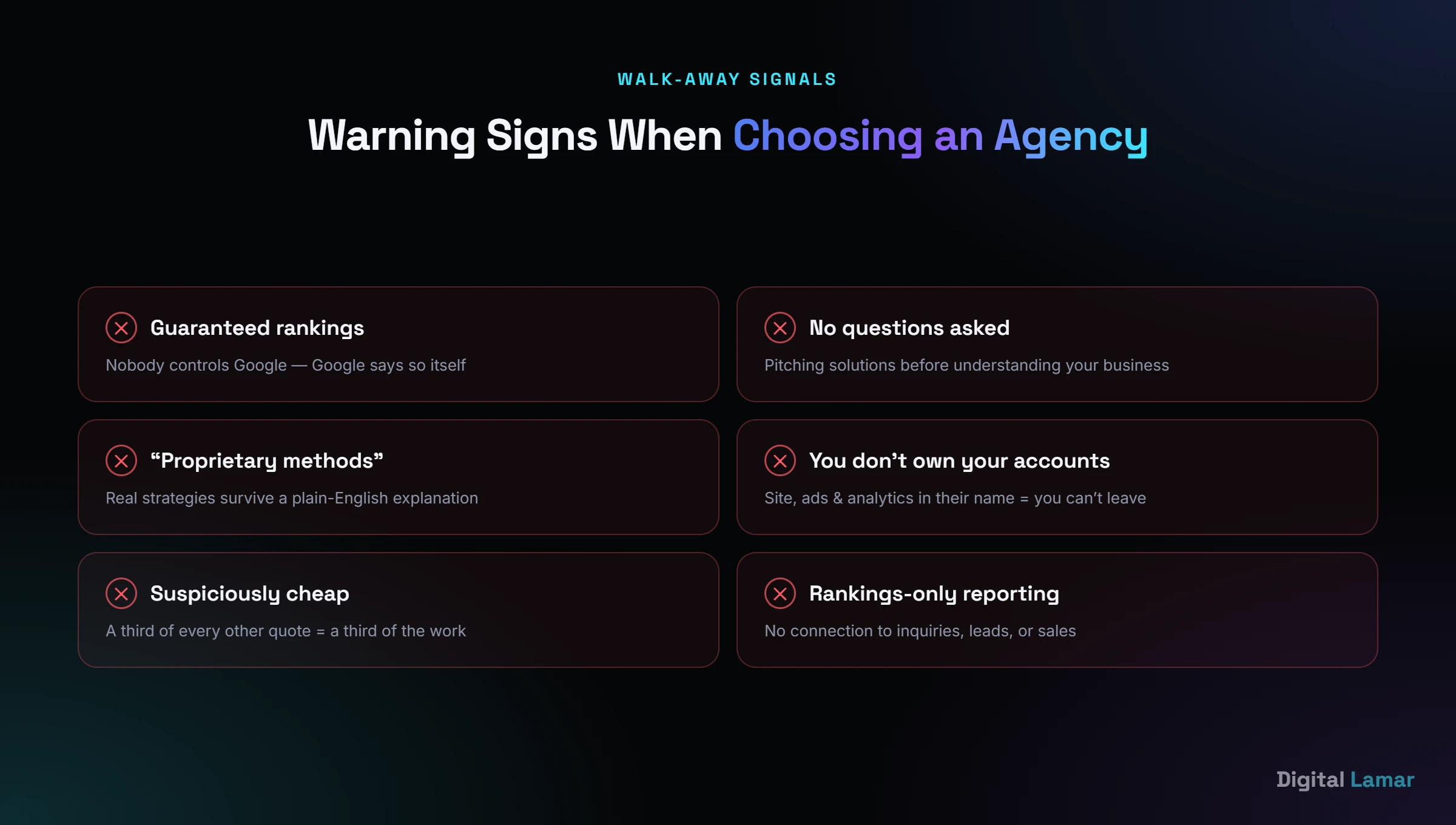
Any one of these is a reason to pause. Two or more is a reason to leave.
- Guaranteed rankings or guaranteed results. Nobody controls Google. Google says so.
- They pitch solutions before asking a single question about your business, market, or goals.
- “Proprietary methods” they can’t explain. Real strategies survive plain-English explanation.
- You don’t own your accounts. See Step 5 — this is the expensive one.
- Pricing far below every other quote. The work is either outsourced, automated, or not happening.
- Rankings-only reporting with no connection to inquiries, leads, or sales.
We’re putting together a deeper guide on agency red flags soon — but honestly, the six above catch most of them.
Choosing an Agency in Pakistan, the UAE & the US — What Changes?
The framework holds everywhere; the emphasis shifts by market:
Pakistan: the talent is real and the pricing is a genuine advantage, but the label “agency” is unregulated — plenty of one-person operations present as full teams. Weight Steps 2 and 3 heavily: verifiable case studies, a real team you can meet, and clear account ownership. If you’re comparing options, here’s how we approach it as a digital marketing agency in Pakistan.
UAE: a crowded, high-spend market where the risk isn’t fake agencies — it’s mismatched ones. An agency that doesn’t understand UAE buyer behavior, Arabic/English audience splits, and local platform economics will burn budget learning on your dime. Market fluency (Step 2’s fourth proof) is the deciding filter for a digital marketing agency in Dubai.
United States: the most expensive agency market in the world, which is why the sharpest question is Step 4’s: what exactly am I paying for? A growing share of US businesses get identical deliverables from vetted offshore teams at a fraction of the cost — the model we run as a digital marketing agency for US businesses.
Key Takeaways
- Define the business outcome, channels, and budget before you contact anyone — vague briefs get padded proposals.
- Shortlist 3-5 agencies on proof: numbered case studies, third-party reviews, and their own visibility.
- The 8 interview questions matter less for the answers than for how directly they’re answered — and “what do we keep if we leave?” is the deal-breaker question.
- Know the four pricing models, and treat dramatic cheapness as a warning, not a win.
- Contracts should confirm you own everything, with a 30-day exit — then start with a scoped 90-day engagement before committing long-term.
Want to pressure-test us with those 8 questions? We’d genuinely enjoy it.
Book a free 30-min strategy callFrequently Asked Questions
How many agencies should I shortlist and interview?
Three to five. Fewer than three gives you no baseline for comparison; more than five turns selection into a part-time job and the differences start blurring.
How can you compare multiple digital marketing agencies before making a decision?
Build a simple side-by-side scorecard using Steps 2 and 3 above: proof (case studies, live results, references) in one column, their answers to the 8 vetting questions in another. Score each shortlisted agency the same way, on the same criteria, so you’re comparing structured evidence instead of impressions from separate sales calls. Three to five agencies compared this way is usually enough to see which one is actually different, not just differently worded.
How much does a digital marketing agency cost?
It varies enormously by market and scope — from a few hundred dollars a month in Pakistan to five figures in the US for the same service category. The model matters as much as the number: see Step 4 above. If you want a number scoped to your business, that’s a short conversation, not a guessing game.
How long should I give an agency before judging results?
Judge process from day one and results by channel: paid ads should show signal within weeks, while SEO needs four months to a year per Google’s own guidance. What you should never wait for is communication — if reporting is vague in month one, it won’t improve in month six.
Does the agency need to be in my city?
No — digital marketing is done remotely by nature, and some of the best value pairs a vetted offshore team with your local market knowledge. What matters is market fluency: an agency that understands your buyers, wherever it sits.
Should I choose a full-service agency or a specialist?
If you need one channel done exceptionally well, a specialist can be the right call. If you need strategy plus multiple channels working together — which is most growing businesses — full-service avoids the coordination tax of managing three vendors who don’t talk to each other.
What’s the single biggest red flag?
Guaranteed rankings. It’s the one promise that’s provably dishonest, and an agency willing to make it will be flexible with the truth elsewhere too.