

On this page
In short
Branding is the deliberate work of shaping what people think and feel when they hear your business name. It covers your purpose, positioning, name, logo, visual identity, voice and the experience customers have with you, kept consistent everywhere. A brand is the reputation that results. Marketing then spreads it. Done well, branding builds trust, makes you recognisable and lowers the cost of every sale over time.
Two shops sell the same spice mix on the same street in Lahore. One packet carries a name customers have cooked with for years; the other is a plain plastic bag with a handwritten label. The plain one is cheaper, and it still sits on the shelf longer.
That gap is branding.
Branding is the reason a customer picks one product over an identical one, pays a little more without complaining, and comes back without being chased. It is often confused with a logo, a colour palette or an advertising campaign, and those are parts of it, but they are not the whole. This guide explains what branding means in plain language, how it differs from marketing and advertising, which elements make it up, and why it matters commercially, with research from Edelman, Kantar and the IPA. It finishes with examples from Pakistan, the UAE and the US and a five-step process any small business can follow. Digital Lamar works on brand and marketing projects for businesses in all three markets, so the advice is organised around the decisions owners there actually make.
What Is Branding?
Branding is the process of deciding what a business stands for and then expressing it consistently, through its name, logo, visual identity, voice, messaging and customer experience, so that people recognise it, remember it and trust it. The goal is a clear, distinct impression in the customer’s mind that competitors cannot easily copy.
Put simply, branding answers three questions before a customer asks them: who is this, why should I care, and can I trust them?
What Is the Difference Between a Brand and Branding?
A brand is the perception people hold about your business; branding is the work you do to shape that perception. You own your branding decisions, but customers own your brand, because it lives in their memories and conversations. Good branding narrows the gap between the brand you intend and the brand people actually describe.
A business always has a brand, whether or not it does any branding. If you don’t decide what you stand for, customers decide for you.
What Is the Meaning of Branding in Urdu?
In Urdu, branding is usually written as برانڈنگ, the English word in Urdu script, and the idea is best explained as پہچان بنانا (pehchaan banana): building an identity people recognise. Some textbooks translate it as تشہیر (tashheer), but that word means publicity, which is closer to advertising than to branding.
The word comes from marking livestock with a hot iron to show who owned them: a mark that says, at a glance, where something came from.
What Is Branding in Marketing and Business?
In marketing and business, branding is the strategic layer that sits above campaigns. It defines who you are, who you serve and how you sound, and marketing uses those decisions to choose channels, write ads and set offers. Branding is built to last for years; most marketing activity is built to run for weeks. Our plain-language guide to what digital marketing is covers the full channel mix.
Branding vs Marketing: What Is the Difference?
Branding is who you are; marketing is how you tell people about it. Branding sets the identity, promise and personality of the business. Marketing is the set of activities, such as SEO, social media, paid ads and email, that carry that identity to the right audience and turn attention into sales.
| Question | Branding | Marketing | Advertising |
|---|---|---|---|
| What it does | Defines who you are and what you promise | Finds and persuades the right customers | Buys attention in a specific space |
| Time horizon | Years | Months and quarters | Days and weeks |
| Typical outputs | Positioning, name, logo, identity, voice, guidelines | Campaigns, content, SEO, email, social media | Paid search, social ads, TV, billboards |
| Main measure | Recognition, trust, price premium | Leads, sales, customer cost | Reach, clicks, conversions |
| Question it answers | Why us? | Who, where and when? | Did they see it? |

Branding sets the identity; marketing and advertising carry it to people.
The two depend on each other. A business with strong branding and no marketing is a well-kept secret, while one with heavy marketing and weak branding pays for attention it cannot hold, because nothing about it sticks once the ad stops. If you are new to the marketing side, this guide to what SEO actually is covers the channel most brands lean on for long-term discovery.
Is Branding the Same as Advertising?
No. Advertising is one paid way of getting a message in front of people, while branding decides what that message should be and how it should look and sound. An advert can build a brand when it repeats a consistent identity, or damage one when it contradicts what customers experience.
Why Is Branding Important for a Business?
Branding is important because it earns trust before the first purchase, makes a business easy to recognise and recommend, lets it charge more than a generic alternative, and makes marketing work harder over time. It turns one-off buyers into repeat customers, and repeat customers are the cheapest sales any business makes.
Here is what independent research shows. Widely shared figures such as “consistent branding lifts revenue by 23%” are left out, because they trace back to vendor surveys rather than studies.
Branding Builds Trust, and Trust Drives Buying Decisions
Trust is now one of the main reasons people choose a brand. In Edelman’s 2025 Trust Barometer Special Report on brand trust, 80% of people said they trust the brands they use, more than they trust business, media, government or NGOs. The same report, based on 15,000 respondents in 15 countries, found trust is as much a purchase consideration as quality and price.
80% of people trust the brands they use, a higher level of trust than they place in business, government, media or NGOs (Edelman Trust Barometer Special Report: Brand Trust, 2025).
Two more findings from that Edelman report matter for smaller businesses. Trust in brands headquartered in a person’s own country was, on average, 15 points higher than trust in foreign brands, so a local business does not need to imitate a global one to be trusted. And 73% said their trust in a brand would rise if it authentically reflected today’s culture, which rewards brands that sound like their customers rather than like a corporate template.
How Does Branding Change What Customers Experience?
Branding changes the product experience itself, not just the decision to buy. A 2004 study in Neuron gave people Coca-Cola and Pepsi, which the researchers call nearly identical in chemical composition, with and without the brand shown. Knowing the brand “had a dramatic influence on expressed behavioral preferences” and on brain responses (McClure et al., Neuron, 2004).
That is why a well-branded product can hold a higher price: customers pay for the expectation, not only the ingredients.
How Much Is a Brand Worth?
A strong brand is one of the most valuable assets a company owns. Kantar’s 2026 BrandZ ranking valued the world’s 100 most valuable brands at a combined record of $13.1 trillion, up 22% on the previous year, with Google’s brand alone valued at about $1.5 trillion (Kantar BrandZ, 2026).
Kantar’s explanation is that being seen as “meaningful and different” matters more than ever. If customers can’t say what makes you different, your brand carries little value.
Does Branding Make Marketing More Effective?
Yes. Long-running research for the UK’s Institute of Practitioners in Advertising found the most effective campaigns split budget roughly 60:40 between long-term brand building and short-term sales activation. Les Binet and Peter Field’s 2013 report set the 60:40 ratio, and the later “Effectiveness in Context” work put the optimum at 62:38 (IPA, 2023).
The ratio is a guide rather than a law, and it shifts by category and company size. The lesson that holds for everyone is simpler: ads that only chase this week’s sale get more expensive over time, because nobody remembers you between purchases. Brand building is what makes the next ad cheaper.
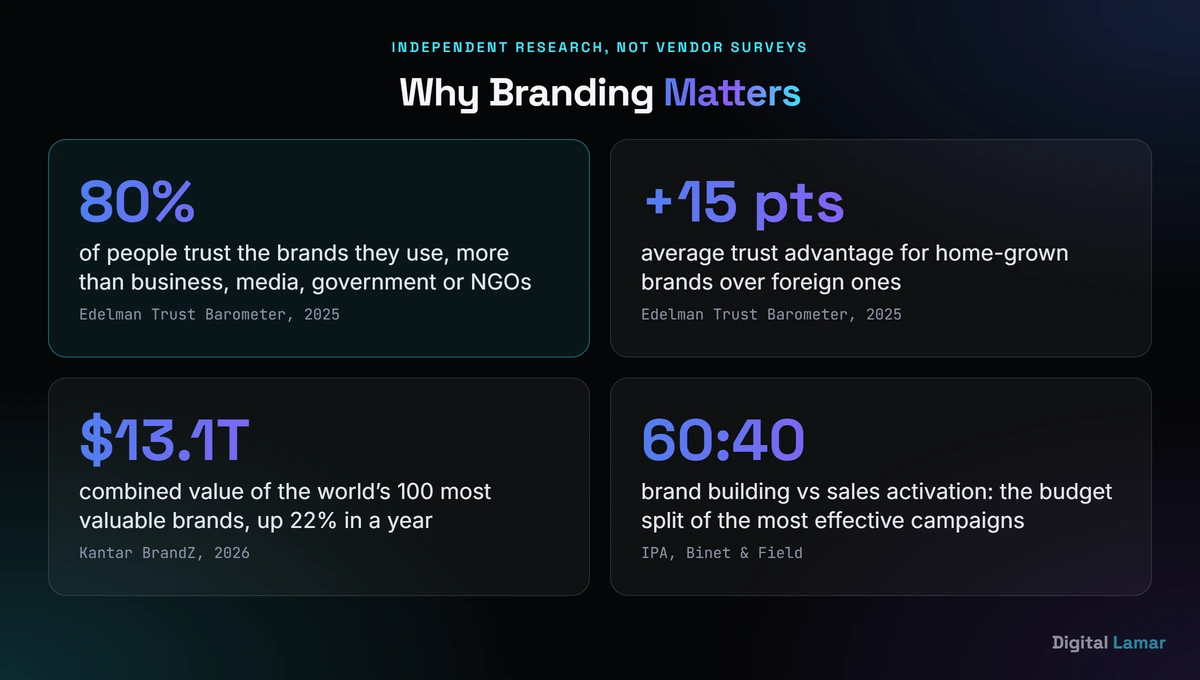
Four independent findings on why branding pays off.
What Are the Elements of Branding?
The key elements of branding are brand purpose and positioning, brand name and logo, visual identity, brand voice and messaging, brand experience, and consistency across every touchpoint. The first and the last do most of the work: purpose decides what everything else should say, and consistency decides whether anyone remembers it.

The six elements of branding, with purpose at the centre.
Brand Purpose and Positioning
Purpose is why the business exists beyond making money; positioning is the specific place you want to hold in the customer’s mind compared with the alternatives. A good positioning statement names the audience, the need, and the reason to choose you over the next option. Write it before you brief a designer, because every visual choice should express it.
Brand Name and Logo
The name and logo are the shortcuts customers use to recall everything else about you. A good name is easy to say in your market’s languages, easy to spell from hearing it, and available as a domain and social handle. The logo is a signature, not a summary: it doesn’t need to show what you sell, it needs to be distinctive and to work at small sizes, from a favicon to a WhatsApp profile picture.
Visual Identity: Colours, Typography and Imagery
Visual identity is the system around the logo: a small colour palette, one or two typefaces, a photography or illustration style, and layout rules. Together these elements make up much of what designers call brand identity. The aim is that a customer recognises your post or packaging before they read the name on it.
Brand Voice and Messaging
Voice is how your brand sounds: formal or casual, English, Urdu or a mix. Messaging is what you repeat: a tagline, a core promise and three or four proof points.
Brand Experience
Brand experience is what actually happens when people deal with you: the website speed, the reply time on WhatsApp, the packaging, the refund process, the after-sales call. This is where promises are kept or broken. One slow refund can undo months of good design, because customers trust what you do over what you say.
Brand Consistency
Consistency means the same identity, voice and promise appear everywhere, every time. Recognition is built through repetition, so a brand that changes its colours each campaign or sounds different on Instagram than in its emails is starting from zero again and again. For freelancer, agency and in-house pricing, see how much social media marketing costs.
Brand guidelines are the usual tool for keeping a growing team consistent, even if the first version is two pages long.
What Are the Types of Branding?
The main types of branding are corporate branding, product branding, service branding, personal branding, employer branding, co-branding and place branding. Most small businesses need corporate branding first, then product branding as their range grows. The types differ in what is being branded, not in the basic process.
| Type of branding | What is branded | Example of what it involves |
|---|---|---|
| Corporate branding | The whole company | Company name, mission, reputation with customers, investors and staff |
| Product branding | A single product or range | Product name, packaging, a distinct look on the shelf or in a marketplace listing |
| Service branding | An intangible service | Consistent client experience, staff behaviour, proposals and reports |
| Personal branding | An individual | A founder’s, doctor’s or consultant’s expertise and public voice |
| Employer branding | The company as a workplace | How the business is seen by job seekers and current employees |
| Co-branding | A partnership of two brands | A joint product or campaign that borrows trust from both names |
| Place branding | A city, region or country | Tourism and investment identity, such as a city’s visitor campaign |
For service businesses, the people are the brand, so service branding starts with staff training and process, not design.
What Are Some Good Branding Examples?
Good branding examples are brands people recognise instantly and trust across markets: Shan Foods from Pakistan, Careem from the UAE, and Google and Coca-Cola from the US. Each shows a different lesson, from carrying home-market trust abroad to a brand being valued separately from the company that owns it.
Shan Foods: A Pakistani Branding Example
Shan Foods started in Karachi in 1981, when founder Sikander Sultan began making spice mixes at home with his wife. It now has a presence in more than 75 countries, and the company says it holds 65% of the UAE market for its category (Arab News, 2024).
The lesson is focus. Shan sells one recognisable promise, home-style recipes made reliable in a box, and overseas Pakistanis buy it partly because it tastes like home.
Careem: A UAE Brand Worth Keeping
When Uber completed its $3.1 billion acquisition of Dubai-based Careem on 2 January 2020, it kept the Careem name rather than replacing it. Uber’s announcement said Careem would become a wholly owned subsidiary “preserving its brand,” operating in 120 cities across 15 countries at the time (Uber, 2020).
A global buyer kept the local name. That only makes sense if Careem’s brand held trust in its region that Uber’s could not replace overnight.
Google and Coca-Cola: US Branding Examples
Google tops Kantar’s 2026 ranking with a brand value of about $1.5 trillion, built on one simple, consistent promise of finding the answer fast. Coca-Cola sits at the centre of the textbook evidence that branding changes preference: in the 2004 Neuron study, two nearly identical colas were judged differently as soon as people knew which brand was in the cup. Both brands win by repeating one idea for decades without drifting.
How Do You Build a Brand for a Small Business?
To build a brand for a small business, define your audience and purpose, research how competitors present themselves, write your positioning and messaging, design a simple visual identity, then apply it consistently at every touchpoint and review it once a year. Strategy comes first; the logo is step four, not step one.

The five steps of branding, in the order that saves rework.
Step 1: Define Your Audience and Purpose
Describe your best customer in one paragraph: who they are, what problem sends them looking for you, and what they worry about before buying. Then write one sentence on why your business exists for them. If you serve several groups, pick the one that brings most of your profit and brand for them first.
Step 2: Research How Competitors Present Themselves
Lay five competitors’ websites, social pages and packaging side by side. Look for the space nobody owns: if everyone sounds corporate, a warm, plain-spoken voice stands out.
Step 3: Write Your Positioning and Messaging
Turn the research into a positioning statement and three to four proof points. A simple template: “For [audience] who need [need], [brand] is the [category] that [key benefit], because [proof].” Test it on five real customers. If they cannot repeat it back in their own words, simplify it before spending anything on design.
This is the step most owners find hardest to do alone, because it means choosing what you won’t be. If you would like an outside view on your positioning, you can book a free 30-minute call with Digital Lamar and talk it through before you brief a designer.
Step 4: Design a Simple Visual Identity
Now brief the logo, colours, typefaces and image style, using the positioning statement as the brief. Keep the system small: two or three colours, two typefaces and ready-made templates.
Step 5: Apply It Everywhere and Review Yearly
Roll the identity out everywhere at once: website, Google Business Profile, social and WhatsApp profiles, signage, packaging and email signatures. Review it yearly and adjust the messaging, not the whole identity.
Owners who want help with any of these steps can use Digital Lamar’s Branding & creative service, which covers visual identity, messaging and the creative assets every campaign needs. Once the brand is set, Social media marketing and Web design & development are usually the first two places it has to show up consistently.
How Is Branding Different in Pakistan, the US and the UAE?
The principles of branding are the same everywhere, but the execution changes by market. In Pakistan, branding has to work in Urdu and English and earn trust where many customers still prefer cash on delivery. In the US, the bar is differentiation in crowded categories. In the UAE, brands speak to a multilingual, largely expatriate audience.
Branding in Pakistan
Pakistani customers often meet a brand first on social media or WhatsApp rather than on a website, so the profile picture, the first reply and the delivery experience carry more weight than a polished homepage. Bilingual messaging that sounds natural in Urdu and English widens reach. Trust signals matter more where people pay on delivery: clear return policies, real customer photos and consistent packaging all reduce the fear of being let down. Edelman’s finding that home-grown brands earn 15 points more trust is an advantage local businesses can lean into.
Branding in the US
American buyers face many near-identical options in most categories, so the brand has to be meaningfully different and say so quickly. Clear positioning, proof such as reviews and case studies, and a consistent experience online and offline are the basics. For Pakistani businesses selling into the US, especially service firms, a brand that looks and sounds as professional as local competitors removes the first objection.
Branding in the UAE
UAE branding usually needs to work in English and Arabic and to speak to customers from many nationalities at once. Premium cues and service standards carry weight in markets like Dubai. Shan’s reported 65% UAE market share for its category shows how far a consistent home-market brand can travel when it serves the diaspora well.
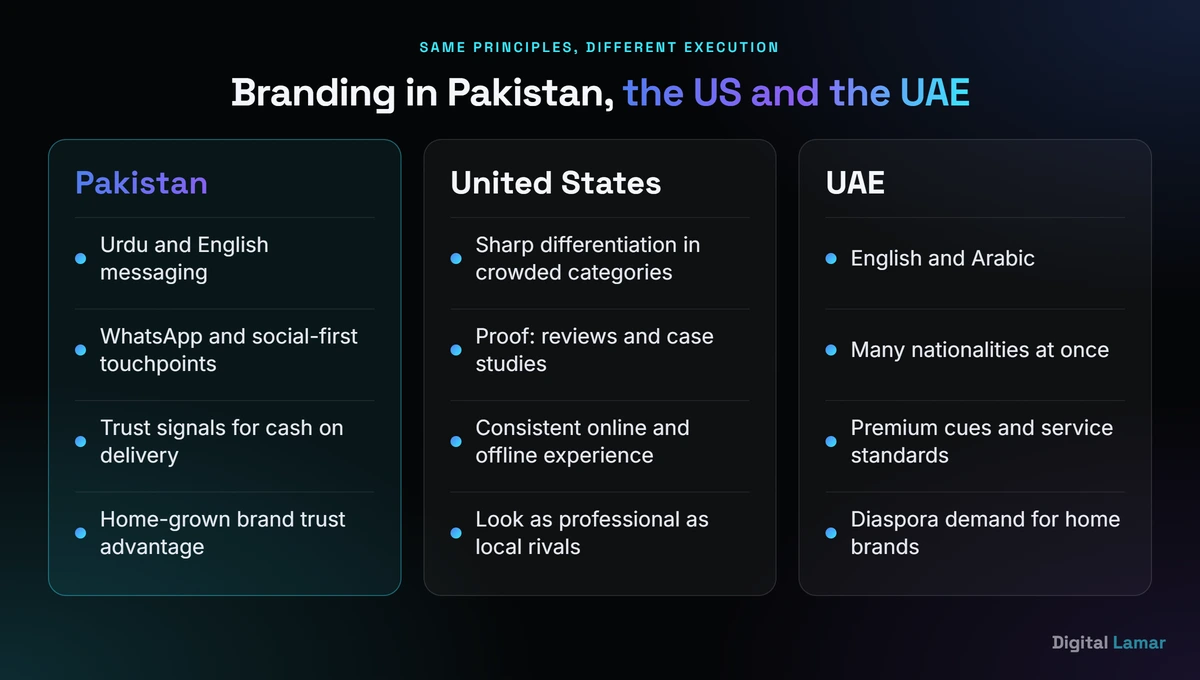
Same principles, different execution in each market.
What Are Common Branding Mistakes to Avoid?
The most common branding mistakes are starting with the logo instead of the strategy, copying the market leader, changing the look every campaign, promising more than the customer experience delivers, and trying to appeal to everyone. Each one wastes money because it makes the brand harder to remember or harder to believe. Your website is often the first place a brand is judged, and website cost in Pakistan shows what a build costs locally.
- Logo first, strategy never. A logo without positioning is decoration. Customers can’t remember what it stands for because nothing was decided.
- Copying the leader. Looking like the biggest competitor makes you look like a cheaper version of them, and customers will often buy the original.
- Constant redesigns. Changing colours, fonts or taglines every few months resets the recognition you built.
- A gap between promise and delivery. If the ad says “fast” and the reply takes two days, the experience wins and the brand loses.
- Talking to everyone. A brand aimed at all customers is remembered by none of them.
If you plan to hire outside help for any of this, our guide on how to choose a digital marketing agency sets out the questions to ask, and this explainer on what a digital marketing agency does shows where branding fits among the other services.
Key Takeaways
- Branding is the deliberate work of shaping how people perceive your business; your brand is the perception that results.
- Branding defines who you are, marketing spreads it, and advertising is one paid way of getting it seen.
- 80% of people trust the brands they use, and trust weighs as much as quality and price in buying decisions (Edelman, 2025).
- The six elements are purpose and positioning, name and logo, visual identity, voice and messaging, experience, and consistency.
- Build in order: audience and purpose, competitor research, positioning, visual identity, then consistent rollout.
- Execution changes by market: bilingual and trust-led in Pakistan, differentiation-led in the US, multilingual and premium in the UAE.
Ready to Build a Brand Customers Remember?
Book a free 30-minute call with Digital Lamar. We’ll review how your business comes across today, where your positioning is unclear, and what to fix first, whether you sell in Pakistan, the US or the UAE.
Book a free 30-min strategy callFrequently Asked Questions
Is branding just a logo?
No. A logo is one element of branding, the visual signature customers use to recognise you. Branding also includes your purpose, positioning, name, colours, typography, voice, messaging and the experience customers have with you. A business can have a beautiful logo and still have weak branding if the rest is inconsistent.
What are the 4 steps of branding?
A common four-step version is: research your audience and competitors, define your positioning and messaging, design your visual identity, and apply it consistently while measuring how people respond. This guide splits the last step into rollout and yearly review, which gives five steps, but the order is the same.
What is a branding kit?
A branding kit is a short package of the files and rules a team needs to use a brand correctly: logo versions, colour codes, typefaces, image examples and a few templates. It keeps designers, staff and freelancers consistent without everyone needing to ask how the brand should look.
What is branding in graphic design?
In graphic design, branding means creating the visual system that expresses a brand: the logo, colour palette, typography, icons, imagery and layout rules, and applying them across packaging, websites and social media. Designers work from the brand strategy, so the visuals carry the positioning rather than just looking attractive.
What is personal branding?
Personal branding is the same process applied to an individual: deciding what you want to be known for and showing it consistently through your work, content and online profiles. Founders, doctors, consultants and freelancers use it to build trust that then transfers to their business.
Can a small business do branding without an agency?
Yes. A small business can define its audience, write its positioning and keep a consistent look using simple templates. Outside help is most useful for the positioning step and for professional visual design, because those are hardest to judge from inside the business and most expensive to redo later.