On this page
- Which Is Better: Google Ads or Facebook Ads?
- The Difference Between Google Ads and Facebook Ads
- How the Two Ad Auctions Work
- Google Ads vs Facebook Ads Cost
- Which Is More Effective?
- Pakistan, the US and the UAE
- Google Ads vs Facebook Ads by Business Type
- Running Both Together
- How to Test Both With a Small Budget
- Mistakes When Choosing a Platform
- When to Get Help
- Key Takeaways
- Frequently Asked Questions
In short
Google Ads is better when people already search for what you sell, because it reaches them at the moment of intent. Facebook Ads (Meta Ads) is better when you need to create demand, because it targets people by who they are, not what they type. Facebook usually costs less per click; Google usually brings buyers who are closer to a decision. Most businesses end up using both.
Two shops in Lahore each have PKR 100,000 to spend on ads this month. One repairs air conditioners. The other sells handmade leather bags. If both put the full amount into the same platform, at least one of them is probably wasting most of it.
The AC repair shop needs people who are typing “AC repair near me” into Google right now, with a broken unit and a hot room. Nobody scrolls Instagram hoping to discover an AC technician. The bag brand has the opposite problem: almost nobody searches for a brand they have never heard of, but plenty of people will stop scrolling for a good-looking bag.
That split, intent versus discovery, is the real answer. Digital Lamar runs both platforms for clients in Pakistan, the US and the UAE, and every figure below is sourced.
Which Is Better: Google Ads or Facebook Ads?
Neither platform is better for every business. Google Ads is better when demand already exists and people search for your product or service. Facebook Ads is better when you need to create demand or sell something people don’t search for. Your product, your margins and your sales cycle decide the winner, not the platform. Local budgets in PKR are covered in Facebook ads cost in Pakistan.
A simple test helps. Search Google the way a customer would. A page full of ads and competitors means demand exists for Google Ads to capture. Almost nothing relevant means you’ll have to find buyers on Facebook and Instagram first.
Plenty of businesses sit in between. A dentist gets emergency searches on Google and slower interest from Instagram. For them the question is which platform first, and in what proportion, which the section on running both answers.
What Is the Difference Between Google Ads and Facebook Ads?
The core difference is how each platform finds people. Google Ads mostly targets what people search for, so your ad appears when someone types a matching query. Facebook Ads targets who people are (location, age, interests and behaviour) and shows your ad while they scroll Facebook, Instagram, Messenger, WhatsApp or Threads, whether or not they were looking.
How Google Ads Targets People: Search Intent
Google Ads runs several campaign types. Search campaigns are text ads on Google search results; Shopping ads show products on results pages and the Shopping tab; Display reaches websites and apps; Video runs on YouTube; and Performance Max is “a goal-based campaign type” that reaches all Google Ads inventory from one campaign, according to Google Ads Help (2026). Search is the one most businesses mean when they say “Google Ads.”
With Search, the keyword is the targeting. Someone typing “accountant for small business Karachi” has raised their hand, which is why search clicks cost more.
How Facebook Ads Targets People: Audiences
Meta Ads targets audiences, not queries. You choose location, age, gender and interests, and Meta’s delivery system then learns who responds and narrows delivery over time. Meta’s own guidance says its system “works best when your audience size is between 2 to 10 million people” and recommends interest targeting only when the audience is at least 2 million, according to Meta for Business (2026).
Your ad can appear in Facebook Feed, Instagram Feed, Stories and Reels, Messenger, WhatsApp Status, Threads and the Meta Audience Network, depending on your objective, according to Meta’s Business Help Centre (2026). Meta also notes that adding more placements “does not increase the cost of your ad.” That breadth is a large part of why Facebook clicks are cheap: there is a lot of inventory, and most of the people seeing it weren’t shopping.

Google answers a search. Meta interrupts a scroll. Both work, for different jobs.
Google Ads vs Facebook Ads Comparison Table
Here are the two platforms side by side on the points that change the decision for most businesses. The cost rows use WordStream’s 2024 benchmark studies (US campaigns), covered in detail in the cost section below.
| Point of comparison | Google Ads | Facebook Ads (Meta Ads) |
|---|---|---|
| How it finds people | Search queries (plus audiences on YouTube and Display) | Audiences: location, age, gender, interests, behaviour |
| Buyer mindset | Already looking for a solution | Not looking; discovering |
| Where ads run | Google Search, Shopping tab, YouTube, Display network, Discover, Google Play | Facebook, Instagram, Messenger, WhatsApp Status, Threads, Audience Network |
| Main formats | Text ads, product listings, video, image | Image, video, carousel, Stories, Reels, instant lead forms |
| Who wins the auction | Ad Rank: bid, ad and landing page quality, context and more | Total value: bid, estimated action rates and ad quality |
| Daily budget flexibility | Up to 2x the daily budget on one day, 30.4x per month | Up to 175% of the daily budget on one day, 7x per week |
| Avg cost per click (US, 2024) | $4.66 (search) | $0.77 (traffic) / $1.88 (leads) |
| Avg cost per lead (US, 2024) | $66.69 | $21.98 (lead ads) |
| Best at | Capturing ready-to-buy demand | Creating demand, visual products, retargeting |
How Do Google Ads and Facebook Ads Auctions Decide What You Pay?
Both platforms sell ads through auctions, and neither one simply rewards the highest bid. Google ranks ads by Ad Rank, which weighs your bid against ad and landing page quality, the searcher’s context and other factors. Meta ranks ads by “total value,” which weighs your bid against the chance a person will act and the ad’s quality.
Google lists six inputs to Ad Rank: your bid, the quality of your ads and landing page, Ad Rank thresholds, the competitiveness of the auction, the context of the person’s search, and the expected impact of your ad assets. It’s “calculated every time a user does a search,” and higher-quality ads can often lead to a lower cost per click, according to Google Ads Help on Ad Rank (2026). If the pay-per-click model itself is new to you, start with what PPC is.
In Meta’s explanation of ad auctions (2026), the winner has the highest total value (bid, estimated action rates and ad quality), subject to a price floor. A more relevant ad “could win an auction against ads with higher bids.”
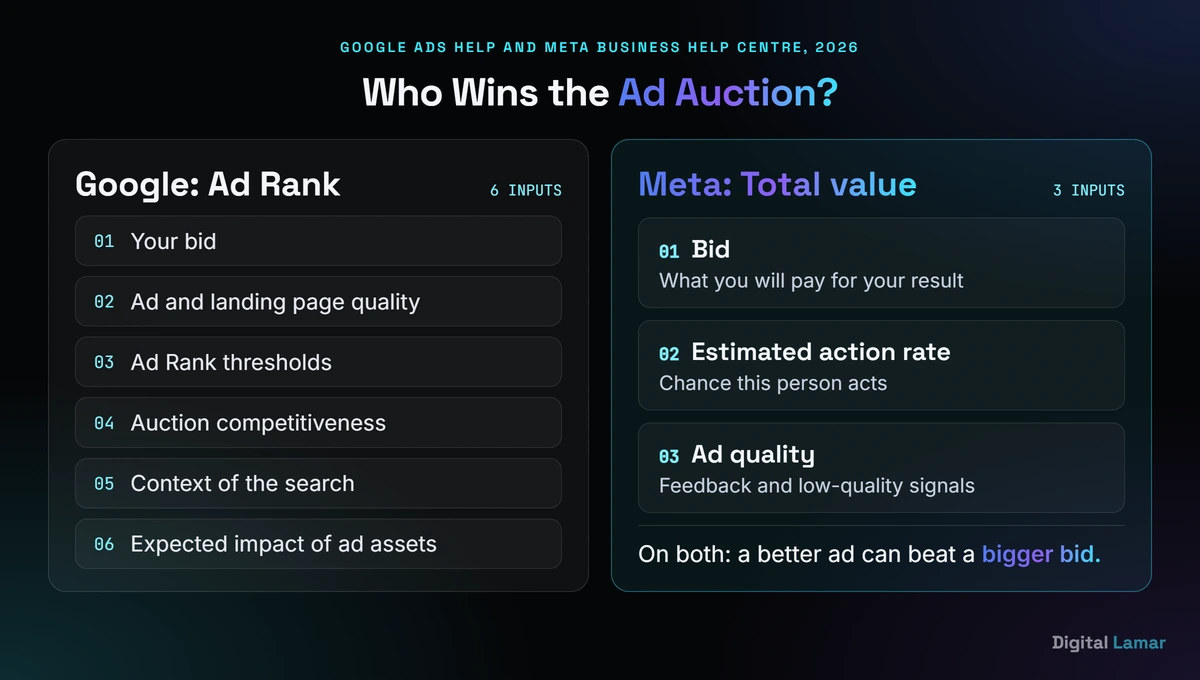
On both platforms, quality is priced into the auction. A better ad is a cheaper ad.
So the practical lesson is the same on both. Money alone doesn’t buy position.
Google Ads vs Facebook Ads Cost: Which Is Cheaper?
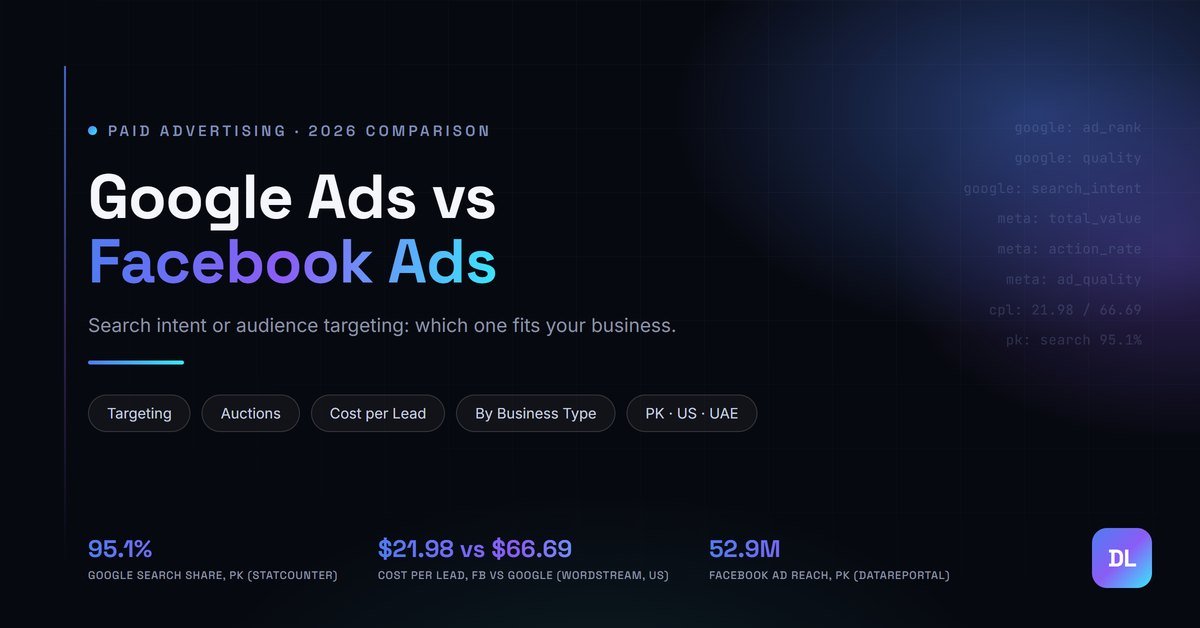
Facebook Ads is usually cheaper per click and per lead. WordStream’s 2024 benchmarks put the average Google search ad click at $4.66 and lead at $66.69, against $1.88 per click and $21.98 per lead for Facebook lead ads. But a cheaper click is not automatically a cheaper customer, because the two platforms reach people at different stages.
Both come from the same publisher, which makes them more comparable. The Google data covers 17,998 US search campaigns run between April 2023 and March 2024, with 80% to 85% of spend on Google and the rest on Microsoft Ads, per WordStream’s Google Ads Benchmarks 2024. The Facebook data covers 2,946 campaigns run between February 2023 and April 2024, per WordStream’s Facebook Ads Benchmarks 2024. Both use medians to limit the effect of outliers, and both are US accounts.
$21.98 vs $66.69 is the average cost per lead on Facebook lead ads versus Google search ads in WordStream’s 2024 US benchmarks. Facebook leads cost about a third as much, but many are captured in an instant form inside the app, by people who were not searching (WordStream, 2024).
Why a Cheaper Facebook Click Doesn’t Mean a Cheaper Customer
A Facebook lead often costs less because it asks less of the person. Lead ads collect details through a form inside Facebook, so someone can submit it in two taps without visiting your site. A Google search lead usually comes from a person who searched, clicked, read your landing page and then called or filled in a form. The second lead has already done more work.
That’s why the right comparison is cost per customer, not cost per lead. Take the benchmark costs and imagine one in twelve Facebook leads buys while one in three Google leads does. Facebook’s cost per customer is then about $264 ($21.98 x 12) and Google’s about $200 ($66.69 x 3), so the “expensive” platform wins. Your own close rates decide this, and only your CRM or sales log can tell you. Track leads by source from day one, even in a spreadsheet.
Industry matters too. In WordStream’s 2024 data, US real estate paid $2.10 per Google search click and $87.36 per lead, against $1.36 per click and $13.87 per lead on Facebook lead ads. Attorneys paid $8.94 per Google click and $144.03 per lead, and still paid $8.50 per click and $104.58 per lead on Facebook. In legal, the cheap-Facebook rule mostly disappears.
How Google Ads and Facebook Ads Budgets Behave Day to Day
Both platforms treat your daily budget as an average, not a hard daily cap. Google can spend up to twice your average daily budget on a single day but no more than 30.4 times it in a month. Meta can spend up to 75% over your daily budget on a given day, capped at 175% per day and seven times the daily budget per week (Google Ads Help and Meta Business Help Centre, 2026).
In practice, a PKR 2,000 daily budget can show PKR 4,000 of spend on a busy Google day or PKR 3,500 on a busy Meta day. Plan cash flow around the monthly figure, not the daily one.
Meta adds one more budget rule worth knowing. An ad set usually leaves its “learning phase” after about 50 results in the week after its last significant edit, and costs are usually higher until it does (Meta Business Help Centre, 2026). A Facebook budget that can’t buy roughly 50 results a week tends to stay in that expensive phase.
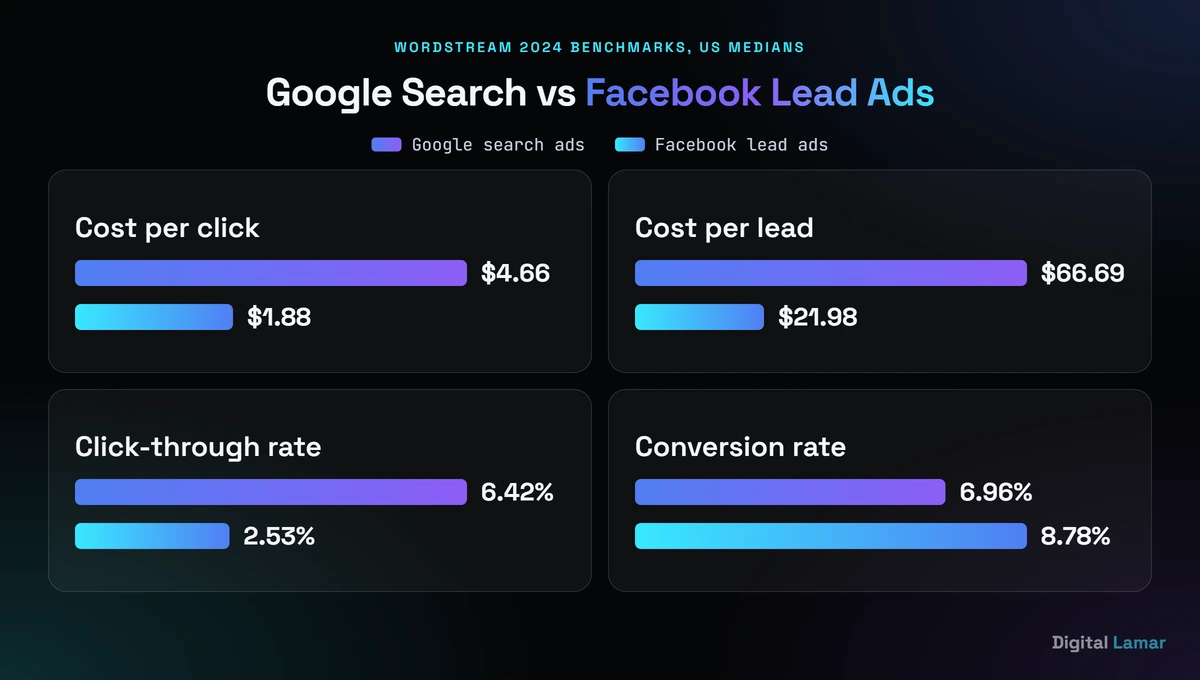
WordStream’s 2024 US medians. Treat them as a frame for your own test, not a forecast.
Which Is More Effective: Google Ads or Facebook Ads?
Google Ads is usually more effective for immediate sales and urgent services, because searchers already want something. Facebook Ads is usually more effective for reaching new customers, launching products and retargeting, because it can put an offer in front of people before they search. “Effective” depends on which job you need done this quarter.
The benchmark numbers show the difference in behaviour. Google search ads had a 6.42% average click-through rate and a 6.96% conversion rate in WordStream’s 2024 data, while Facebook lead ads had a 2.53% click-through rate and an 8.78% conversion rate. People click search ads far more readily because the ad matches what they just typed. Facebook’s higher conversion rate partly reflects its in-app forms, which are quicker to complete than a website form.
Neither number tells you about quality. Judge effectiveness by revenue per rupee spent, measured in your own records.
Want an outside view before you commit? Book a free 30-minute call with Digital Lamar and we’ll look at your product, margins and sales cycle, then tell you which platform to test first and with what budget.
Google Ads vs Facebook Ads in Pakistan, the US and the UAE
The logic is the same everywhere; the audiences differ. In Pakistan, Google handles almost all searches and YouTube’s ad reach slightly exceeds Facebook’s. In the US, the published benchmarks favour Facebook on cost. In the UAE, Meta’s ad reach covers most internet users.
Google Ads vs Facebook Ads in Pakistan
Pakistan is a two-platform market with very different sizes on each side. Google held 95.1% of search engine market share in Pakistan in September 2026, with Bing at 3.75% and no other engine above 1%, according to StatCounter (September 2026). If someone searches for your service in Pakistan, they almost certainly do it on Google.
On the audience side, Facebook ads could reach 52.9 million people in Pakistan in late 2025, Instagram 22.4 million and YouTube 54.3 million, out of 117 million internet users, according to DataReportal’s Digital 2026: Pakistan report. Facebook’s ad reach grew by 7.1 million in a year, while YouTube’s fell by 1.6 million. Since YouTube ads run through Google Ads, a Pakistani business can reach a Facebook-sized video audience from either platform.
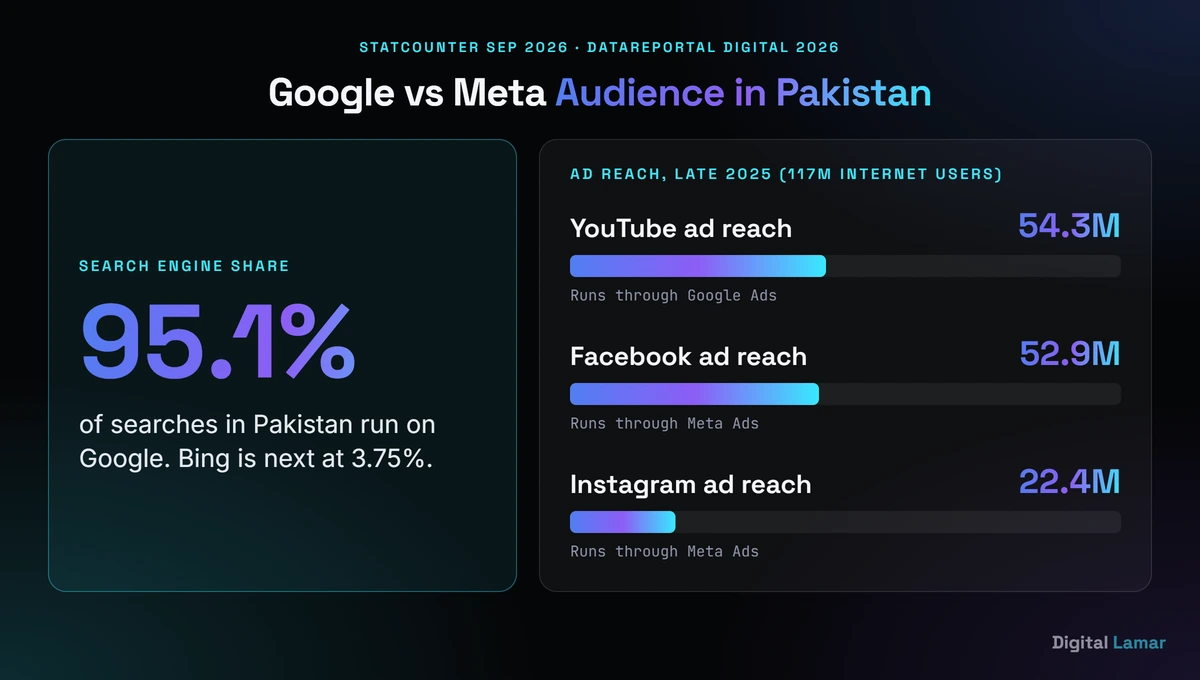
Pakistan’s search is Google’s, and its video and social reach is split almost evenly.
Pakistan has no reputable, published CPC or CPL benchmark for either platform. Local agency articles quote rupee ranges without data sources, and they contradict each other. The honest way to get a number is to run a small, controlled test on each platform (described below) and read your own cost per lead after a full week. For Pakistan-specific execution, see our digital marketing agency in Pakistan page.
Google Ads vs Facebook Ads in the US
The US is where the benchmark data lives, and it points one way on cost: Facebook leads at $21.98 against $66.69 on Google search (WordStream, 2024). US advertisers also face rules that change targeting. For ads about housing, employment or financial products, Meta limits or removes age, gender, postal code, exclusion, lookalike and saved audience options for advertisers based in or reaching the US, according to Meta’s Business Help Centre on Special Ad Categories (2026).
That rule matters most for real estate and finance, where Facebook’s targeting advantage shrinks. A US mortgage broker on Meta has to advertise broadly and let creative do the filtering, which makes Google’s search intent relatively more valuable.
Google Ads vs Facebook Ads in the UAE
The UAE has a small, highly connected population. Facebook ads could reach 9.70 million people there in late 2025, Instagram 8.05 million and YouTube 8.37 million, out of 11.3 million internet users, according to DataReportal’s Digital 2026: United Arab Emirates report (published November 2025). Meta’s platforms can reach most of the online population.
No reputable UAE platform benchmark is published either, so the same test-first approach applies. A Dubai business targeting a narrow segment (say, villa buyers in two communities) may find Meta’s audience falls under its recommended 2 million, which is a point in favour of Google Search for niche, high-value services. Our digital marketing agency in Dubai page covers how we work in that market.
Google Ads vs Facebook Ads: Which Is Better for Your Business Type?
The best platform depends on whether your customers search for you. Urgent local services and high-intent B2B services usually start with Google Ads. Ecommerce brands, new products and visual offers usually start with Facebook Ads. Real estate often needs both: Google for active buyers, Meta for buyers who haven’t started searching yet.
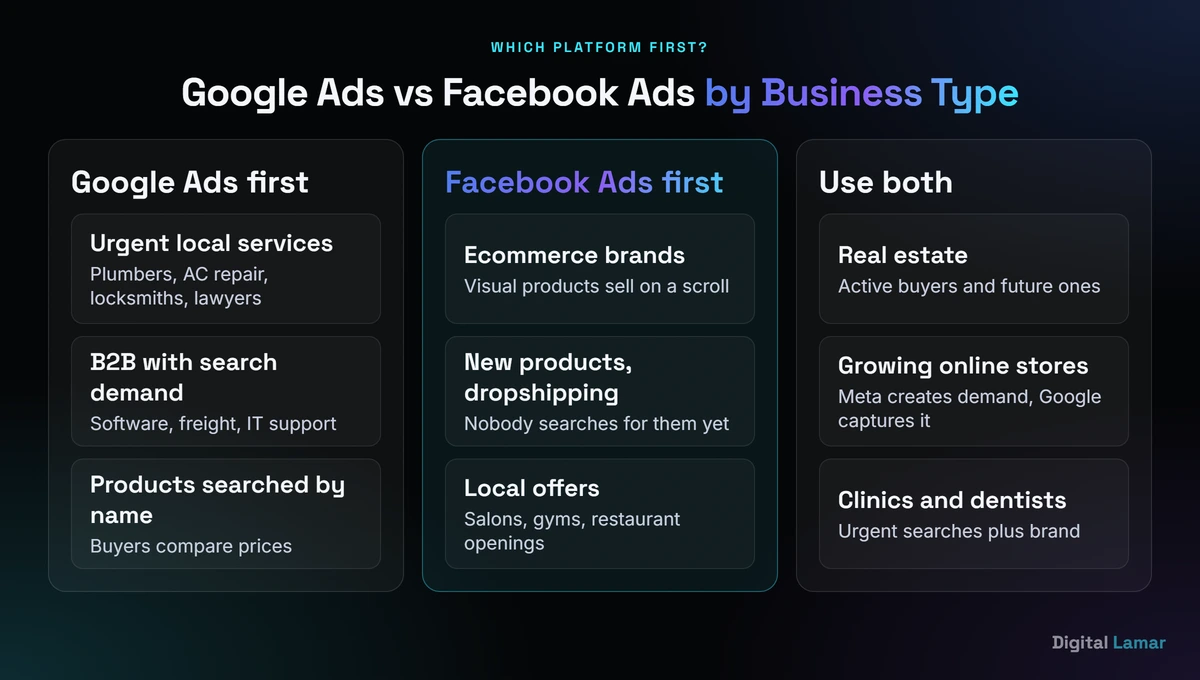
Start where your customers already are, then add the second platform.
Google Ads vs Facebook Ads for Ecommerce
Most ecommerce stores do better starting on Facebook and Instagram, then adding Google Shopping once there’s search demand for their products or brand. Visual products sell on a scroll, and Meta can retarget people who viewed a product. Google Shopping becomes valuable when people search for the product category by name.
Commodity products flip this. If you sell something people search for by model number (a specific phone charger, a printer cartridge), Google Shopping can beat social from day one, because the buyer already knows what they want and is comparing prices. WordStream’s 2024 data shows US “Shopping, Collectibles & Gifts” advertisers paid $2.61 per Google click and $0.68 per Facebook traffic click. Our ecommerce marketing agency page explains how we run both for online stores.
Google Ads vs Facebook Ads for Real Estate
Real estate usually needs both platforms. Google Ads captures active buyers searching for a project, area or property type. Facebook Ads builds a pipeline of people who might buy in six to twelve months and responds well to visual property content. In the US, Meta’s housing rules limit targeting, which shifts some advantage back to Google.
The cost gap is large. US real estate leads cost $87.36 on Google search and $13.87 on Facebook lead ads in WordStream’s 2024 data. So compare cost per closed deal, not cost per lead. In Pakistan and the UAE, where Meta’s housing restrictions don’t apply in the same way, Meta’s targeting works fully. For the Gulf, our guide to real estate marketing in Dubai goes deeper, and the real estate digital marketing page covers our approach.
Google Ads vs Facebook Ads for Local Services
Local services with urgent demand (plumbers, AC repair, locksmiths, clinics, lawyers) should usually start with Google Ads. People search when they need help now, and Google can show your ad, phone number and location to them. Facebook works better for local businesses selling something discretionary, like a salon offer or a restaurant opening.
The deciding question is urgency. A burst pipe produces a search. A new gym membership offer has to find people who weren’t thinking about the gym that morning, which is Meta’s job.
Google Ads vs Facebook Ads for B2B
B2B companies with clear search demand, like accounting software, freight forwarding or IT support, usually get better leads from Google Ads, because the person searching is often the one who needs the service. Facebook can work for B2B, but it’s better suited to building awareness among owners and managers of small businesses than to reaching specialised corporate buyers.
In WordStream’s 2024 data, US “Business Services” leads cost $105.64 on Google search and $16.95 on Facebook lead ads. Test Facebook rather than dismiss it, but qualify those leads hard.
Should You Run Google Ads and Facebook Ads Together?
Yes, once one platform is working. Running both lets Facebook create interest and Google capture it when those people later search. Retargeting connects them: someone who clicks a Google ad can later see a Meta ad, and vice versa. Don’t start both at once on a small budget, though, because splitting a thin budget starves both learning systems.
A common pattern looks like this. Meta ads introduce a product to people who match your customer profile. Some of them search your brand name days later on Google, where a cheap branded search campaign makes sure they find you instead of a competitor. Meanwhile, people who visited your site from Google but didn’t buy get a reminder in their Instagram feed. Each platform does the job it’s good at.
How to Split a Budget Between Google Ads and Facebook Ads
Start with roughly 70% to 80% of your budget on the platform that fits your business type and the rest on the other as a test. After a month, move money toward the lower cost per customer. There is no universal split.
The minimum on Meta is set by its learning phase, so give your main ad set enough budget for about 50 results a week. On Google, the minimum is set by your keyword costs: if your keywords cost PKR 150 a click and your site converts 5% of visitors, you need about 20 clicks (PKR 3,000) for each lead. Run that arithmetic before you choose a split, not after.
How to Test Google Ads vs Facebook Ads With a Small Budget
Run one simple campaign on each platform for the same offer, for at least one full week, with conversion tracking on both and no edits during the test. Compare cost per lead, then follow those leads to see which source produces paying customers. The platform with the lower cost per customer wins the next month’s budget.
- Set up tracking first. Install the Google tag and the Meta Pixel, and define the same conversion on both (a form, a call or a purchase).
- Pick one offer. Same product, same price, same landing page, so you test the platforms, not the offers.
- Keep each campaign narrow. On Google, one Search campaign on your highest-intent keywords. On Meta, one campaign with one ad set and two or three creatives.
- Leave it alone for a week. Significant edits reset Meta’s learning phase, and a week covers weekday and weekend behaviour.
- Compare cost per customer, not cost per click. Tag every lead by source and record which ones buy.
A week of data from your own account beats any benchmark in this article. Benchmarks describe other people’s businesses.
Mistakes When Choosing Between Google Ads and Facebook Ads
The most common mistake is choosing a platform by its cost per click. Close behind: running Facebook ads for an urgent service people only search for, running Google ads for a new product nobody searches for yet, and judging either platform on less than a week of data. For the latest platform numbers, see our report on social media users in Pakistan.
- Comparing clicks instead of customers. A $0.77 click that never buys is more expensive than a $4.66 click that does.
- Sending Google traffic to the homepage. Ad and landing page quality feed Ad Rank, so a page that matches the search lowers your cost per click.
- No conversion tracking. Without it, both platforms optimise for the wrong thing and you can’t compare them.
- Splitting a small budget across too many campaigns. Each Meta ad set needs its own path to about 50 results a week.
Paid ads are also only half of the search picture. If you’re deciding between paying for Google traffic and earning it, our comparison of Google Ads vs SEO covers that trade-off.
When Should You Get Help With Google Ads and Facebook Ads?
Get help when ad spend is large enough that wasted spend costs more than management, when you can’t set up conversion tracking yourself, or when you’ve tested one platform and can’t tell why it isn’t working. A good manager should show you the account, the tracking and cost per customer, not just clicks and impressions.
Digital Lamar manages Google and Meta campaigns through its Paid advertising (PPC) service, and organic social through Social media marketing. Ad accounts stay in your name and ad spend goes straight to Google or Meta from your own payment method. If you’re comparing agencies, our guide on how to choose a digital marketing agency lists the questions worth asking.
Key Takeaways
- Google Ads captures existing demand through search; Facebook Ads creates demand by targeting audiences while they scroll.
- Facebook is usually cheaper per click and per lead: $1.88 and $21.98 on lead ads against $4.66 and $66.69 on Google search (WordStream, 2024, US).
- Cheaper leads aren’t cheaper customers. Compare cost per customer using your own close rates.
- Both auctions reward quality: a more relevant ad can beat a higher bid on Google and on Meta.
- In Pakistan, Google handles 95.1% of searches, while YouTube (54.3M) and Facebook (52.9M) have similar ad reach.
- Urgent local services and B2B usually start on Google; ecommerce and new products usually start on Meta; real estate often needs both.
- Test both with one offer, tracking and one untouched week before you split a budget.
Not Sure Whether to Start With Google or Meta?
Book a free 30-minute call with Digital Lamar. We’ll look at your product, your margins and how your customers buy, then recommend which platform to test first, with what budget, and what the first week should tell you.
Book a free 30-min strategy callFrequently Asked Questions
Are Meta ads the same as Facebook ads?
Yes. Meta Ads is the current name for the platform that runs Facebook ads. One campaign in Meta Ads Manager can place ads on Facebook, Instagram, Messenger, WhatsApp Status, Threads and the Audience Network, so “Meta ads vs Google ads” and “Facebook ads vs Google ads” are the same comparison.
Is Google Ads harder to run than Facebook Ads?
Google Ads is usually harder to set up well, because keyword choice, match types, negative keywords and landing pages all affect cost. Facebook Ads is quicker to launch but harder to keep working, because creative wears out and needs regular replacement. Both need proper conversion tracking to be worth the money.
Is Google AdSense the same as Google Ads?
No. Google Ads is where advertisers pay to show ads. Google AdSense is where website owners earn money by showing those ads on their own sites. If you want to promote a business, you need Google Ads; AdSense is for publishers selling space on their pages.
Should I use Google Ads or Facebook Ads for dropshipping?
Most dropshipping stores start with Facebook and Instagram ads, because they sell impulse or novelty products that few people search for yet. Meta can show the product to people likely to want it. Google Shopping makes sense later, if people start searching for the product by name.
Which is better for a small business with a small budget?
Choose the platform that matches how your customers find you, and put most of a small budget there. If customers search for your service, start with a tightly focused Google Search campaign. If they need to see your product first, start with one Meta campaign. Add the second platform once the first one works.
How long does it take to know whether Google Ads or Facebook Ads works?
Give each platform at least one full week without significant edits before judging it, and a month before making a big budget decision. Meta measures its learning phase over the week after an edit, and a week also captures weekday and weekend differences in how customers search and scroll.