

On this page
In short
The case for hiring a digital marketing agency is mostly arithmetic: one mid-level US marketing hire costs six figures once benefits and tools are counted, covers one or two skills, and can quit. An agency costs less, covers the full stack — strategy, SEO, ads, content, design, analytics — and scales up or down with your needs. But it’s not for everyone: if you need one narrow skill, can’t commit to at least a quarter, or haven’t validated your offer yet, an agency is the wrong purchase. This guide gives you both sides honestly.
Search “why hire a digital marketing agency” and you’ll find dozens of articles written by agencies concluding — surprise — that you should hire one immediately. We’re an agency too, so read us with the same skepticism. But we’d rather make the honest version of the argument: the real reasons hiring works, the actual numbers behind them, and the three situations where we’d tell you not to hire anyone, including us.
If you’re still working out what a digital marketing agency does in the first place, start there — this post assumes you know the what and are weighing the whether.
The Cost Math Nobody Shows You
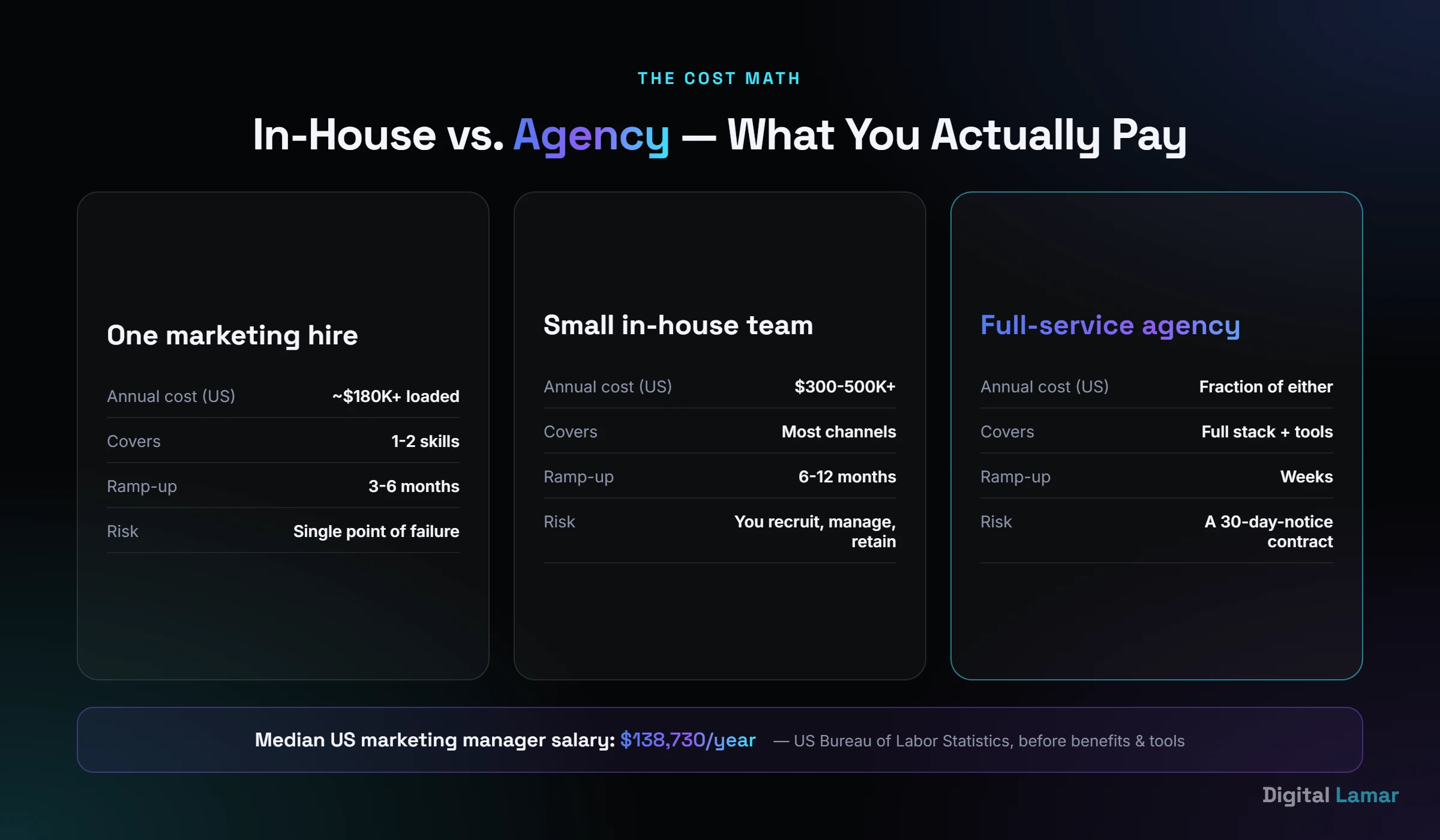
What one hire actually costs versus what an agency actually covers.
Start with the number most businesses underestimate. Per the US Bureau of Labor Statistics, the median wage for a marketing manager is $138,730 a year — and that’s the salary alone, before benefits (typically another 30-40%), recruitment costs, software licenses, and the ramp-up months where they’re learning your business instead of growing it.
And here’s the structural problem: that six-figure hire is one person with one or two core skills. Modern digital marketing needs SEO, paid advertising, content, design, analytics, social, email, and increasingly AI search optimization — genuinely different disciplines. Nobody is senior in all of them. So the real in-house comparison isn’t one salary; it’s three to five:
| Option | Annual cost (US market) | What you get |
|---|---|---|
| One marketing manager | ~$180K+ loaded | Strategy + 1-2 executed channels; single point of failure |
| Small in-house team (3-4 people) | $300K-$500K+ | Most channels covered; you manage, train, and retain them |
| Full-service agency retainer | A fraction of either | Full stack, senior oversight, tools included, no hiring risk |
The sticker salary also isn’t the whole bill. Add recruitment costs (typically several thousand dollars per hire, plus your time interviewing), a marketing tool stack that runs thousands more per year, ongoing training to keep skills current, and the quiet killer: turnover. When your one marketer leaves — and the average marketing tenure is short — the channel knowledge, account access, and momentum walk out with them, and the clock starts over at month zero with the next hire.
This isn’t an argument that in-house is bad — at a certain scale, building internal marketing is exactly right. It’s an argument that for most small and mid-sized businesses, the agency model buys more capability per dollar, sooner. The honest framing: in-house is a capital investment you make once marketing is a proven engine; an agency is how most businesses afford to prove it.
8 Honest Reasons to Hire a Digital Marketing Agency
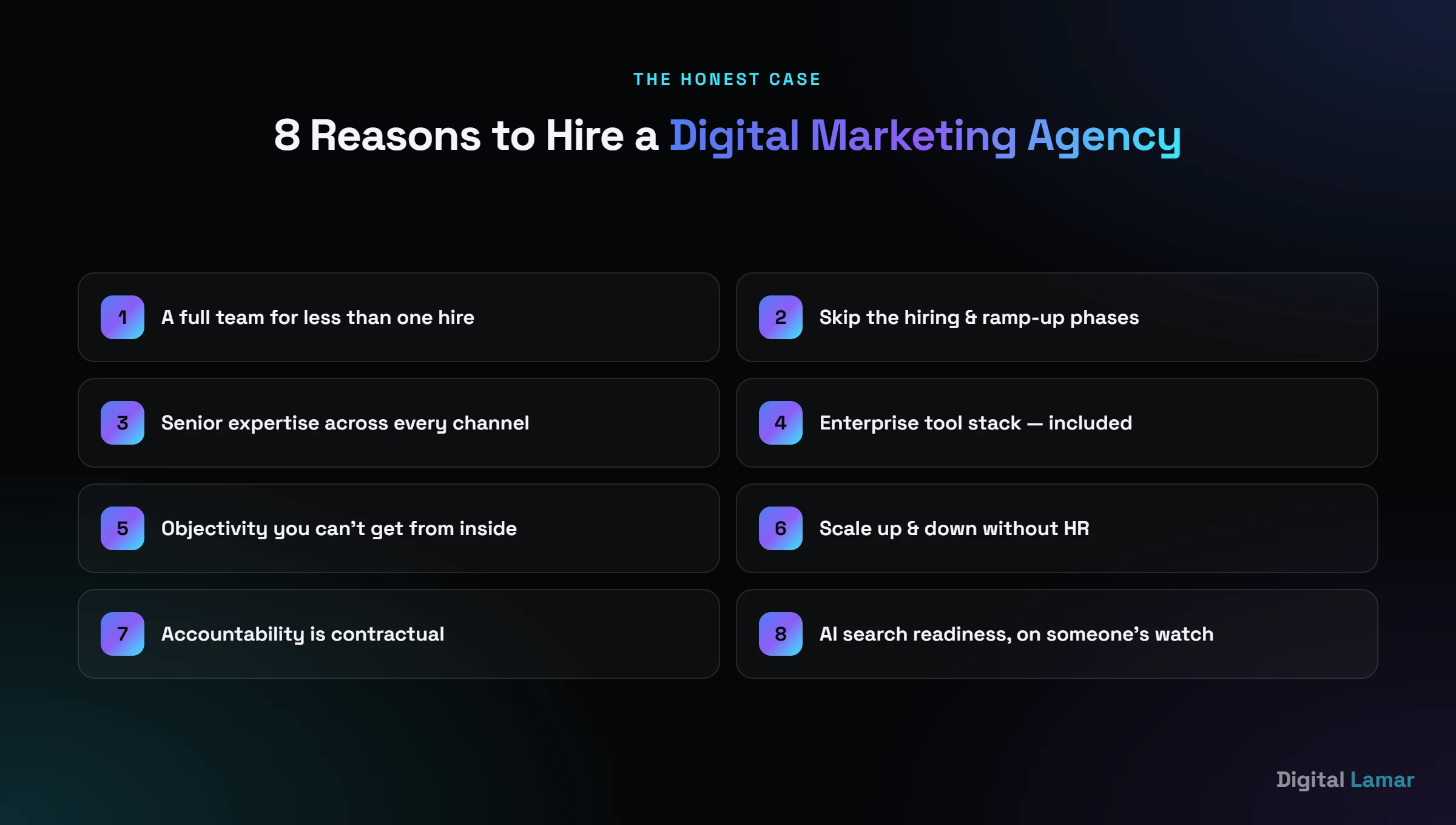
The eight reasons that hold up under scrutiny.
1. You get a full team for less than one hire
The arithmetic above, in one line: a retainer typically costs less than a single loaded mid-level salary and buys you a strategist, an SEO specialist, an ads manager, a content writer, and a designer — each doing the part they’re actually good at.
2. You skip the two most expensive phases: hiring and learning
Recruiting a marketer takes months; ramping them up takes more. And if the hire turns out wrong — wrong skills, wrong fit, wrong level — you pay for the discovery twice: once in salary, once in the quarters lost finding out. An agency has already made its hiring mistakes on someone else’s budget, already built its processes, and already has the templates, workflows, and playbooks a new hire would spend a year assembling. Kickoff to execution is typically weeks, not quarters.
3. Senior expertise across every channel
The person setting your paid ads strategy at a good agency has run dozens of accounts across industries. The pattern recognition that comes from that — what’s normal, what’s broken, what’s worth testing — is precisely the thing you can’t hire in one junior generalist.
4. The tool stack comes included
Semrush, Ahrefs, crawlers, rank trackers, reporting platforms, creative tools — a serious marketing stack runs thousands of dollars a year. Agencies carry those licenses across clients, so you get enterprise tooling without the enterprise invoice.
5. Objectivity you can’t get from inside
Internal teams inherit internal politics — the homepage nobody’s allowed to criticize, the channel that’s someone’s pet project. An outside team’s only stake is the results, and honest outside eyes routinely find growth sitting in plain sight.
6. You can scale up and down without HR
Busy season, product launch, new market entry — scale the engagement up. Cash-tight quarter — scale it down. Try doing either with employees: one direction is a hiring cycle, the other is a layoff. With an agency, both are a scope conversation and a revised retainer. For businesses with seasonal demand or uneven cash flow — which is most of them — flexibility is the most underrated line item in the agency model.
7. Accountability is contractual
A good agency lives and dies by demonstrable results, reported monthly, tied to leads and revenue. That’s a sharper accountability loop than most internal marketing functions ever face — and if it stops working, ending a retainer is a conversation, not a termination process.
8. The AI search shift is happening on someone’s watch — make sure it’s someone’s
Buyers now ask ChatGPT and Google’s AI Overviews before they ever click a website. Showing up in those answers is a new discipline, and it’s moving fast — Gartner’s 2026 CMO Spend Survey found CMOs already allocate 15.3% of marketing budgets to AI, yet only 30% feel ready to scale their AI capabilities. That gap between spend and readiness is exactly where specialist help earns its keep. Teams like ours working on AI search optimization track this shift as a job, not a side-reading list. In-house generalists mostly haven’t had the bandwidth to start.
3 Times You Shouldn’t Hire an Agency (Honestly)
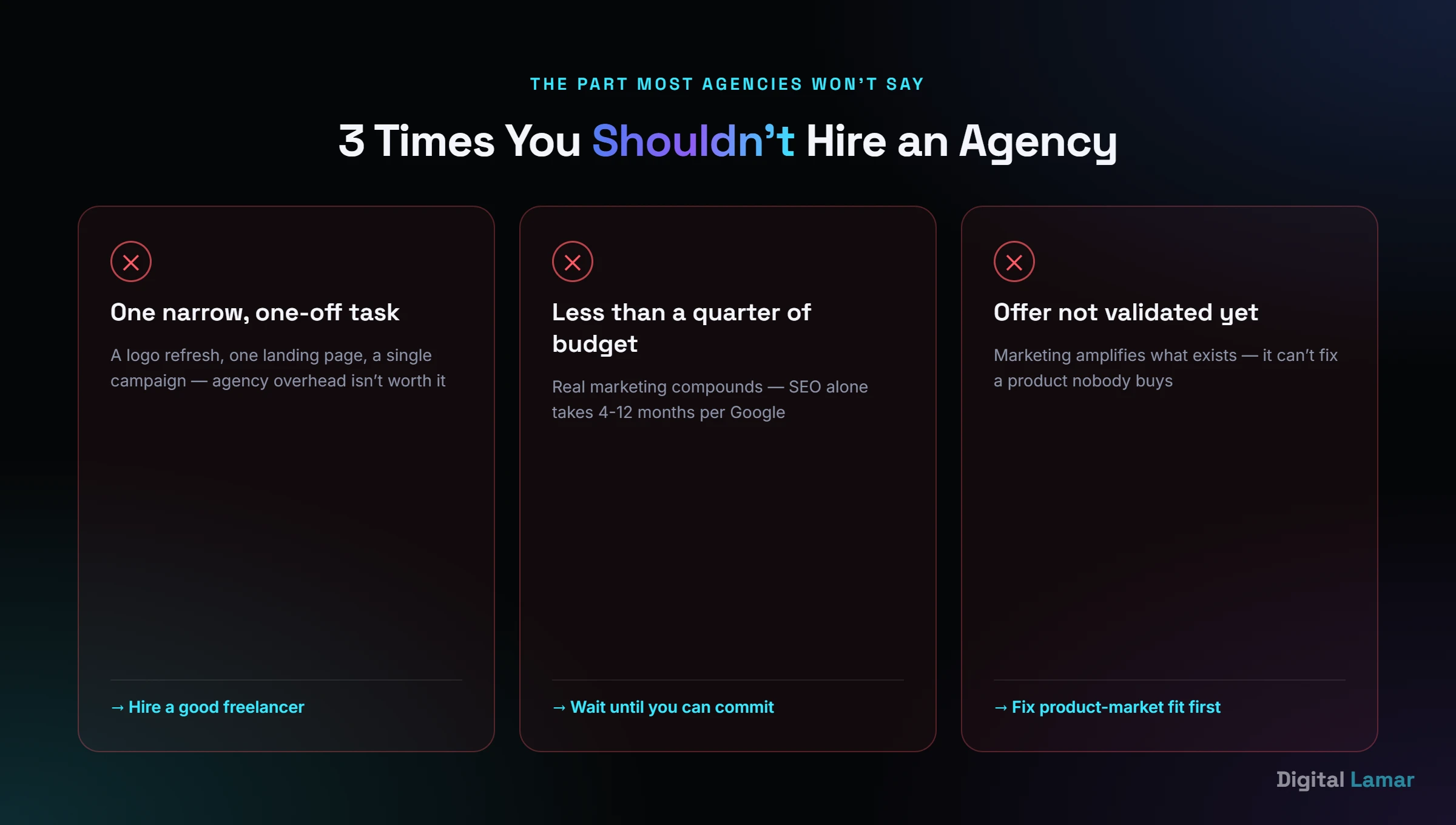
An honest agency will tell you this on the first call. Here it is in writing.
- You need one narrow, one-off skill. A logo refresh, a landing page, a single ad campaign — hire a good freelancer and keep it simple. Agencies earn their fee on ongoing, multi-channel work; paying agency overhead for a single task is buying a truck to deliver one letter. (Our own breakdown of agency vs freelancer vs in-house covers when each wins.)
- You can’t commit to at least a quarter. Real marketing compounds. Google’s own guidance puts SEO results at four months to a year; paid channels move faster but still need iteration cycles. If the budget only exists for six weeks, an agency retainer will disappoint you — and a good agency will say so upfront.
- You haven’t validated the offer yet. Marketing amplifies what exists. If nobody’s buying at all — not “not enough people,” but nobody — the problem is the offer, the pricing, or the market, and no agency can amplify your way out of that. Fix product-market fit first; marketing money spent before that is rented attention for something people don’t want.
What Hiring an Agency Actually Looks Like
If you’ve never worked with one, the first quarter follows a fairly standard arc: audit and strategy in month one, execution builds in month two, results and reporting mature from month three. We’ve written the full month-by-month version in what an SEO agency does — the same rhythm applies, channel by channel, to a full-service engagement.
The part you control is the setup: come in with a clear outcome, give the agency real access and honest answers, and hold them to the reporting they promised. The partnership works exactly as well as both sides’ inputs — the clients who get the best agency results treat the agency like a team they hired, not a vendor they’re testing.
One more expectation worth setting: the first invoice arrives before the first result, and that’s normal, not a scam. Foundational work — audits, research, fixes, strategy — is what makes months three through twelve pay. The agencies that skip it to “show something fast” are the ones that have nothing left to show by month six. If you’re now weighing specific agencies against each other, the natural next read is our guide on how to choose a digital marketing agency — the 7 steps, 8 interview questions, and warning signs, in one place.
The Pakistan, UAE & US Angle
Where you sit changes the shape of the decision:
In Pakistan, the case for an agency is about leverage — a growing digital economy where a digital marketing agency in Pakistan costs dramatically less than its Western equivalent while competing for the same online attention.
In the UAE, it’s about pace — one of the highest digital ad-spend growth markets anywhere, where a digital marketing agency in Dubai that knows the market saves you the expensive months of learning it yourself.
In the US, it’s increasingly about arbitrage — the world’s most expensive marketing labor market, which is why more US businesses pair with vetted offshore teams like our digital marketing agency serving US businesses: identical deliverables, US-market fluency, fraction of the payroll.
Key Takeaways
- The core argument is arithmetic: US marketing managers earn a median $138,730 (BLS) before benefits and tools — an agency retainer typically costs less and covers the full skill stack.
- The strongest agency advantages: senior cross-channel expertise, included tooling, objectivity, scalability, and contractual accountability.
- AI search is the newest reason: buyers ask ChatGPT and AI Overviews first, and staying visible there is now a specialist discipline.
- Don’t hire an agency for one-off tasks, sub-quarter budgets, or an unvalidated offer — freelancers, patience, and product work respectively fit those better.
- If the reasons fit, the next step is selection — shortlist on proof and interview hard.
Not sure which side of the hire/don’t-hire line you’re on? That’s exactly what a first call is for — and we’ll tell you honestly if the answer is “not yet.”
Book a free 30-min strategy callFrequently Asked Questions
Is hiring a digital marketing agency worth it for a small business?
Usually yes, precisely because small businesses can least afford a bad full-time hire. A retainer converts a six-figure fixed cost into a flexible one and buys senior skills a small business couldn’t attract as employees. The exceptions are the three cases above: one-off needs, sub-quarter budgets, or an unvalidated offer.
When is the right time to hire an agency?
When you have a validated offer, a defined outcome you want more of, and at least a quarter of budget to invest — and when marketing is stuck as “whatever’s left of someone’s week.” That combination is the signal.
How much does a digital marketing agency cost compared to in-house?
In the US, a loaded mid-level marketing hire runs roughly $180K a year and a small team $300-500K; retainers for equivalent coverage typically come in well below one loaded salary. Exact pricing depends on scope and market — Pakistan and UAE economics differ substantially.
What should I expect in the first 90 days?
Month one is audit and strategy, month two is execution ramping up, month three is scaling plus reporting that ties work to leads. If an agency can’t describe its own version of that arc, keep interviewing.
Can an agency work alongside my existing marketer?
Yes — it’s one of the most common setups. Your in-house person keeps brand knowledge, approvals, and internal coordination; the agency supplies the specialist execution no single hire can cover. Good agencies make that person look brilliant, not redundant.
Do agencies work with businesses outside their own country?
Constantly — digital marketing is remote-native work. What matters is market fluency, not geography: an agency should show it understands your buyers, your competitors, and your platforms, wherever its desks are.