On this page
In short
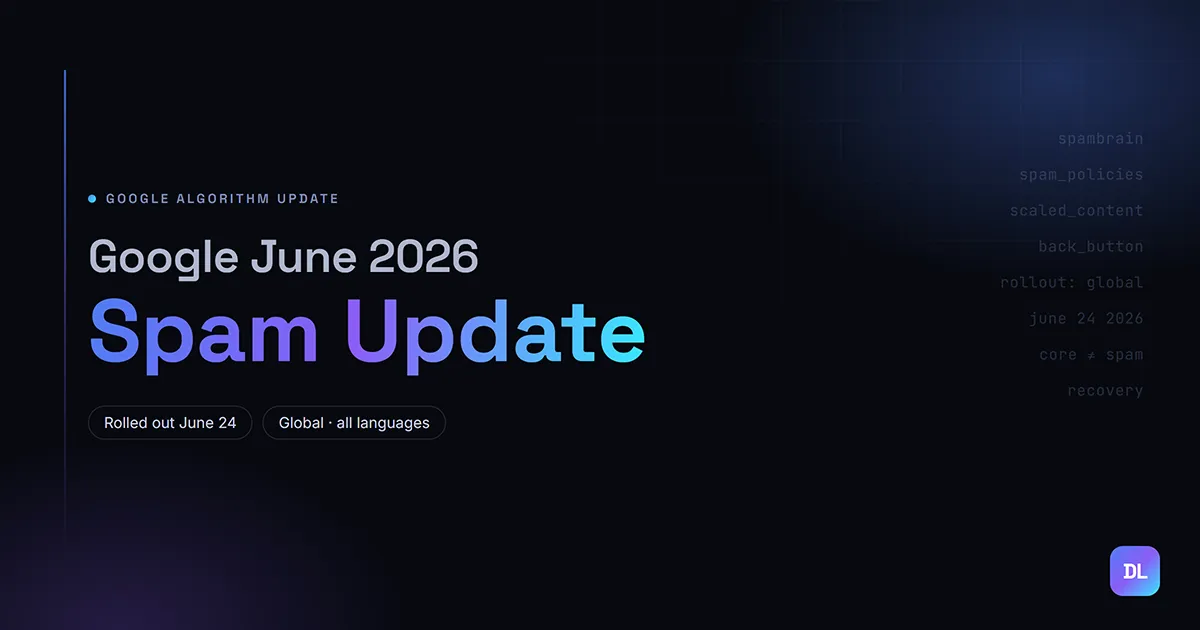
Google began rolling out the June 2026 spam update on June 24, 2026 — its second spam update of the year. It applies globally, to all languages, and may take a few days to finish. It’s a SpamBrain refresh that enforces Google’s existing spam policies harder — this round leaning on scaled, mass-produced content and technical spam. It does not target link spam or the site-reputation-abuse policy. If you publish original, genuinely useful content, you should be fine. If your traffic dropped, don’t panic-edit — diagnose, fix the root cause, and expect recovery to take weeks to months.
On June 24, 2026, Google confirmed it had started rolling out the June 2026 spam update. If you woke up to a traffic drop in Search Console this week, this is the first thing you should rule in or out — and this guide will help you do exactly that.
We’ll skip the breathless news-flash treatment. Instead, here’s what a working SEO actually needs to know: what this update is, what it targets, whether your site is at risk, and a calm, realistic plan to recover if you were hit.
What happened: the June 2026 spam update, in plain English
Google announced the update on its Search Status Dashboard and on LinkedIn. The official wording was deliberately short:
“Today we released the June 2026 spam update to Google Search. This is a normal spam update, and it will roll out for all languages and locations. The rollout may take a few days to complete.”
— Google Search Central
Here are the facts worth pinning down:
- Name: June 2026 spam update
- Launched: June 24, 2026 (around midday US Eastern time)
- Rollout: A few days to complete
- Scope: Global — every language and region
- Type: A “normal” spam update (an improvement to Google’s automated spam detection, including SpamBrain)
- Second of 2026: It follows the March 2026 spam update and the May 2026 core update
A spam update is not a one-off punishment event. As Google puts it, its automated anti-spam systems run constantly; every so often it makes a “notable improvement” to how they work and labels that a spam update. In practice, that means the system gets better at spotting tactics it previously missed — and sites relying on those tactics can lose rankings, sometimes overnight.
Spam update vs core update — the difference that matters
This trips up a lot of business owners, so let’s settle it. People see “Google update” and assume their content wasn’t good enough. But a spam update and a core update judge completely different things.
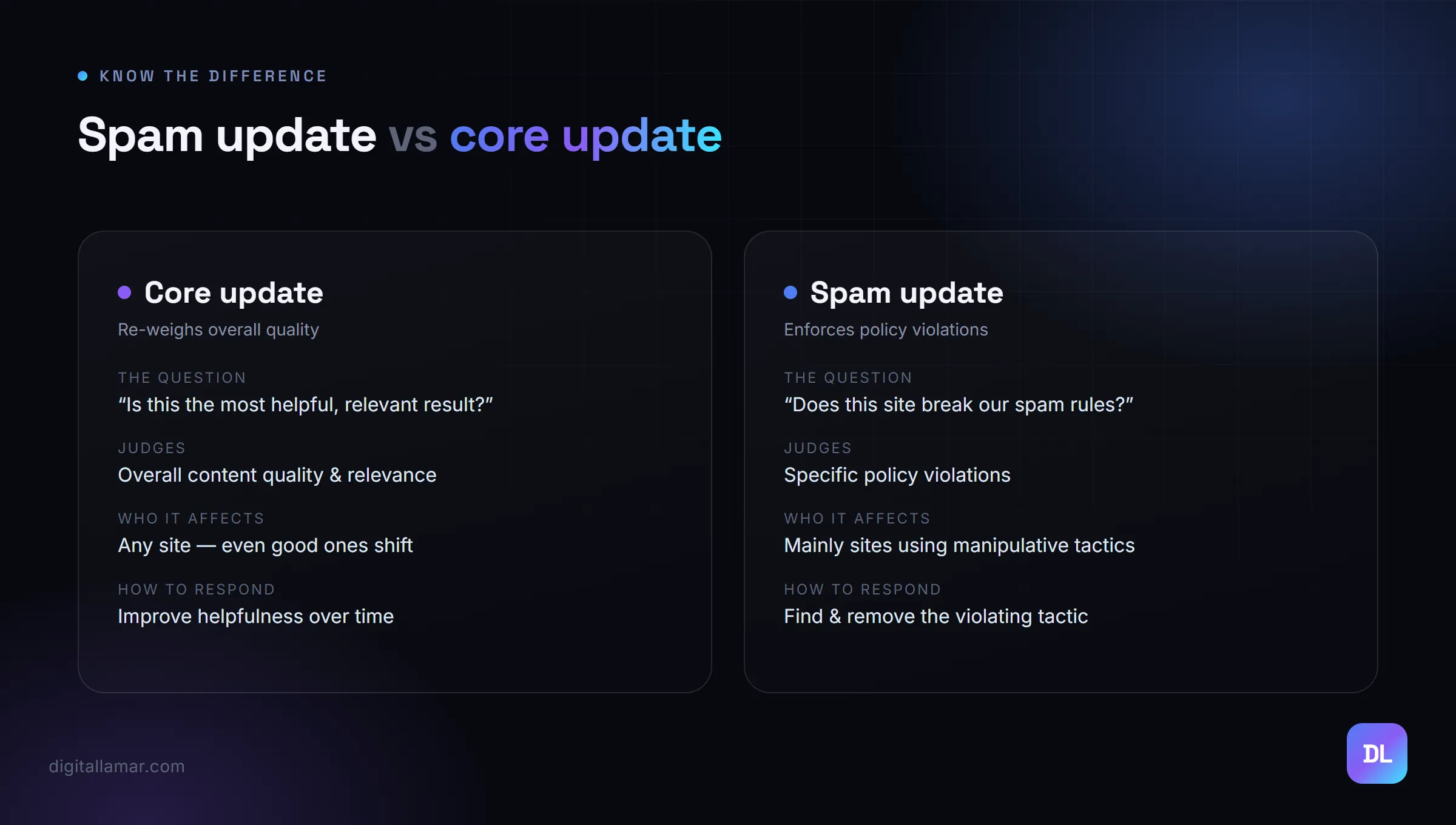
| Core update | Spam update | |
|---|---|---|
| The question it asks | “Is this the most helpful, relevant result?” | “Does this site break our spam rules?” |
| What it judges | Overall content quality & relevance | Specific policy violations |
| Who it affects | Any site — even good ones can shift | Mainly sites using manipulative tactics |
| How to respond | Improve helpfulness over time | Find and remove the violating tactic |
| Recovery feel | Gradual, with the next refresh | After the fix is verified over months |
The practical takeaway: if you were hit by a spam update, you’re usually not being told “write better content.” You’re being told “stop doing a specific thing Google considers manipulative.” That’s a far more diagnosable problem — which is good news.
What the June 2026 update targets (and what it spares)
Google didn’t introduce new spam policies with this update — it sharpened enforcement of the existing ones. Based on Google’s notes and early analysis from the SEO community, here’s the shape of it.
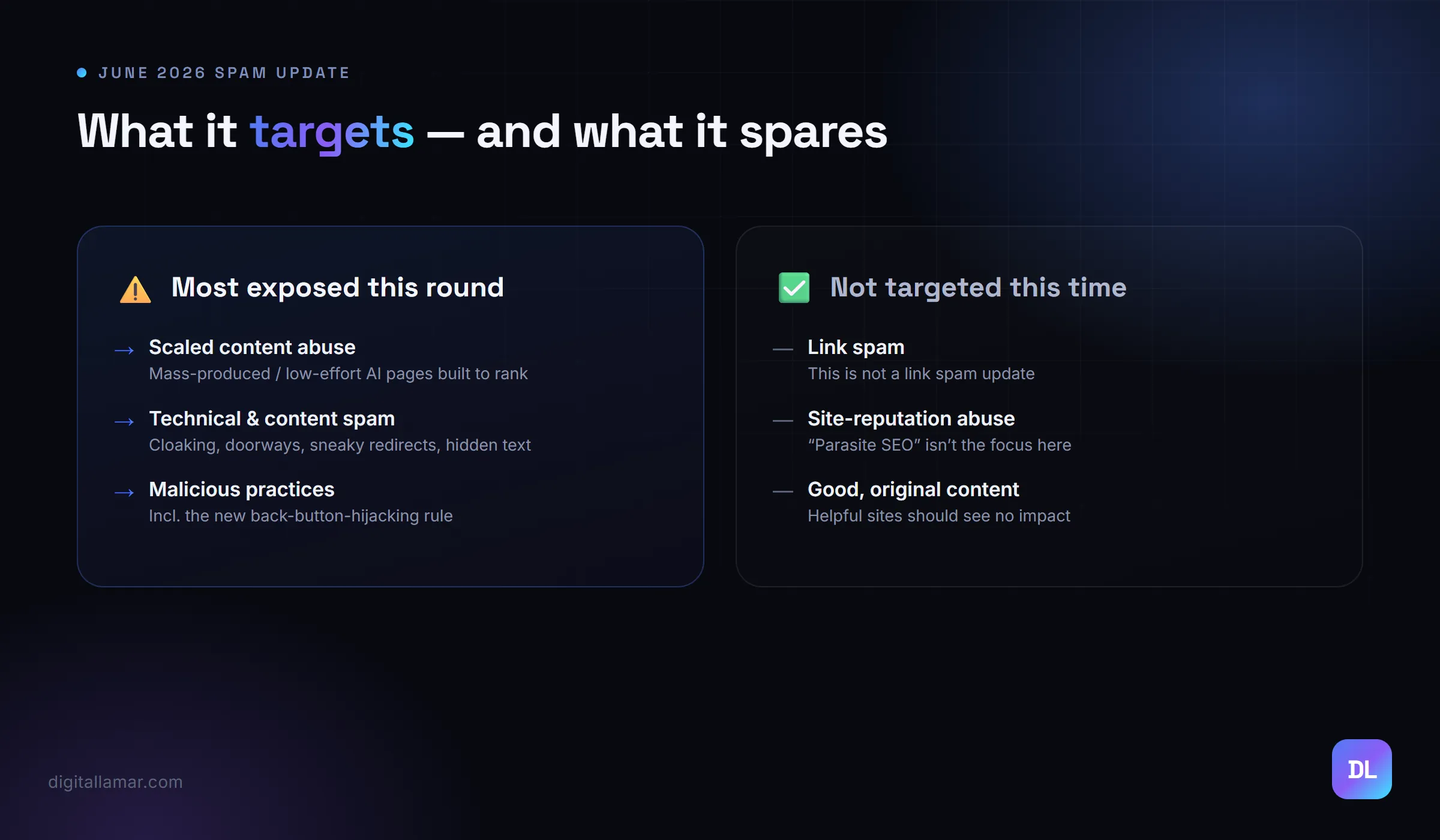
Most exposed this round:
- Scaled content abuse — mass-produced, spun, or thin pages generated at scale (very often low-effort AI content) primarily to game rankings rather than help readers.
- Other technical & content spam — cloaking, sneaky redirects, doorway pages, hidden text, keyword stuffing, and auto-generated junk.
- Malicious-practice violations — including the newly enforceable “back button hijacking” rule (more on that next).
What Google said this update does not target:
- Link spam — this is not a link spam update. (Important, because for link spam updates, cleaning up bad links doesn’t restore lost ranking — the benefit is simply gone.)
- The site-reputation-abuse policy (“parasite SEO”) — not the focus of this particular update.
Worth knowing
Google would not say what percentage of queries this update affected — it never does. The only reliable signal is your own Search Console data from June 24 onward. Ignore the panic on social media and watch your own numbers. Source: Search Engine Roundtable
The new “back button hijacking” rule you should know about
Two months before this update, Google added a new line to its spam policies: back button hijacking, with enforcement starting June 15, 2026 — right before this spam update landed.
What it is: back button hijacking is when a site manipulates browser history so that pressing the “back” button doesn’t take the visitor to the previous page. Instead they’re trapped, redirected, or shoved onto an ad or another page. It’s a hostile, user-trust-breaking pattern — and now an explicit spam violation that can trigger demotions or manual actions.
The detail most site owners miss: you can be penalised even if you didn’t write the offending code. Back button hijacking often comes from a third-party ad network, plugin, or library you’ve embedded. Google’s position is that it’s your site, so it’s your responsibility. If you run display ads or heavy third-party scripts, test your back button on mobile now — before Google’s systems do it for you.
Are you at risk? A 5-point self-check
Run through these honestly. The more you answer “yes,” the more this update should be on your radar.
- Have you published content at scale with little human oversight? Bulk AI articles pushed out to “cover keywords” are exactly what scaled-content-abuse enforcement looks for.
- Does your content actually help a reader, or just exist to rank? If you’d be embarrassed to send a page to a customer, Google’s systems can tell too.
- Are you using any technical tricks? Doorway pages, cloaking, sneaky redirects, hidden text — any of these put you squarely in scope.
- Do your ads or plugins interfere with the back button? Test it on a phone. If “back” misbehaves, fix it.
- Did your traffic drop noticeably on or after June 24? Check Search Console. A sharp, dated drop that lines up with the rollout is your strongest clue.
If you answered “no” across the board and still saw a dip, it may be normal volatility, a separate core-update effect, or seasonality — not necessarily this spam update. Diagnose before you act.
The recovery playbook: what to do if you were hit
If the evidence points to this update, resist the urge to make twenty frantic changes. Spam recovery is about removing the cause, then proving good behaviour over time. Here’s the order of operations.
- Confirm the timing. In Search Console, compare the weeks before and after June 24. A clear, dated drop that matches the rollout is your signal. No clear drop? This probably isn’t your problem.
- Identify the violating tactic. Audit against Google’s spam policies line by line. Be specific: which pages, which tactic. Vague self-criticism doesn’t help.
- Fix the root cause, not the symptom. Remove or genuinely rewrite thin/scaled pages. Delete doorway pages. Strip cloaking and sneaky redirects. Repair the back-button behaviour. Replace manipulative pages with content that serves a real user need.
- Don’t mass-delete in a panic. Pruning genuinely useless pages is fine; nuking your whole site is not. Keep and improve anything that helps real readers.
- Wait for re-crawl and re-assessment. Google’s systems need to recrawl your site and “relearn” that you comply — over months, not days. Make the fix once, properly, then be patient.
One hard truth from Google’s own documentation: making changes may help — there’s no guaranteed switch-back. The fastest path is to genuinely stop doing the thing, then keep publishing content that earns its place. This is the same foundation our SEO services are built on.
Not sure if the update hit your site?
We’ll audit your Search Console data against Google’s spam policies and tell you exactly what’s going on — and what to fix first.
Get a Free Spam-Update AuditHow long recovery actually takes
Be realistic. Spam updates roll out over days, but recovery can take much longer because Google has to recrawl your site and confirm the fix over time. History gives a useful sense of scale — some spam updates wrap in a day, others run for weeks:
- March 2026 spam update — about 1 day to roll out
- August 2025 spam update — 27 days
- December 2024 spam update — 7 days
- March 2024 spam update — 15 days
- October 2023 spam update — 15 days
And remember: those are rollout times. Even after a fix, sites typically wait until a later refresh, and Google says it can take “many months” for its systems to relearn that you comply. Plan for a quarter, not a weekend.
How to future-proof your site against every spam update
The good news about spam updates is that they’re the most avoidable kind of Google update. You don’t need to guess Google’s next move — you just need to not give it a reason to demote you. The checklist is boring on purpose:
- Publish for humans first. Every page should have a clear reason to exist beyond “ranking for a keyword.”
- Use AI as an assistant, not an author. AI-assisted content is fine; mass-produced AI content with no oversight is exactly what gets caught. Edit, fact-check, and add genuine expertise.
- Keep your technical house clean. No cloaking, doorways, hidden text, or sneaky redirects — the same fundamentals we cover in our guide to technical SEO.
- Audit third-party scripts. Ads and plugins can introduce violations (like back button hijacking) without you realising. Review what you embed.
- Build real authority. Genuine expertise, real mentions, and a trustworthy brand are the opposite of spam — and increasingly, they’re what gets you cited in AI search too. (More on that in our AI solutions.)
- Watch your own data. Check Search Console around every confirmed update so you can separate real impact from noise.
Key takeaways
- The June 2026 spam update began June 24, 2026 — global, all languages, a few days to roll out.
- It’s a SpamBrain enforcement refresh, not new rules — this round leaning on scaled/AI content abuse and technical spam.
- It does not target link spam or site-reputation abuse.
- A spam update enforces policy violations; a core update re-weighs quality. Different problems, different fixes.
- The new back button hijacking rule is now enforceable — check your ads and plugins.
- Recovery is slow: fix the root cause once, then expect weeks to months for Google to relearn that you comply.
Frequently asked questions
What is the Google June 2026 spam update?
It’s an improvement to Google’s automated spam-detection systems (including SpamBrain) that rolled out on June 24, 2026. It enforces Google’s existing spam policies more effectively, applies globally to all languages, and was expected to take a few days to complete. It is the second spam update of 2026.
What does the June 2026 spam update target?
It sharpens enforcement of existing spam policies, with this round leaning on scaled content abuse (mass-produced or low-effort pages, often AI-generated) and other technical and content spam such as cloaking, doorway pages, and sneaky redirects. Google stated it does not target link spam or the site-reputation-abuse policy.
Is a spam update the same as a core update?
No. A core update re-evaluates the overall quality and relevance of content across the web, so even good sites can move. A spam update specifically enforces policy violations — it mainly affects sites using manipulative tactics. They require different responses: improve helpfulness for a core update; remove the violating tactic for a spam update.
How do I recover from the Google spam update?
Confirm the timing in Search Console, audit your site against Google’s spam policies to identify the specific violating tactic, fix the root cause (remove or genuinely rewrite thin/scaled pages, strip technical tricks, repair back-button behaviour), avoid panic-deleting useful pages, and then wait for Google to recrawl and reassess your site over the following weeks and months.
How long does it take to recover from a spam update?
Longer than the rollout. Spam updates roll out over days, but recovery typically takes weeks to months because Google must recrawl your site and confirm the fix over time. Google says it can take “many months” for its systems to relearn that a site complies. Plan for a quarter rather than a weekend.
What is back button hijacking?
Back button hijacking is when a site manipulates browser history so that pressing “back” doesn’t return the visitor to the previous page — trapping or redirecting them instead. Google added it to its spam policies with enforcement starting June 15, 2026. Site owners can be penalised even when the behaviour comes from a third-party ad network or plugin embedded on their site.