On this page
In short
Generative Engine Optimization (GEO) and Answer Engine Optimization (AEO) are about getting your business mentioned, cited, and recommended by AI tools like ChatGPT, Perplexity, and Google’s AI Overviews — not just ranked in blue links. As people increasingly ask AI instead of searching, GEO and AEO are becoming as important as traditional SEO. The good news: the foundations overlap, so you can start today.
Your customers have started asking AI instead of Google. “What’s the best digital marketing agency in Dubai?” “Which CRM should a small business use?” “Who can build me a website in Pakistan?” — these questions are increasingly typed into ChatGPT, Perplexity, and Google’s AI Overviews, and the AI answers with a short list of recommended names.
If your business isn’t one of those names, you’re invisible in a channel that didn’t even exist three years ago. That’s the problem GEO and AEO solve. This guide explains both in plain English — what they are, how they differ from SEO (and from each other), why they matter right now, and exactly how to start.
What is Generative Engine Optimization (GEO)?
Generative Engine Optimization (GEO) is the practice of positioning your brand and content so that generative AI platforms — ChatGPT, Google AI Overviews, Perplexity, Gemini, Copilot — cite, mention, or recommend you in their answers.
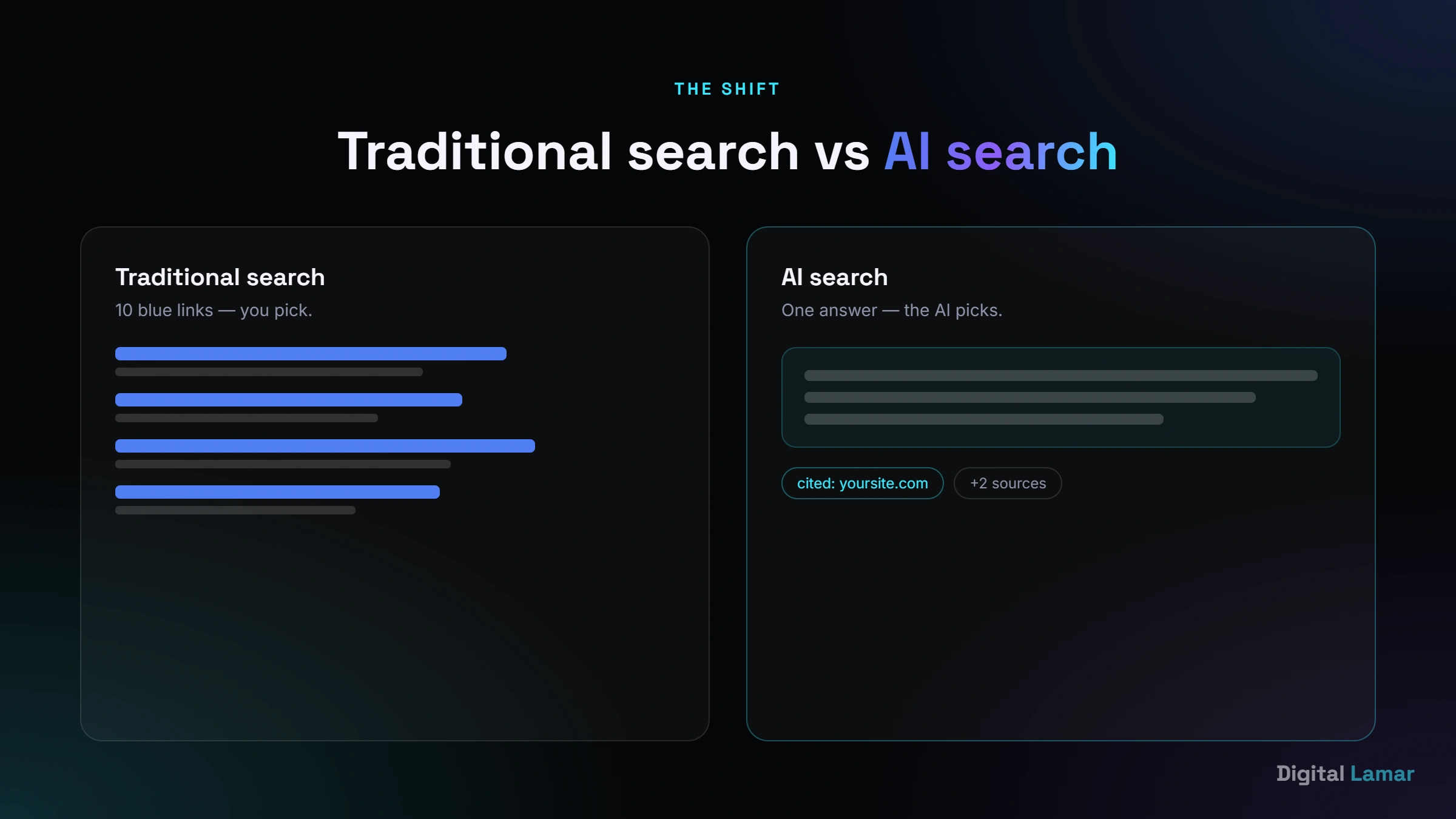
Traditional SEO tries to win a position in a list of links. GEO tries to win a mention inside an AI-generated answer. When someone asks ChatGPT “who are the top SEO agencies for real estate?”, GEO is the work that makes your name show up in that response — with a citation back to your site.
It’s a shift from “rank and get clicked” to “be referenced and get recommended.” The AI reads the web, decides which sources are trustworthy and relevant, and synthesises an answer that quotes a handful of them. GEO is how you become one of those quoted sources.
What is Answer Engine Optimization (AEO)?
Answer Engine Optimization (AEO) is the practice of structuring your content so it becomes the direct answer to a question — in featured snippets, voice assistants, “People Also Ask” boxes, and AI answer engines.
Where classic SEO might rank you #3 for “how to choose a marketing agency,” AEO aims to make your concise, well-structured answer the response that gets read aloud by Siri, shown in Google’s answer box, or pulled into an AI summary. It rewards clarity: short, self-contained answers, clean question-and-answer formatting, and schema markup that tells machines exactly what your content means.
In simple terms: AEO is about being the answer; GEO is about being cited in the answer. They overlap heavily — which is exactly why people confuse them.
GEO vs AEO vs SEO — the difference, finally explained
This is where most people get lost, so let’s make it concrete. SEO, AEO, and GEO aren’t rivals — they’re layers of the same goal: being found when someone is looking for what you offer. They just target different surfaces.
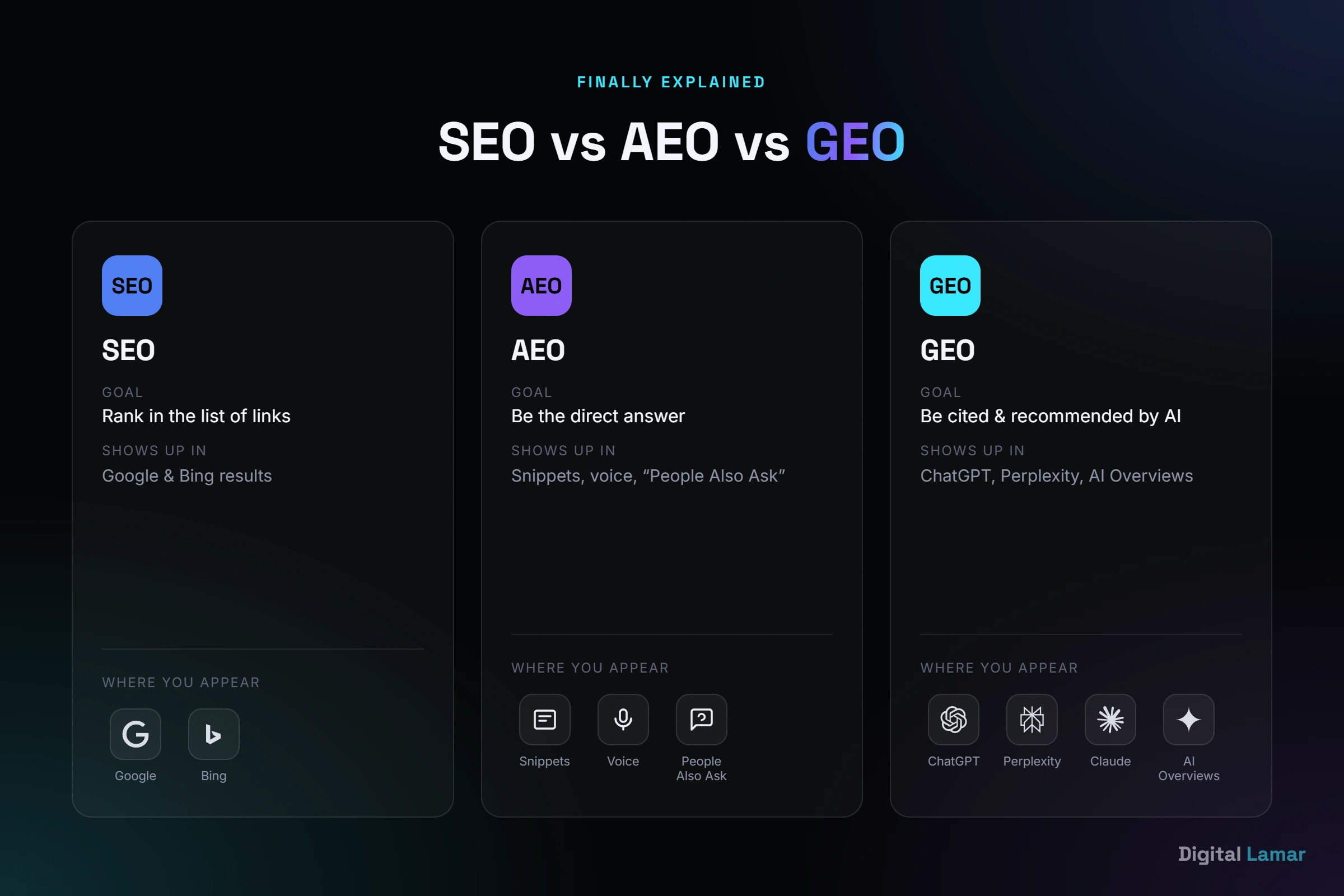
| SEO | AEO | GEO | |
|---|---|---|---|
| Goal | Rank in the list of links | Be the direct answer | Be cited & recommended by AI |
| Where it shows | Google / Bing results | Snippets, voice, “People Also Ask” | ChatGPT, Perplexity, AI Overviews, Gemini |
| You optimise | Keywords, links, relevance | Concise answers, Q&A structure, schema | Entities, mentions, extractable content, authority |
| Success metric | Rankings & clicks | Owning the answer box | Citations & AI recommendations |
| Example query | “best CRM software” | “what is a CRM?” | “which CRM should a small agency use?” |
So is AEO part of GEO? Largely, yes — they’re overlapping circles rather than separate boxes. AEO focuses on direct answers (snippets, voice, answer engines); GEO focuses on being cited inside generative AI responses. Both sit under the bigger umbrella some people now call AIO (AI Optimization) or simply “AI search.” You don’t need to obsess over the labels — you need your content to be clear, structured, trustworthy, and easy for a machine to quote.
Did you know?
Google’s AI Overviews now appear in at least 16% of all searches — and they cite a competitor’s page roughly 69% of the time. If you’re not optimising for AI answers, your competitors are showing up in them instead. Source: Search Engine Land
Why GEO & AEO matter right now
Three years ago, “ask the AI” wasn’t a buying behaviour. Today it’s mainstream — and growing faster than almost any channel in marketing history. The numbers are hard to ignore:
- ChatGPT has 800M+ weekly users (and crossed ~900M by early 2026). That’s a search engine-scale audience asking for recommendations daily.
- AI-referred website visits grew 527% year-over-year in 2025 — a channel going from rounding error to real traffic.
- AI visitors convert better: studies show ~15.9% conversion from ChatGPT referrals vs ~1.76% from organic search. People arriving from an AI recommendation already trust you.
- The GEO market itself is projected to grow from ~$848M in 2025 to $33.7B by 2034.
The catch: AI visibility is volatile. Between 40% and 60% of the sources AI tools cite change from one month to the next. That means this is still an open game — businesses that move early can win citations their slower competitors haven’t claimed yet. For agencies and SMBs in markets like Pakistan, the UAE, and the US, that’s a rare first-mover advantage.
Across marketing communities like Reddit, the most common question isn’t “how do I do GEO?” — it’s “can someone explain GEO and AEO in simple terms?” The terminology is new and noisy, and a lot of marketers suspect it’s just SEO with a rebrand. They’re half right — and we’ll settle that debate below.
How AI engines actually decide who to cite
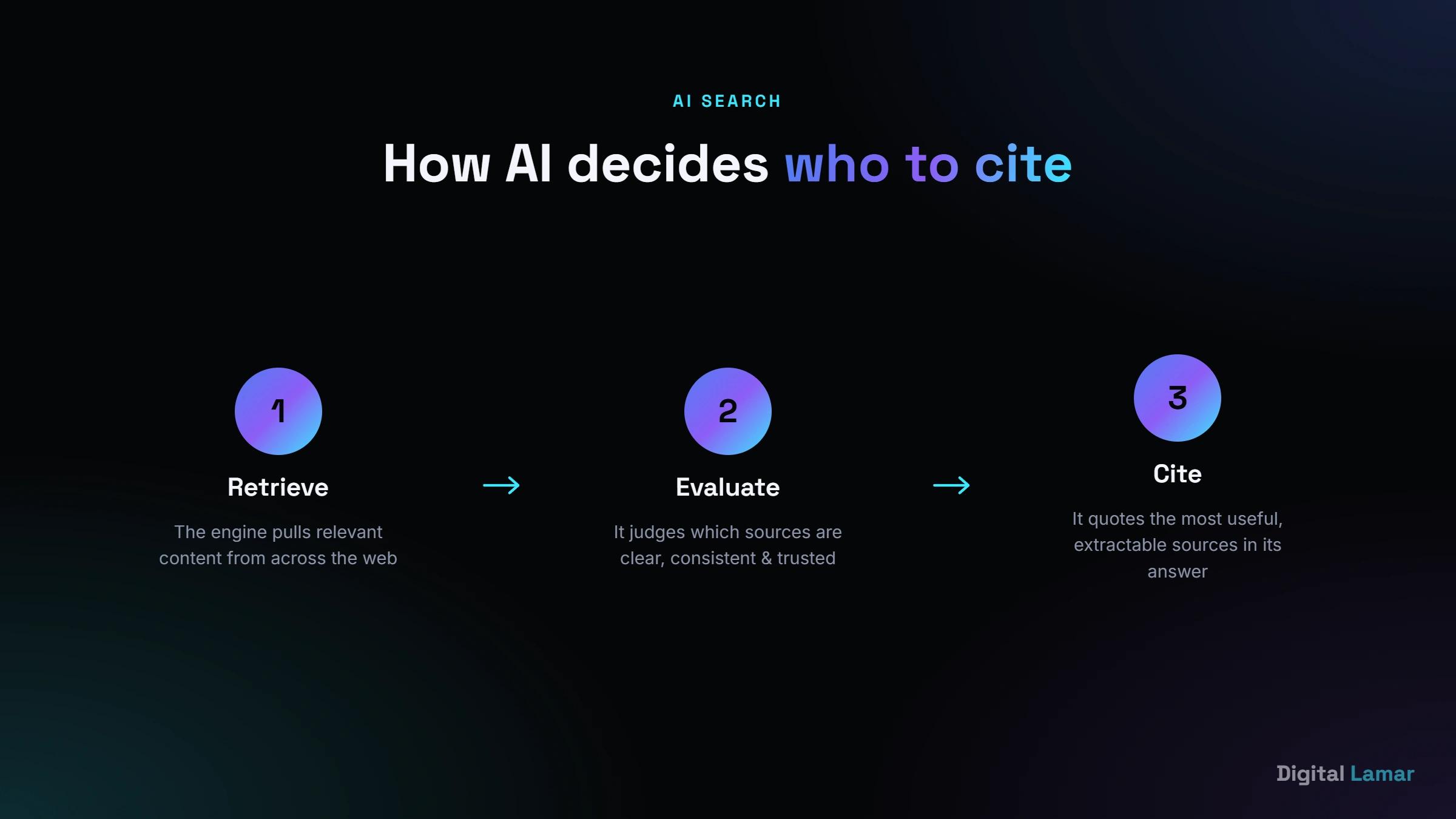
AI tools don’t “rank” pages the way Google does. They retrieve relevant content, judge which sources are credible, and synthesise an answer that quotes the most useful, quotable ones. Five things consistently make content more citable:
1. Clear entities (who you are, stated consistently)
AI builds a “map” of brands, people, and topics from across the web. If your business is described consistently on your site, LinkedIn, Crunchbase, directories, and review sites, the AI understands what you are and what you’re known for — and is more likely to recommend you for it.
2. Extractable, self-contained content
AI quotes paragraphs that make sense on their own. A sentence like “Technical SEO is the work of optimising your website’s foundation so search engines can crawl and index it” can be lifted straight into an answer. Rambling, context-dependent writing can’t. Front-load your answers.
3. Mentions and citations across the web
In AI search, unlinked brand mentions matter more than in classic SEO. Being talked about on Reddit, YouTube, podcasts, and industry sites teaches the AI that you’re a real, trusted entity — even without a backlink.
4. Structured data (schema)
Schema markup (JSON-LD) spells out what your content means — that this is an FAQ, an organisation, a how-to. It helps AI engines parse and reuse your content accurately. (We go deep on this in our guide to technical SEO.)
5. Technical accessibility
Most AI crawlers don’t run JavaScript. If your content only appears after JS loads, it can be invisible to them. Fast, server-rendered, crawlable pages are the price of entry — the exact overlap where GEO meets technical SEO, and where our SEO services come in.
Did you know?
Between 40% and 60% of the sources AI tools cite change every month. AI visibility isn’t “set and forget” — it’s an ongoing game, which is exactly why early movers can still grab citations their competitors haven’t. Source: Search Engine Land
How to start optimising for GEO & AEO
You don’t need a new agency or a new budget line to begin. Most of GEO and AEO is good SEO done with AI in mind. Here’s a practical starting checklist for a business owner:
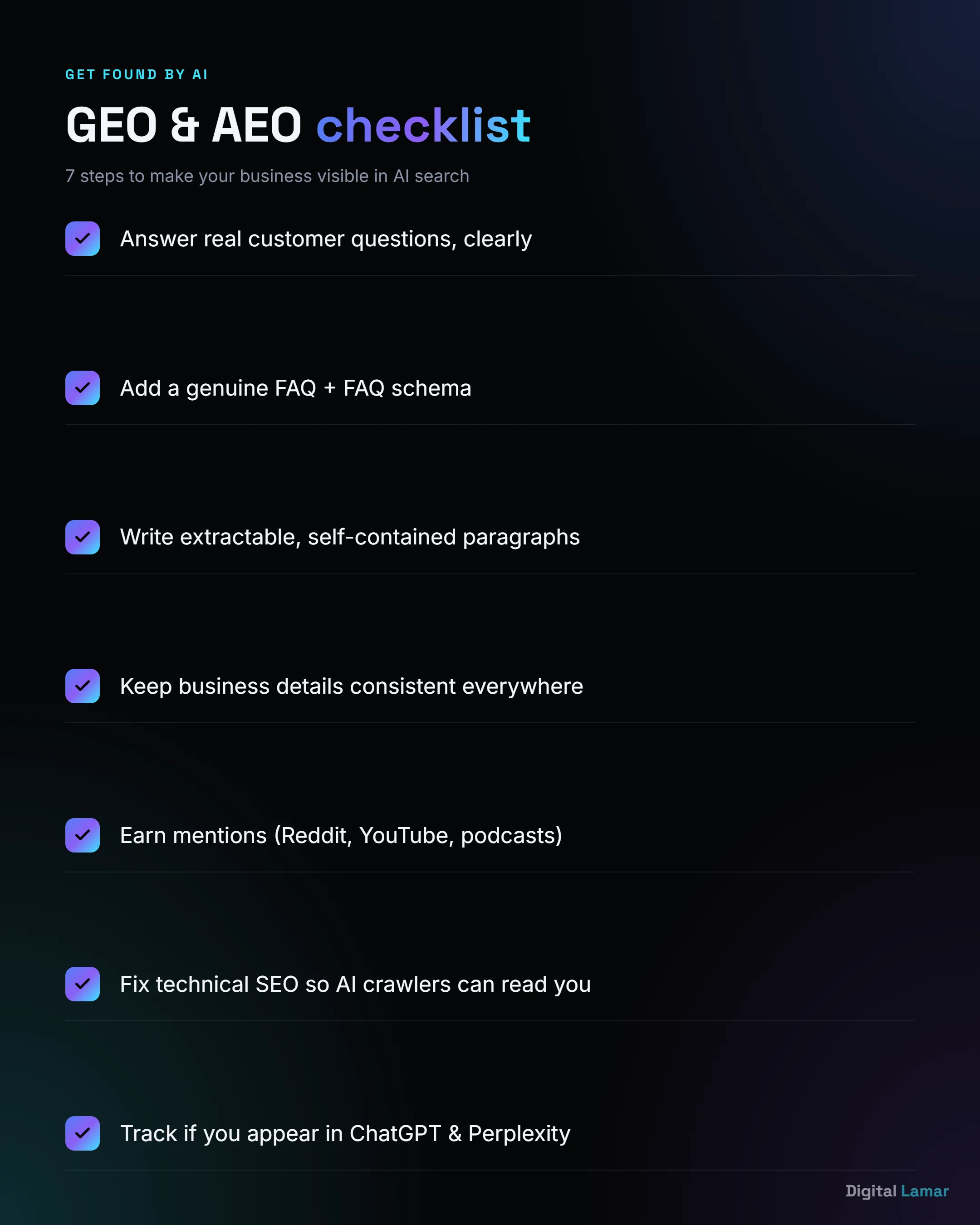
- Answer real questions, clearly. Build pages and sections around the exact questions customers ask, with a concise answer in the first two sentences.
- Add a genuine FAQ + schema. Mark up Q&As with FAQ schema so machines can lift them directly.
- Make your content extractable. Short paragraphs, descriptive headings, front-loaded answers — write so a single paragraph can be quoted out of context.
- Be consistent everywhere. Use the same business description and details across your site, Google Business Profile, LinkedIn, and directories so AI gets your “entity” right.
- Earn mentions, not just links. Get talked about on Reddit, YouTube, podcasts, and industry sites — AI weighs being mentioned, even without a link.
- Fix the technical foundation. Fast, crawlable, server-rendered pages with clean schema — so AI crawlers (which don’t run JavaScript) can actually read you.
- Measure it. Ask ChatGPT and Perplexity the questions you should appear for, and track whether you show up over time.
What about tools? The simplest one is free: open ChatGPT, Perplexity, and Google AI Overviews and ask the questions a customer would — then note whether you appear and who does instead. For ongoing tracking, dedicated AI-visibility tools (such as Ahrefs’ Brand Radar, Semrush’s AI toolkit, Peec AI, or Otterly) monitor how often AI engines mention and cite your brand versus competitors. Start with the free manual check; add a tool once AI search is driving real traffic.
Want to know if AI can even see your business?
We’ll run a free AI-visibility check — what ChatGPT and Google AI say about you today, and how to get cited.
Get a Free AI-Visibility CheckGEO & AEO examples (what it looks like in practice)
Concrete examples make the difference click:
- AEO example: Someone asks Google “what is answer engine optimization?” and your one-paragraph definition appears in the answer box at the top — above all the blue links. You own the answer.
- GEO example: Someone asks ChatGPT “best digital marketing agencies for real estate in Dubai” and your agency is named in the response, with a citation to your real-estate page. You’re recommended by the AI.
- The overlap: A well-structured FAQ on your site can win a featured snippet (AEO) and get quoted by Perplexity (GEO) — from the exact same content. That’s why doing both well is efficient, not double the work.
Does AI search only favour big brands?
It’s a fair worry: if AI learns from the whole web, won’t it just keep recommending the biggest names? Not necessarily — and this is where smaller, focused businesses can win. Generative engines reward specificity and relevance, not just size. A large brand might dominate broad queries, but for a precise question — “best SEO agency for Dubai real estate developers” or “affordable web design for clinics in Karachi” — a focused business with clear, well-structured content and genuine niche authority is often the better answer for the AI to give.
Add to that the volatility we mentioned (40–60% of citations change monthly), and the picture is encouraging: the AI-search landscape is still forming. Niche players who publish clear, expert, citable content now can claim recommendations before bigger, slower competitors even notice the channel exists.
“Isn’t GEO just SEO with a new name?”
Honest answer: mostly, yes — and that’s good news. The foundations are the same. Relevant content, a trustworthy brand, clean technical SEO, and broad web presence help you in Google and in AI answers. If you’re doing real SEO well, you’re already most of the way to GEO.
But there are real differences worth knowing:
- Unlinked mentions matter more for AI than for Google.
- Extractable, self-contained writing matters more — AI quotes paragraphs, not pages.
- JavaScript-rendered content is a bigger risk, since most AI crawlers don’t run JS.
- You measure citations and mentions, not just rankings and clicks.
So don’t throw out your SEO playbook and don’t pay for a separate “GEO product.” Treat GEO and AEO as a lens on the SEO you should already be doing — with a few AI-specific tweaks. That’s exactly how our AI solutions work alongside core SEO.
Ready to get found by AI, not just Google?
Explore our AI SolutionsKey takeaways
- GEO = getting cited/recommended by generative AI (ChatGPT, Perplexity, AI Overviews). AEO = being the direct answer (snippets, voice, answer boxes).
- They overlap — both sit under “AI search,” and AEO is largely part of GEO. Don’t obsess over labels; obsess over clarity, structure, and trust.
- It matters now: ChatGPT has 800M+ weekly users, AI referrals grew 527% YoY, and AI visitors convert far better than organic.
- AI cites clear entities, extractable content, broad mentions, schema, and technically accessible pages.
- GEO is mostly great SEO with an AI lens — start with the foundation, then add the AI-specific tweaks.
Frequently asked questions
What is the difference between AEO and GEO?
AEO (Answer Engine Optimization) is about being the direct answer to a question — in featured snippets, voice search, and answer engines. GEO (Generative Engine Optimization) is about being cited and recommended inside generative AI answers from tools like ChatGPT and Perplexity. AEO focuses on owning the answer; GEO focuses on being referenced in it. They overlap heavily.
What is the meaning of AEO and GEO?
AEO stands for Answer Engine Optimization and GEO stands for Generative Engine Optimization. Both are practices for making your content visible in AI-driven search experiences, rather than only in traditional lists of links.
Is AEO part of GEO?
Largely, yes. AEO and GEO are overlapping circles under the broader umbrella of “AI search optimization” (sometimes called AIO). AEO concentrates on direct answers and snippets, while GEO concentrates on citations inside generative AI responses — but the underlying work (clear, structured, trustworthy content) is shared.
What is GEO in AI?
In AI, GEO means optimising your brand and content so that generative AI engines — ChatGPT, Google AI Overviews, Perplexity, Gemini — mention, cite, or recommend you when answering relevant questions.
Is GEO just SEO?
Mostly. The foundations are identical — relevant content, a trusted brand, clean technical SEO. GEO adds a few AI-specific tweaks: unlinked mentions matter more, content must be extractable, JavaScript rendering is riskier, and you measure citations rather than only rankings.
How do I start with GEO and AEO?
Answer real customer questions clearly, add FAQ schema, write extractable self-contained paragraphs, keep your business details consistent across the web, earn mentions on platforms like Reddit and YouTube, fix your technical SEO so AI crawlers can read you, and track whether you appear in ChatGPT and Perplexity over time.