On this page
- Why SaaS SEO Is a Different Job
- The Five Keyword Layers That Actually Matter
- Comparison and Alternatives Pages: The Standard Play
- The Spam Policy Nobody Mentions
- Your Marketing Site Is Probably a React App
- Your Docs Site Is Your Largest SEO Surface
- Where Everything Should Live
- Content and Authority, Briefly
- AI Search: What Changes and What Doesn’t
- Measuring It: Pipeline, Not Sessions
- In-House or an Agency
- Key Takeaways
- Frequently Asked Questions
In short
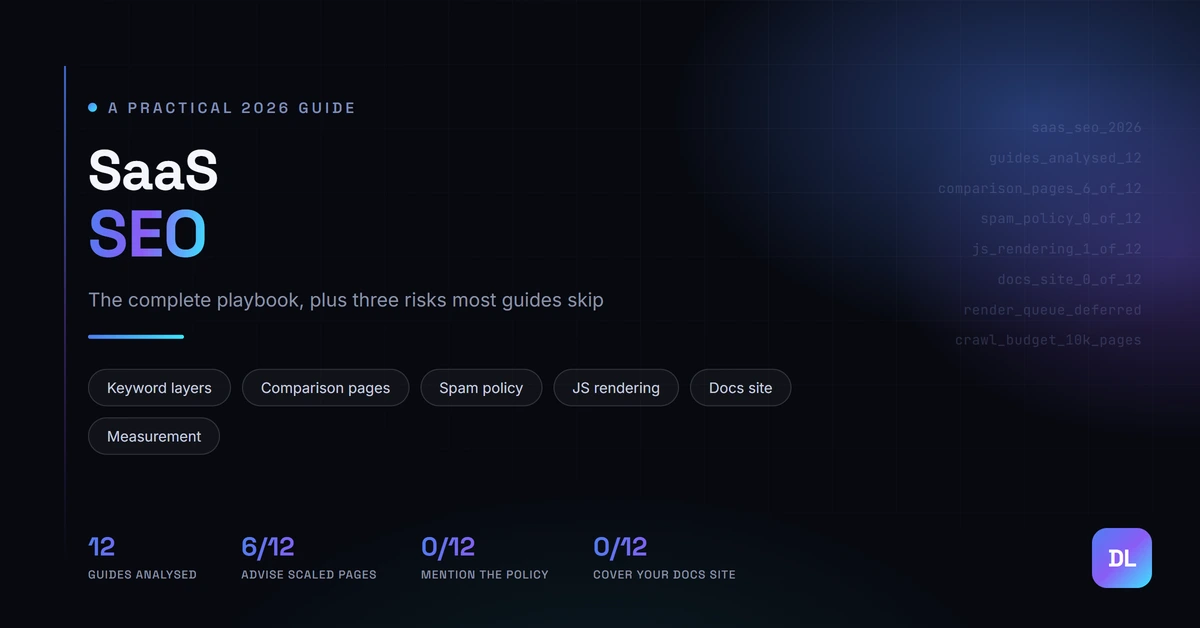
We read twelve SaaS SEO guides before writing this one. Six of them tell you to build comparison and alternatives pages at scale. Not one mentions that Google’s spam policies define doorway abuse as pages “created to rank for specific, similar search queries,” which is close to a description of that tactic. One of the twelve discusses JavaScript rendering, despite most SaaS marketing sites being React applications. None discusses your documentation site, which is usually the largest set of pages you own. This guide covers the standard playbook, then those three gaps.
There is no shortage of SaaS SEO advice. There is a shortage of SaaS SEO advice that tells you where the tactics stop working, or where they start being risky.
Before writing this, we pulled twelve of the most visible guides on the topic and counted what each one covers at the heading level. The results were consistent to the point of being funny. Twelve out of twelve cover measurement. Eleven cover technical SEO. Ten cover keyword research. Ten cover link building. Eight now cover AI search, which was a differentiator about a year ago and is table stakes today.
Three subjects were almost entirely missing, and all three carry real money.
This guide covers the standard playbook properly, because you need it, and then spends most of its length on the parts nobody wrote. At Digital Lamar we run search programmes for software companies across Pakistan, the UAE and the United States, and the three gaps below are where we most often find a SaaS site quietly losing.
Why SaaS SEO Is a Different Job
SaaS SEO is the practice of growing organic search visibility for a software product, where the conversion is a trial, a demo or a signup rather than a purchase. The mechanics of search are identical to any other sector. What differs is the shape of the buying process and, more importantly, the shape of the website.
Three structural differences matter more than anything else. First, the product is the destination, so the distance between a page and a signup is short, and the pages that matter most are often product and use-case pages rather than blog posts. Second, buyers compare relentlessly, which is why comparison content dominates SaaS SEO advice. Third, and this is the one nobody accounts for, a SaaS company usually operates several distinct web properties at once: a marketing site, a blog, a documentation site, a changelog, sometimes a community, and the application itself. Each has its own technology, its own team, and often its own subdomain.
That last point is the root of most SaaS SEO problems we see.
An ecommerce store has one website. A SaaS company has four, built by different people, and only one of them belongs to marketing. The other three still compete in search, still consume crawl budget, and still shape what Google believes the company is about. If you have ever wondered why a help article outranks your product page, that is the reason. The foundations of all this sit in ordinary technical SEO, but the multi-property structure is specific to software companies.
The Five Keyword Layers That Actually Matter
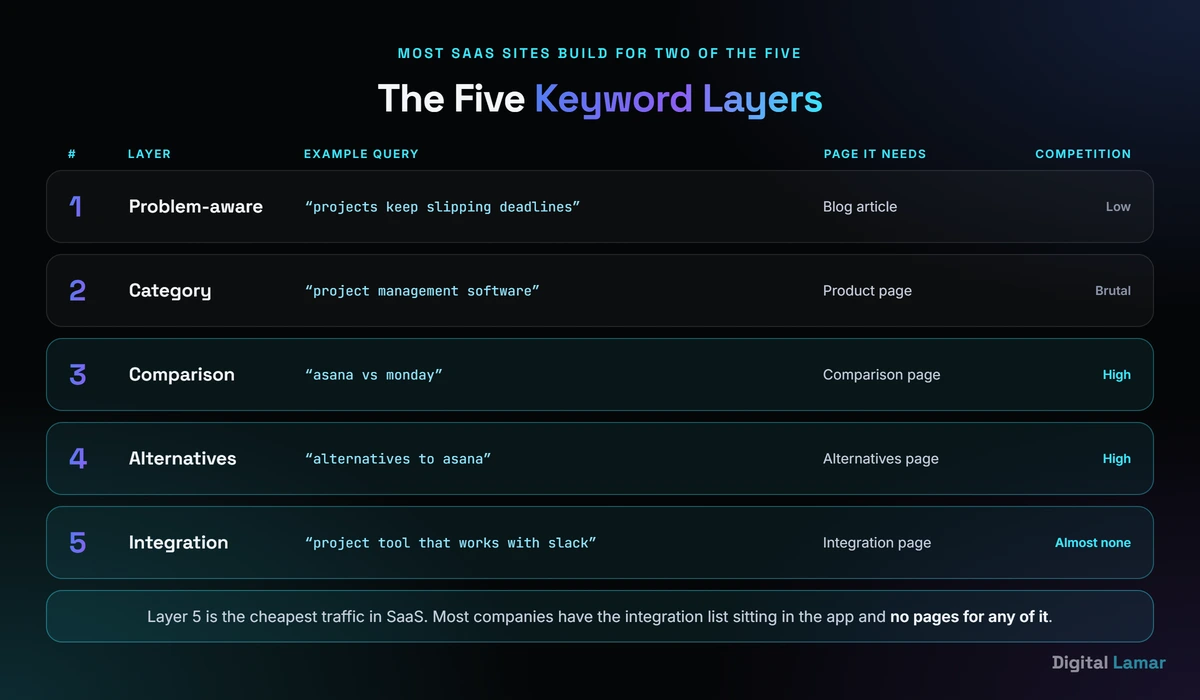
Each layer needs a different page type. Most SaaS sites build for two of the five.
Keyword research for SaaS fails when it treats all queries as one pool sorted by volume. Buyers arrive through five distinct layers, and each one demands a different kind of page.
Problem-aware queries describe the pain, not the product. Someone searching how to stop a spreadsheet from breaking does not know your category exists. Category queries name the software type, which is where most SaaS SEO effort concentrates and where competition is fiercest. Comparison queries pit two named products against each other. Alternatives queries look for a replacement, usually after a price rise or a bad experience. Integration and use-case queries ask whether the product works with a specific tool or for a specific job.
A worked example makes the difference concrete. Take a project management tool. The problem-aware query is something like “how to stop projects slipping deadlines,” and it wants an article, probably on the blog, that never mentions the product until the end. The category query is “project management software,” which wants a product page and will be brutally contested by companies with a hundred times the domain authority. The comparison query names two products. The alternatives query names one. And the integration query, “project management tool that works with Slack,” wants a dedicated page that most companies never build despite it being the easiest layer to win.
That last observation is worth sitting with.
Integration pages are cheap to produce, carry genuine commercial intent, face almost no competition, and map directly onto something your product actually does. Most SaaS companies have a list of integrations sitting in their app with no corresponding pages on their marketing site. It is the closest thing to free traffic available in this sector, and it is routinely ignored in favour of fighting for the category term.
The last two layers are where SaaS SEO earns its reputation, and they are also where it gets dangerous.
Comparison and alternatives queries convert extraordinarily well because the searcher has already decided they need something in your category. The problem is that this observation leads directly to a tactic that most guides recommend and none of them examines. We will get to that in two sections. First, the tactic itself, described honestly, because it does work when it is done properly.
Comparison and Alternatives Pages: The Standard Play
The standard advice runs like this. Identify every competitor in your category. Build a page for each one in the form “your product versus competitor,” and a second page in the form “alternatives to competitor.” Populate each with a feature table, pricing, and a recommendation that happens to be you. Repeat until you have covered the category.
Done well, this is legitimately one of the highest-return things a SaaS company can do in search. The queries carry commercial intent, the searcher is deep in evaluation, and the competitor is often not defending their own brand plus the word alternatives.
Done at volume with a template, it becomes something else.
The failure mode is easy to describe. A team builds a page generator, feeds it a list of eighty competitors, and publishes one hundred and sixty pages in an afternoon. Every page has the same four paragraphs of introduction, the same feature table with two rows swapped, and the same closing pitch. The only genuinely unique content on each page is the competitor’s name. That is where the tactic crosses a line, and it is a line Google has written down.
The Spam Policy Nobody Mentions
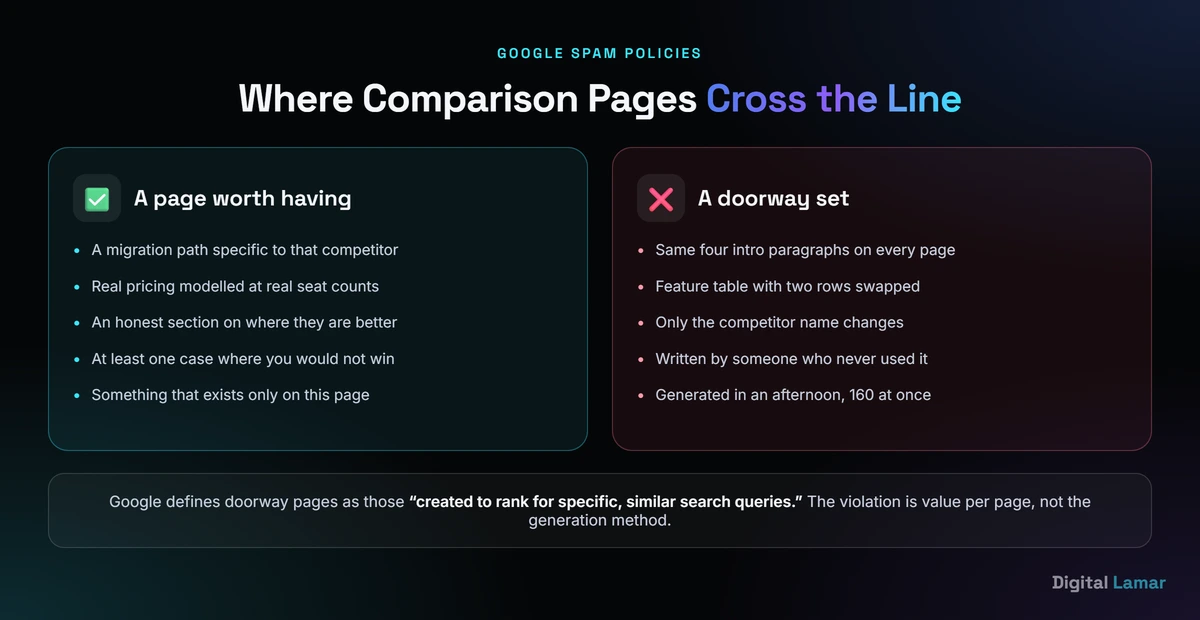
Same tactic, two sides of a line Google has published.
The finding that prompted this guide
Six of the twelve SaaS SEO guides we analysed recommend building comparison and alternatives pages at scale. Zero of the twelve mention Google’s spam policies. The tactic is universally advised and the constraint on it is universally omitted.
Google publishes two definitions that bear directly on this, and neither is obscure.
Google’s spam policies define scaled content abuse as a situation where “many pages are generated for the primary purpose of manipulating search rankings and not helping users,” and explicitly include “using generative AI tools or other similar tools to generate many pages without adding value for users.” The same document defines doorway pages as “sites or pages created to rank for specific, similar search queries” that “lead users to intermediate pages that aren’t as useful as the final destination.”
Read that second definition again with a programmatic set of one hundred and sixty near-identical comparison pages in mind. It is uncomfortably close.
Here is the part that resolves it, and it is the part worth internalising. The policy does not prohibit generating pages programmatically. The violation is defined by purpose and value, not by method. Google’s own framing is that the problem is pages made “primarily for the purposes of manipulating ranking signals” or produced “without adding value for users.” Generation at scale is not itself the offence.
Which turns an anxious question into a practical test.
The question is not “how many comparison pages can I safely publish.” It is “does each page contain something a reader could not get from the other pages.” If page forty differs from page thirty-nine only by a product name, you have built a doorway set. If page forty contains a genuine migration path, real pricing at real seat counts, an honest account of where the competitor is better, and a use case where the choice actually flips, you have built one hundred and sixty useful pages and the count is irrelevant.
What does a defensible comparison page actually contain? In our experience, four things that a template cannot generate. A migration path specific to that competitor, including what breaks and what data does not transfer. Real pricing modelled at real seat counts, since headline pricing rarely survives contact with a quote. An honest section on where the competitor is genuinely better, which is the part everyone omits and the part that makes the rest credible. And at least one scenario where you would recommend the competitor instead.
That fourth item sounds commercially insane. It is the strongest thing on the page.
A reader who finds one honest recommendation against your own product will believe everything else you wrote. A reader who finds a page where you win on all fourteen rows of a feature table believes none of it, and neither does a search engine assessing whether the content demonstrates first-hand experience.
In practice that means far fewer pages than the templated approach produces, each of them substantially longer, and a hard rule that no page ships without at least one section that exists only on that page. It is slower. It is also the difference between an asset and a liability. It is also the single most common thing we are asked to unpick after a traffic drop, and reviewing a page set before it is published is considerably cheaper than removing it afterwards.
One further note, because the same policy covers it. Google’s guidance on creating helpful, reliable, people-first content asks whether content demonstrates first-hand expertise and whether a reader would feel they need to search again after reading it. A comparison page written by someone who has never used the competitor fails both tests, regardless of how it was generated.
Your Marketing Site Is Probably a React App
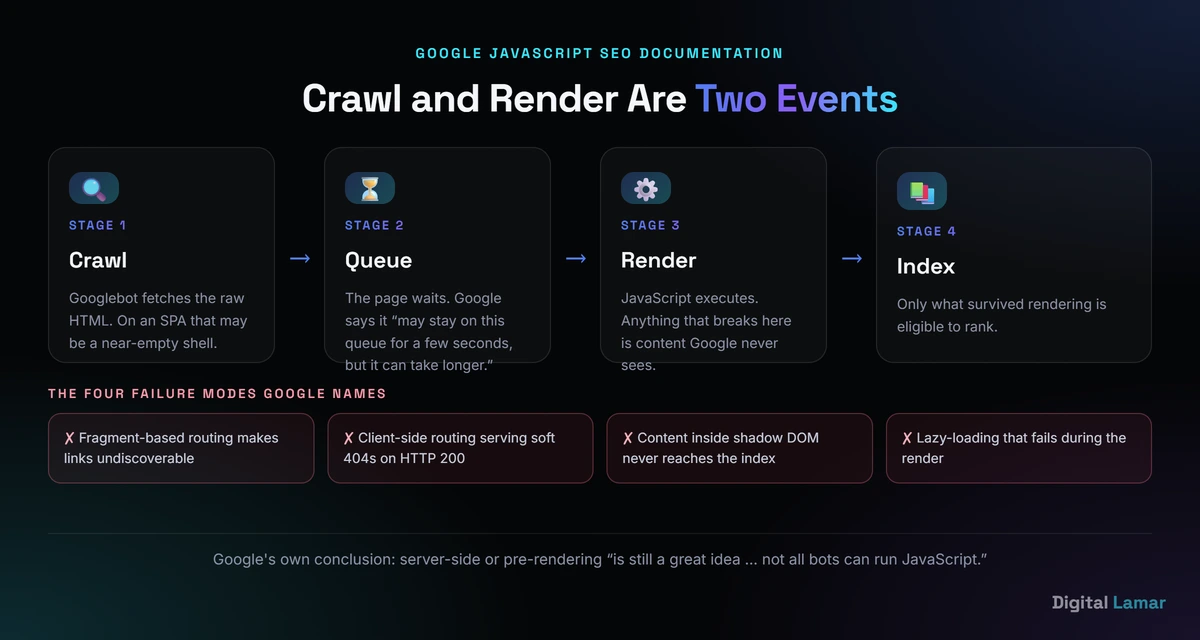
Crawling and rendering are separate stages, and the gap between them is where SPA pages disappear.
Only one of the twelve guides we read discusses JavaScript rendering. Meanwhile the overwhelming majority of SaaS marketing sites are built in React, Next.js, Vue or something similar, frequently by the same engineering team that builds the product.
The bit that surprises engineers
Google does not render your JavaScript at the moment it crawls the page. Google’s own documentation states that a page enters a rendering queue and “may stay on this queue for a few seconds, but it can take longer than that.” Crawling and rendering are separate events, separated by an indefinite gap.
Crawl and render are two events, not one.
That single fact explains a great deal of otherwise baffling SaaS SEO behaviour. A page that returns a nearly empty HTML shell and populates itself with JavaScript is not invisible to Google, but it is deferred. Anything that breaks during that deferred render is content Google never sees.
Google’s documentation names the specific failure modes, and each maps to something SaaS teams do routinely.
Fragment-based routing. URLs built with hash fragments cannot be reliably resolved, which makes the links undiscoverable. Soft 404s from client-side routing. A single-page application handling its own routing will often serve a “not found” screen while returning HTTP 200, which Google interprets as an ambiguous error state. Shadow DOM content. Content inside shadow DOM may not appear in the rendered HTML at all. Lazy-loading done incorrectly, which prevents images loading during the render.
Google’s own conclusion is direct: server-side or pre-rendering “is still a great idea because it makes your website faster for users and crawlers, and not all bots can run JavaScript.”
That last clause deserves attention in 2026. Googlebot renders JavaScript. Many AI crawlers do not, or do so less reliably. A marketing site that depends on client-side rendering may be indexed adequately by Google and be close to invisible to the systems increasingly used to shortlist software.
There is a one-minute test for this, and every SaaS marketer should run it today.
The practical check takes about a minute and requires no tools. Open one of your key pages, view source rather than inspect element, and search the raw HTML for a sentence you can see on the screen. If the sentence is not in the source, that content is render-dependent, and everything above applies to it.
Now do the same for your internal links.
If the navigation is generated client-side, the links Google uses to discover the rest of your site may not exist in the initial HTML either. A rendering issue quietly becomes a discovery issue, and pages that were never linked in raw HTML simply do not get found. This is how a site with two hundred good pages ends up with forty in the index and no obvious explanation.
Then check Search Console’s URL Inspection tool on the same page and compare the rendered HTML it reports against what you see in the browser. That comparison is the closest thing to seeing your site through Googlebot’s eyes, and it is free.
None of this is exotic. It is just invisible from a marketing dashboard.
Fixing this is usually an engineering decision rather than a marketing one, which is exactly why it goes unaddressed for years. The marketing team cannot change the rendering strategy, and the engineering team has never been told it affects revenue. Framing it as a pipeline problem rather than an SEO problem is often the only thing that moves it.
Your Docs Site Is Your Largest SEO Surface
Not one of the twelve guides mentions documentation. This is the gap that surprised us most, because for a mature SaaS company the docs site is frequently the largest set of pages the business owns, often by an order of magnitude.
A marketing site might run to eighty pages. A documentation site with an API reference can run to several thousand, generated automatically, updated constantly, and maintained by engineers who have never been asked to think about search. Nobody in the company thinks of it as marketing surface, and Google makes no such distinction. Every one of those pages is a page on your domain, carrying your name, competing for your crawl budget and shaping what search engines conclude your business is about.
Two consequences follow, and they pull in opposite directions.
The first is that documentation is often your best-performing organic content, and nobody planned it. Developers search for exact error strings, method names and integration steps, and they land on your docs. That traffic is qualified, high-intent and completely unmanaged in most companies. It rarely links anywhere commercial, so it converts at close to zero despite being the strongest signal of active evaluation you will ever get.
The second consequence is less pleasant, and it involves crawl budget.
Google’s guidance on managing crawl budget for large sites states that it becomes a genuine consideration for sites with over one million pages, or over ten thousand pages “with very rapidly changing content.” An auto-generated API reference that redeploys on every release lands squarely in the second category. The same document lists what wastes the budget: duplicate URLs, soft 404 pages, long redirect chains, and pages carrying noindex that Google crawls before discarding.
A versioned documentation site can produce all four at once. Version 1, version 2 and version 3 of the same page are near-duplicates. Deprecated endpoints often return soft 404s. Version redirects chain. And teams frequently apply noindex to old versions, which stops them being indexed but does not stop them being crawled.
Google’s canonicalization guidance is the tool for the duplicate half of this, and its stated purpose is precisely this problem: specifying a canonical helps “avoid spending crawling time on duplicate pages” so Googlebot can concentrate on new and updated content instead. For a versioned docs set, that means canonicalising older versions to current, not merely noindexing them.
The commercial half is easier, and almost nobody does it.
The commercial fix is simpler than the technical one. Documentation pages should link to the relevant product page, the pricing page and support, in a consistent template. Most docs sites link only to other docs, which means your highest-intent audience arrives, gets its answer, and leaves without ever seeing a commercial page.
Where Everything Should Live
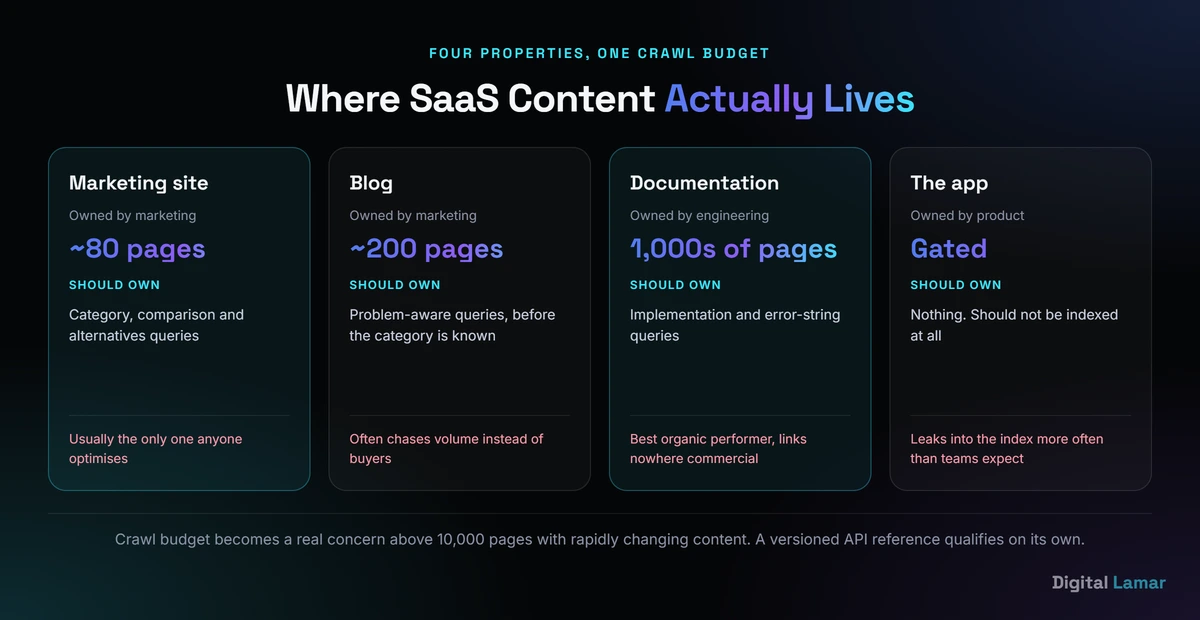
Four properties, four different jobs, and one crawl budget between them.
Once you accept that a SaaS company runs several web properties, the architecture question becomes unavoidable: what sits on the main domain, and what sits on a subdomain.
It is worth being accurate about what Google actually says here, because a great deal of confident advice exists on this topic and very little of it is sourced. Google’s URL structure guidance does not state a preference between subdomains and subdirectories. It recommends readable URLs using words rather than identifiers, hyphens between words, and minimising parameters that generate duplicate content. That is the extent of the official position.
So anyone telling you Google penalises subdomains is going beyond the documentation.
The reason the myth persists is that people observe a real effect and misattribute the cause. Sites do frequently see documentation on a subdomain underperform, and the explanation is usually mundane: the subdomain has almost no internal links pointing at it, it was launched years after the main site, and nobody has ever built a link to it deliberately. Move that same content to a subdirectory and it inherits an existing link graph overnight. The gain is real. It just has nothing to do with a penalty, and understanding which of the two is happening determines whether a migration is worth the engineering cost.
What can be said with more confidence is practical rather than algorithmic. Content on a subdirectory shares the domain’s history and internal linking automatically. Content on a subdomain needs its own links and its own accumulation of signals. For a blog that exists to support the product, a subdirectory removes friction. For documentation on a completely different platform, a subdomain is often the only realistic option, and that is a reasonable trade rather than a mistake.
The decision that matters more than either is which property owns which query type. Category and comparison queries belong to the marketing site. Problem-aware queries belong to the blog. Implementation queries belong to documentation. When two properties target the same query, the weaker one usually wins, because documentation tends to match the literal wording of a search more closely than a marketing page does.
Content and Authority, Briefly
This section is short on purpose. Ten of the twelve guides cover keyword research, ten cover link building, and nine cover funnel mapping. There is little we can add, so we will not pretend otherwise.
The parts that hold up across everything we read: build content around the five layers rather than around volume; publish for the problem-aware layer to reach people before they know your category exists; and treat integration and use-case pages as product pages rather than blog posts, since they carry commercial intent and belong in the site structure accordingly.
On authority, the SaaS-specific observation worth making is that your product is frequently your best link asset. Free tools, calculators, open datasets and genuinely useful templates earn links from people who have no interest in linking to your blog. That is a link-building strategy an engineering team can execute, which is unusual and underused.
If you want the fundamentals underneath all of this, our guide to what SEO actually is covers how ranking works from the ground up, and Google Ads vs SEO covers the sequencing question when budget is limited.
AI Search: What Changes and What Doesn’t
Eight of the twelve guides now cover AI search, so this is no longer a differentiator and we will not pad it out as though it were.
The short version: most of what earns a citation in an AI answer is work you are already doing. Consistent factual information across the web, content that answers real questions in plain language, and structured data that makes claims machine-readable all feed both systems. This is the substance of generative engine optimization, and it overlaps heavily with conventional search work.
Two things are genuinely SaaS-specific and worth acting on.
Buyers increasingly shortlist software by asking an assistant, which means the answer is assembled from third-party sources rather than from your site. Whatever review sites, community threads and comparison articles say about you is doing the talking. And the rendering problem described earlier compounds here, because a client-rendered marketing site is harder for non-Google crawlers to read at all. Digital Lamar built its AI search optimization practice around that gap, and for software companies it is mostly an accuracy and structure problem rather than a content volume problem.
Measuring It: Pipeline, Not Sessions
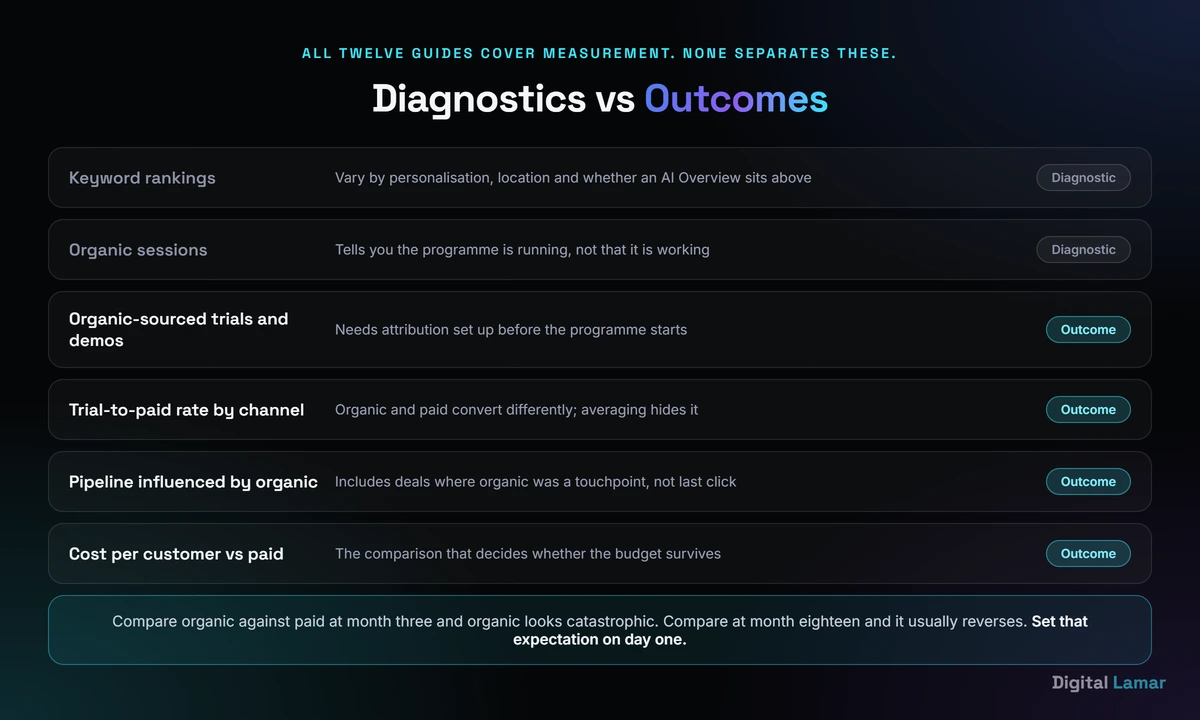
Every guide covers measurement. Almost none separates the vanity layer from the pipeline layer.
All twelve guides cover measurement, which tells you it is important and tells you nothing about how to do it. The distinction that matters is between metrics that describe search performance and metrics that describe business performance.
Rankings and sessions belong to the first group. They are diagnostics, useful for telling you whether the SEO programme is functioning, and close to useless for telling you whether it is working. Rankings in particular have become an unreliable measure, since results now vary by personalisation, location and whether an AI Overview occupies the space above them.
The metrics that describe the business are these. Organic-sourced trials or demos, which requires attribution set up before the programme starts rather than retrofitted. Trial-to-paid rate by acquisition channel, because organic trials frequently convert at a different rate to paid ones and averaging them hides the difference. Pipeline influenced by organic, including deals where organic was a touchpoint rather than the last click. And cost per acquired customer from organic, compared honestly against paid, including the salary cost of everyone producing the content.
That last comparison is the one most SaaS teams avoid, and it is the one that determines whether the programme survives a budget review.
There is a timing problem buried in it, though, and it is worth naming before someone uses the numbers against you. Paid acquisition reports its cost per customer immediately. Organic reports nothing for months, then reports a number that keeps improving as the content compounds. Comparing them at month three makes organic look catastrophic. Comparing them at month eighteen usually reverses the picture entirely.
Set that expectation at the start or the programme dies at month four.
The other measurement habit worth building is segmenting by page type rather than by keyword. Group your pages into comparison, alternatives, integration, use-case, blog and documentation, then look at trials sourced per group. Most SaaS teams discover that one group produces almost everything and another produces nothing at all, which changes where the next quarter’s effort goes far more usefully than any keyword report.
That one exercise reorders most roadmaps.
One practical note on the current landscape. Google’s rollout of intermediate redirect URLs in August 2026 has disrupted third-party rank tracking across the industry. If your reporting depends on a rank tracker, expect gaps. Search Console is first-party and unaffected, which makes it the more reliable source for query-level performance regardless.
In-House or an Agency
Some of this work only functions inside the company. Product knowledge cannot be outsourced, and a comparison page written by someone who has never used your software will read like one. Documentation belongs to engineering. The genuinely differentiated content, the part that no competitor can copy, comes from people who talk to your customers.
Everything else is a question of access, not talent.
The parts that tend to justify outside help are the ones with a steep learning curve and an expensive failure mode: the technical rendering audit, the crawl budget and canonicalisation work on a large docs set, the judgement call on where a programmatic page set sits relative to the spam policies, and AI visibility auditing.
The staffing question is simpler than most agencies make it sound.
The honest test is whether someone in the company can own this for several hours a week, every week, for at least a year, and whether that person has the technical access to change how pages render. If the answer to either is no, the work does not get done regardless of who is nominally responsible.
When software companies do bring in help, category experience matters less than technical depth here, because the three sections above are engineering problems wearing marketing clothes. Digital Lamar works as a saas marketing agency across exactly those constraints, and the fastest diagnostic is usually the crawl and render audit rather than a keyword report. If you want the search foundations underneath it handled as a programme, that is what our SEO (Search Engine Optimization) work covers.
Key Takeaways
- Across twelve SaaS SEO guides analysed in August 2026, six recommend building comparison and alternatives pages at scale and none mentions Google’s spam policies, which define doorway abuse as pages “created to rank for specific, similar search queries.”
- The policy does not prohibit programmatic pages. The violation is purpose and value, not method. The working test is whether each page contains something a reader could not get from the others.
- Google renders JavaScript in a queue, and its documentation says a page “may stay on this queue for a few seconds, but it can take longer than that.” Crawling and rendering are separate events.
- Google names four SPA failure modes specifically: fragment-based routing, soft 404s from client-side routing, shadow DOM content, and broken lazy-loading. Its own advice is that server-side or pre-rendering “is still a great idea.”
- None of the twelve guides mentions documentation, despite it usually being the largest set of pages a SaaS company owns and often its best organic performer.
- Crawl budget becomes a real concern above one million pages, or above ten thousand “with very rapidly changing content.” A versioned, auto-generated API reference qualifies.
- Google’s URL structure guidance states no preference between subdomains and subdirectories. Anyone claiming a penalty is going beyond the documentation.
- Measure organic-sourced trials, trial-to-paid by channel, influenced pipeline and cost per acquired customer. Rankings and sessions are diagnostics, not outcomes.
Want to know whether your comparison pages are assets or liabilities, and whether Google can actually render your marketing site? Digital Lamar audits both.
Book a free 30-min strategy callFrequently Asked Questions
What is SaaS SEO?
SaaS SEO is the practice of growing organic search visibility for a software product, where the conversion is a trial, demo or signup rather than a purchase. The search mechanics are the same as any sector. What differs is that buyers compare relentlessly, the product itself is the destination, and a SaaS company typically runs several web properties at once, including a marketing site, blog, documentation and the application, all of which compete in search and share one crawl budget.
Are comparison and alternatives pages safe to build at scale?
They are safe when each page carries genuine, distinct value, and risky when it does not. Google’s spam policies define doorway pages as those “created to rank for specific, similar search queries,” and scaled content abuse as many pages generated primarily to manipulate rankings without helping users. Crucially, the policy does not prohibit programmatic generation. The test is whether page forty contains something a reader could not get from page thirty-nine. If the only difference is a product name, that is a doorway set.
Does Google have a problem indexing React or Next.js sites?
Not inherently, but rendering is deferred. Google’s documentation states that pages enter a rendering queue and may stay there longer than a few seconds, so crawling and rendering are separate events. Problems arise from specific implementations that Google names: fragment-based routing, soft 404s produced by client-side routing, content inside shadow DOM, and incorrectly implemented lazy-loading. Google’s own recommendation is that server-side or pre-rendering remains a good idea, partly because not all bots run JavaScript at all.
Should our documentation live on a subdomain or a subdirectory?
Google’s URL structure guidance expresses no preference between the two, so anyone claiming a ranking penalty for subdomains is going beyond the documentation. The practical difference is that subdirectory content inherits the domain’s internal linking and history automatically, while a subdomain accumulates its own. If your docs run on a separate platform, a subdomain is usually the only realistic option and that is a reasonable trade. What matters more is which property targets which query type.
Is SEO still worth it for SaaS in 2026?
Yes, though the work has changed shape. Rankings have become a less reliable measure because results vary by personalisation, location and whether an AI Overview sits above them. The channels that feed AI answers overlap heavily with conventional search work, so the underlying investment serves both. What has genuinely changed is that accuracy and structure now matter as much as content volume, since buyers increasingly shortlist software by asking an assistant that assembles its answer from third-party sources.
How should a SaaS company measure SEO?
Separate the diagnostics from the outcomes. Rankings and sessions tell you whether the programme is functioning. Organic-sourced trials and demos, trial-to-paid rate by acquisition channel, pipeline influenced by organic, and cost per acquired customer compared against paid tell you whether it is working. Attribution has to be set up before the programme starts rather than retrofitted afterwards. Note also that Google’s August 2026 redirect rollout has disrupted third-party rank tracking, which makes Search Console the more reliable source.