

On this page
In short
A growing share of US startups now outsource digital marketing to Pakistani agencies, and the driver isn’t just “it’s cheaper.” Pakistan ranked 16th globally in the 2026 Global Outsourcing Talent Index, ahead of the UK, the US, and Japan, with the second-highest labor cost score of any country measured. Combined with heavy timezone overlap and a marketing talent pool that’s grown fast enough to notice, the math has shifted from “acceptable tradeoff” to genuinely competitive. This guide covers the real numbers, the honest concerns, and how to actually start.
A Series A founder in Austin recently ran the numbers on hiring a marketing lead. The recruiter’s shortlist started at $165,000 in base salary, before benefits, before a laptop and a software stack, before the four months it would likely take to find someone good and get them ramped up. That’s not an unusual number. It’s the median outcome of trying to hire senior marketing talent in the US in 2026.
What’s changed is what happens next. A few years ago, the alternative to that budget line was simple: hire junior, hire slow, or don’t hire at all. Today, a growing number of founders are quietly doing something else entirely: building their marketing function with a Pakistani agency instead, and getting senior-level output for a fraction of that first quote.
This isn’t a story about cutting corners. It’s a story about arithmetic, and about one country in particular that keeps showing up at the center of it. (If you’re still getting oriented on what a digital marketing agency does in the first place, that’s worth a quick read first; this piece assumes that baseline.)
The Real Math Behind Outsourcing
Here’s the number that starts every one of these conversations.
The median wage for a marketing manager in the US is $138,730 a year, according to the US Bureau of Labor Statistics. Add the standard 30 to 40% that benefits, payroll taxes, and equipment tack on, and the fully loaded cost of one hire lands closer to $180,000 to $190,000 a year. For a startup watching runway, that’s a serious commitment for one person with one or two core skills.
Outsourcing doesn’t just shrink that number. It reshapes what the money buys.
In Deloitte’s 2024 Global Outsourcing Survey, 25% of executives reported measurable reductions in vendor service costs from outsourcing arrangements. The more telling figure sits right next to it: 80% said they planned to maintain or increase their third-party outsourcing investment going forward. Executives aren’t holding steady on outsourcing because it’s a nice-to-have they’re testing. They’re increasing it because the return has already proven itself across multiple budget cycles, and that kind of sustained commitment from finance teams doesn’t happen on a hunch.
| Option | Annual cost (US) | Skills covered | Time to full output |
|---|---|---|---|
| One US marketing hire | $180,000-$190,000 | 1-2, generalist or specialist | 3-6 months (hire + ramp-up) |
| Outsourced Pakistani team | Typically less than one hire | Full stack: strategy, SEO, content, paid, design | 2-4 weeks |
The gap in that table is the whole argument. A loaded US hire buys one person guessing across disciplines they may not have mastered yet. An outsourced Pakistani team arrives already assembled, with a strategist, an SEO specialist, a content writer, a paid media manager, and a designer each doing the part of the job they’re actually best at. No recruiting cycle eating a quarter of the year. No single point of failure if one person quits mid-campaign. For the broader case on hiring an agency at all versus building in-house, we’ve laid out the full argument in why hire a digital marketing agency; this piece focuses specifically on why Pakistan wins that math.
Why Pakistan, Specifically
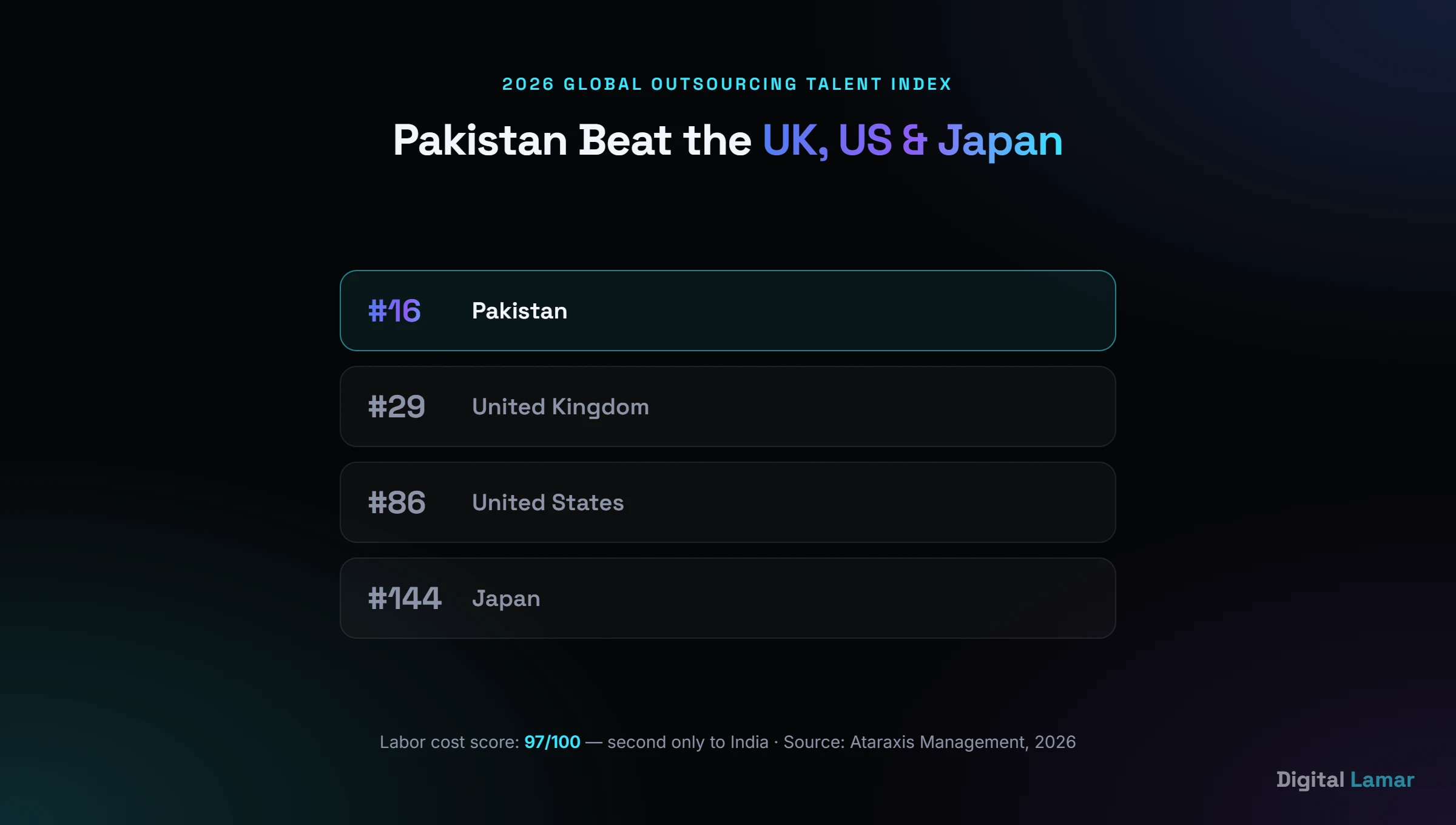
Pakistan didn’t just make the list. It beat three of the biggest economies on it.
Outsourcing itself isn’t new. What’s newer is Pakistan’s position on the list of places to do it. The 2026 Global Outsourcing Talent Index, compiled by Ataraxis Management across 177 countries, placed Pakistan at 16th overall. The United Kingdom ranked 29th. The United States ranked 86th. Japan ranked 144th.
Did you know
Pakistan outranked the US, the UK, and Japan in the 2026 Global Outsourcing Talent Index, driven largely by a labor cost score of 97 out of 100, second only to India’s 96.
Source: Ataraxis Management, Global Outsourcing Talent Index 2026That ranking isn’t built on cost alone, though cost is a major piece of it. The index scores countries on talent availability, labor cost, digital infrastructure, and English proficiency, and Pakistan scored 80 out of 100 on talent availability, ahead of every EU country, every Middle Eastern nation, and every African economy included in the study. Pakistan’s IT and IT-enabled services exports back that up with real trade data: they rose 19.7% to $3.38 billion in the first nine months of fiscal year 2025-26 alone, according to Pakistan’s INP WealthPK. That’s not a market someone is speculating about. It’s one that’s already being paid for, at scale, by clients who keep coming back.
What US Startups Actually Get
Cost is the number that gets a founder’s attention, but it isn’t the reason engagements last. Three things tend to make the difference between outsourcing that works and outsourcing that quietly fails.
The first is timezone overlap, and it’s better than most founders expect. Pakistan Standard Time sits nine to ten hours ahead of US Eastern Time, which means a Pakistani team’s evening hours land squarely inside a US team’s morning. Standups, campaign reviews, and creative feedback loops can happen live rather than over an asynchronous 24-hour delay, which is the single biggest difference between working with a Pakistani agency and working with a team on the other side of the planet.
Compare that to a team in the Philippines or India working purely night-shift hours to catch a US afternoon, or one in Eastern Europe with barely any overlap at all. Pakistan’s geography happens to land in a genuinely useful middle ground.
The second factor is English proficiency at a working level across marketing specifically, not just customer support. Copywriting, client calls, and campaign strategy conversations don’t need a translation layer in between, which matters more than it sounds. A campaign brief that loses nuance in translation costs a client real money before a single ad even runs.
The third is deliverable parity. A well-run Pakistani agency runs the same tools a US agency would: Semrush, Google Ads, HubSpot, the same analytics stack, and produces work built to US market conventions rather than a generic template adapted after the fact. Underneath both of those is a fourth, quieter factor: Pakistan’s population skews young, and a large, steady pipeline of university graduates has been entering tech and marketing roles for over a decade now. That’s part of why the talent availability score in the outsourcing index above wasn’t a fluke.
The Honest Concerns (and What Actually Addresses Them)
Any credible guide to outsourcing has to deal with the real objections, not wave past them. Here are the four that come up in nearly every founder conversation, addressed straight.
Will the quality actually hold up? This is fair, and it’s also the easiest to verify before signing anything. Ask for case studies with real numbers attached, not testimonials. Ask who specifically will work on the account. A serious agency answers both without hesitation; our full vetting framework, including the exact questions to ask, is in how to choose a digital marketing agency.
What about communication and culture fit? This is where the timezone overlap and English proficiency covered above do most of the work. The gap that actually causes friction isn’t language, it’s process: agencies that document scope, run structured weekly reviews, and put deliverables in writing avoid almost all of the miscommunication founders worry about upfront.
Is data and IP safe? With the basics in place, yes: signed NDAs, contracts assigning all work product to the client, and access limited to what each person actually needs. None of that is unique to offshore work. It’s just what a competent agency does.
What about infrastructure reliability? This is the one honest weak point in Pakistan’s outsourcing profile: the Ataraxis index scored the country just 30 out of 100 on digital infrastructure, well below its talent and cost scores. In practice, established agencies mitigate this the same way any serious remote team does: redundant internet connections, cloud-based project tools that don’t depend on a single local server, and backup power. It’s worth asking a prospective agency directly how they handle it, and a straight answer is a good sign in itself.
How to Actually Start
Founders who get the most out of an outsourced marketing relationship tend to follow a similar pattern. Start with a scoped pilot, typically 60 to 90 days, rather than a multi-year commitment out of the gate. Define two or three measurable outcomes for that pilot up front: qualified leads, organic traffic growth, or a specific campaign launch, so both sides know what success looks like before work begins.
Schedule a standing weekly call inside the overlap window (US morning, Pakistan evening) and insist on it from week one. Put deliverables and deadlines in writing, every time. Then scale only after the pilot proves itself, not before.
A typical 90-day pilot breaks down cleanly: the first 30 days cover audit, research, and strategy; the next 30 build out the actual campaigns, content, or technical work; the final 30 focus on optimizing what’s live and proving the results in a report that ties back to leads or revenue, not just activity. If an agency can’t describe its own version of that arc before you sign anything, that’s worth noticing.
This is the same discipline that makes any agency relationship work, US-based or otherwise. It just matters more when the working relationship is new and the team is remote, because the first pilot is doing double duty: proving the marketing works, and proving the partnership works.
Key Takeaways
- A fully loaded US marketing hire runs $180,000 to $190,000 a year for one person with 1-2 skills (BLS, 2026).
- Pakistan ranked 16th globally in the 2026 Global Outsourcing Talent Index, ahead of the UK, US, and Japan, with a 97/100 labor cost score.
- 80% of executives plan to maintain or increase outsourcing investment (Deloitte, 2024), a stronger signal than the 25% already reporting cost savings.
- Timezone overlap (Pakistan evening = US morning) and English-proficient teams remove the two biggest practical objections to offshore work.
- The honest weak point is digital infrastructure (30/100 on the same index), addressed in practice through redundant connections and cloud-based tooling.
- Start with a scoped 60-90 day pilot with defined outcomes before committing longer term.
This is exactly the model we run day to day: a Pakistan-based team built specifically to work as a digital marketing agency for US businesses, inside the overlap hours, on the same tools, held to the same reporting standard a US agency would be.
Curious what this would actually look like for your startup’s marketing?
Book a free 30-min strategy callFrequently Asked Questions
How do you outsource digital marketing to a Pakistani agency?
Start with a scoped pilot engagement of 60 to 90 days with two or three defined, measurable outcomes. Vet the agency on case studies with real numbers, confirm who specifically works on your account, and set a standing weekly call inside the timezone overlap window before committing to anything longer.
Why outsource your digital marketing instead of hiring in-house?
The core reason is coverage per dollar. A single US marketing hire costs $180,000 or more fully loaded and covers one or two skills. An outsourced team, particularly one based in a high-ranking outsourcing market like Pakistan, typically covers the full marketing stack (SEO, paid media, content, design) for less than that single salary.
Is Pakistan actually a good place to outsource digital marketing?
According to the 2026 Global Outsourcing Talent Index, yes: Pakistan ranked 16th out of 177 countries overall, ahead of the UK, US, and Japan, driven by a 97/100 labor cost score and an 80/100 talent availability score.
How much can a US startup save by outsourcing marketing to Pakistan?
Exact savings depend on scope, but the structural comparison is clear: a full outsourced marketing team commonly costs less than a single loaded US marketing hire, which runs $180,000 to $190,000 a year including benefits and tools.
What’s the working-hours overlap between the US and Pakistan?
Pakistan Standard Time runs roughly nine to ten hours ahead of US Eastern Time, which puts Pakistan’s evening hours inside the US morning. That’s enough for live standups and real-time feedback rather than fully asynchronous, 24-hour-delay communication.
Is it safe to share marketing data and brand assets with an offshore agency?
With standard safeguards, yes: NDAs signed before any access is granted, contracts that explicitly assign all work product to the client, and access controls limited to what each team member needs. These practices are standard for any serious agency, regardless of where it’s based.