

On this page
- Why SEO for Doctors Is Not Like SEO for Anyone Else
- What Patients Actually Type: The Five Query Types
- Local SEO for Doctors: The Biggest Single Lever
- The Practitioner Listing Most Practices Never Claim
- The Pages a Practice Website Actually Needs
- Schema Markup: What Exists, and What Doesn’t
- E-E-A-T and YMYL: Why Health Content Is Judged Hardest
- Reviews: A Conversion Filter and a Local Signal
- Why One SEO Playbook Doesn’t Fit Every Specialty
- Getting Cited by AI, and Where SEO Ends
- How to Measure It, and How Long It Takes
- Key Takeaways
- Frequently Asked Questions
In short
Two things most SEO advice for doctors gets wrong. First, there is no medical schema rich result: Google supports no Physician or MedicalClinic type, so practices marking up “medical schema” are marking up something that produces nothing. Second, individual doctors at a multi-practitioner location are entitled to their own Google Business Profile alongside the practice, which is the single largest untapped local lever most clinics have. This guide covers both in detail, plus the five query types patients actually use, why a surgeon’s SEO looks nothing like a paediatrician’s, and how long any of it realistically takes.
Most SEO guides written for doctors are the same guide with a stethoscope on the cover. Claim your listing, write some blog posts, get reviews, improve your page speed. All true, all generic, and none of it explains the parts of search that behave differently because you practise medicine.
Three things genuinely differ. Google holds health content to the strictest quality standard it applies to anything. Your competitive field is enormous, with roughly 839,000 physicians and surgeons in the United States according to the Bureau of Labor Statistics (2024 data). And the technical layer available to you is narrower than almost every article claims, because two of the tactics most commonly recommended to medical practices either do not exist or are described incorrectly.
That second point is where this guide starts, because it is the one you can act on this week.
At Digital Lamar we run search work for practices across Pakistan, the UAE and the United States, and the pattern is consistent: the practices that gain ground are not the ones publishing the most content. They are the ones whose technical and local foundations are actually correct, which is a much smaller and more achievable job than the average SEO guide implies.
Why SEO for Doctors Is Not Like SEO for Anyone Else
Search engines classify medicine as the highest-risk category of content they handle. In Google’s framework this is called Your Money or Your Life, and it means a page about a medical condition is assessed far more harshly than a page about, say, garden furniture. Google’s guidance on creating helpful, reliable, people-first content (Google Search Central, 2026) asks whether content is produced by someone with demonstrable expertise, and whether a reader would trust it enough to act on it. For a practice with real clinicians on staff, that requirement is an advantage rather than an obstacle, but only if the credentials are visible on the page rather than buried on an about page.
The second difference is regulatory. Under the HIPAA Privacy Rule’s marketing provisions, a covered entity must obtain written authorisation before using protected health information for marketing, per current HHS guidance under 45 CFR 164.508. In practical SEO terms this rules out publishing patient stories, before-and-after images or named testimonials without a signed authorisation, and it means you cannot confirm in a public review reply that a reviewer was ever your patient. Whole categories of content marketing that work in other industries are simply unavailable.
The third difference is geography. Almost nobody travels for routine care.
A national ranking for “knee pain treatment” is close to worthless if the reader lives four hundred miles away, which means the entire competitive game for most practices happens inside a radius of a few miles. That sounds limiting. It is actually the reason a small practice can beat a large hospital system in search, because within a tight radius the field is small enough to win.
What Patients Actually Type: The Five Query Types
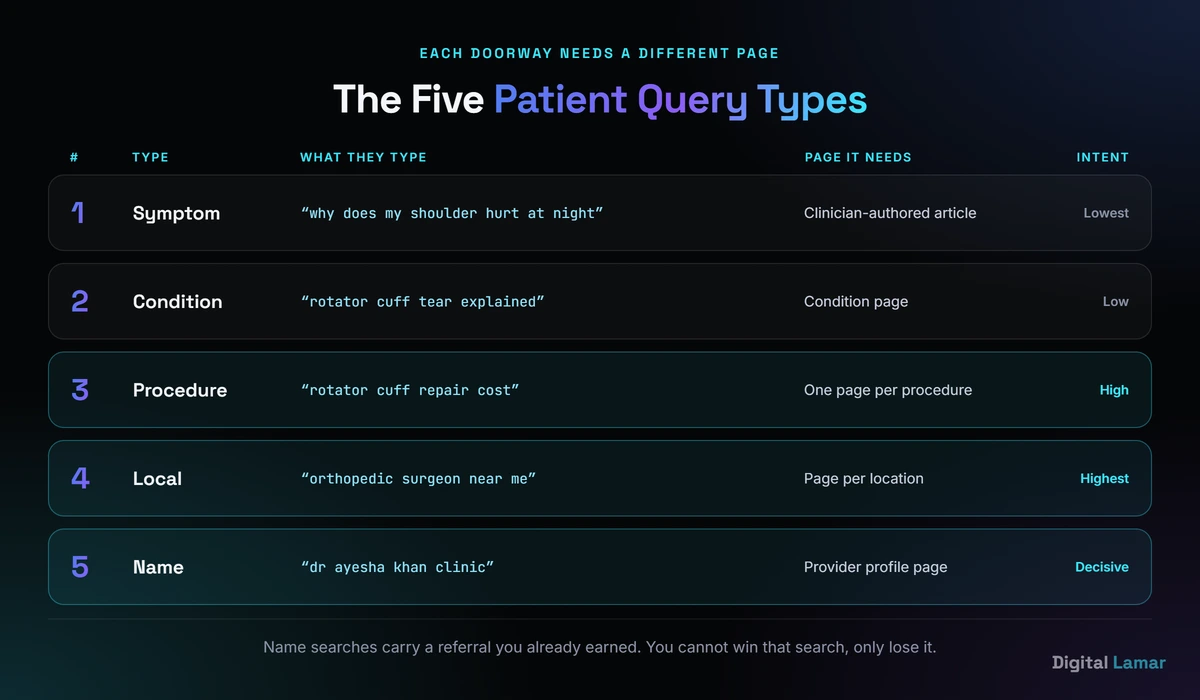
Each type needs a different page. Most practices only ever build for one of them.
Keyword research for a medical practice fails when it treats all searches as one pool. Patients arrive through five distinct doorways, and each one demands a different kind of page.
Symptom searches come first and convert last. Someone typing “why does my shoulder hurt at night” is not booking today, but they are forming an impression of who is authoritative. Condition searches are one step down the funnel: the person now has a name for the problem and wants to understand it. Treatment or procedure searches are where commercial intent appears, because someone searching a specific procedure has usually decided they need it. Local searches, which almost always carry a place name or the phrase near me, are the highest-intent traffic you will ever receive. And name searches, where someone types your practice or a specific doctor’s name, are the ones people forget entirely.
That last category matters more than its volume suggests. A patient who has been given your name by a friend or another doctor will search it before calling, and what they find at that moment decides whether the referral converts. You are not competing for that search. You are only able to lose it.
The practical implication is a page inventory rather than a keyword list. Symptom and condition queries need educational pages authored by a named clinician. Procedure queries need a dedicated page per procedure, not a bullet on a services page. Local queries need a page per physical location. Name queries need a provider profile per doctor. Practices that build one generic services page and a blog are competing for exactly one of the five.
Local SEO for Doctors: The Biggest Single Lever
If you do one thing, do this. Local SEO for doctors is the discipline of appearing when someone nearby searches for the care you provide, and for most practices it produces more booked appointments than every other SEO activity combined.
It rests on three foundations. Your Google Business Profile has to be complete and current, carrying accurate hours, accepted insurance, photographs, a working booking link and a steady flow of reviews. Your practice name, address and phone number must be byte-identical everywhere they appear, across your website, insurance directories, hospital affiliate pages and every legacy listing you have accumulated over the years. And each physical location needs its own page on your site, with genuinely different content rather than the same paragraph with the city name swapped.
The consistency requirement is the one that quietly breaks. Multi-location practices accumulate conflicting information faster than anyone expects, usually through old suite numbers, disconnected fax lines and directory entries created years ago by a vendor nobody remembers hiring. Search engines treat contradictory business data as a trust problem, and the fix is unglamorous auditing rather than anything creative.
One honest caveat about where the map pack now sits. When rater8 asked nearly 1,000 US patients which part of a Google results page they trust most for healthcare decisions, the local map pack took 13%, behind organic blue links at 20% and well behind the AI Overview at 37%. Local SEO is still the highest-yield work available to a practice. It is no longer the only thing on the page worth winning.
The Practitioner Listing Most Practices Never Claim
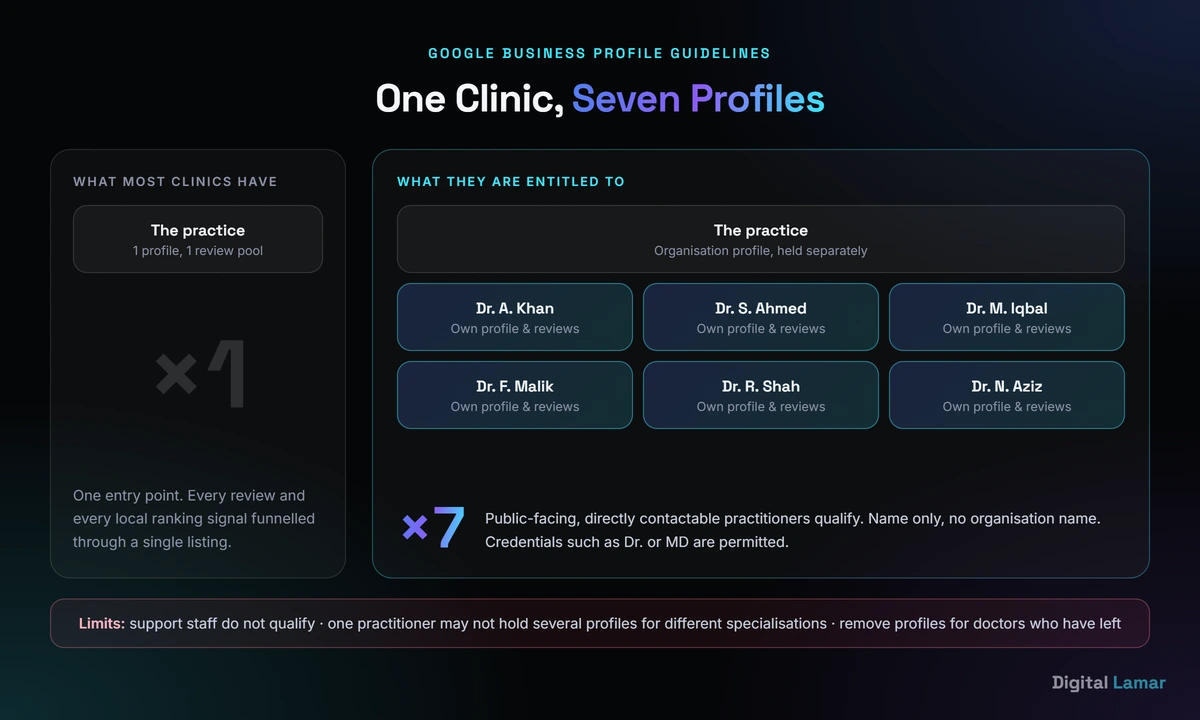
A six-doctor clinic is entitled to seven profiles, not one. Most claim one.
Here is the lever almost nobody uses correctly.
Google’s guidelines for representing your business permit individual practitioners to hold their own Business Profile, separate from the profile of the practice they work in. A doctor qualifies if they are in a public-facing role and can be contacted directly at the verified location. Support staff do not qualify, and neither do sales or lead-generation roles.
The naming rules are specific, and getting them wrong is what causes these listings to be rejected or merged. Where several practitioners work at one location, a practitioner’s profile should carry only the practitioner’s name, without the organisation’s name attached. Where someone is the sole public-facing practitioner at a branded organisation, the format flips to brand followed by practitioner name. Titles and degree certifications are explicitly allowed in either case, so Dr., MD, JD and similar credentials can appear.
Google is equally clear on the other half: when multiple practitioners operate at one location, the organisation should create a profile for that location separately from the practitioners’ own profiles.
Work through what that means for a clinic with six physicians. One profile for the practice, plus six individual profiles, each capable of appearing in local results and each accumulating its own reviews. Compare that to the same clinic running a single listing, and the difference in surface area is not incremental. It is the single largest untapped local opportunity in most medical practices, and it exists because the rules are buried in general business documentation rather than anything addressed to doctors.
Two limits worth stating plainly. A practitioner is not permitted several profiles covering different specialisations, so one doctor means one profile. And a profile for a doctor who has left needs removing rather than repurposing, because a listing pointing at someone who no longer practises there is exactly the kind of inaccuracy that erodes trust in everything else you publish. If you would rather have someone audit your current listing structure before you start creating profiles, that is a conversation worth having first, because merged or suspended listings are considerably harder to fix than to avoid.
The Pages a Practice Website Actually Needs
Most practice websites are built around the practice. Effective ones are built around the five query types, which produces a noticeably different site map.
You need a page per procedure you actually want to be known for, written to answer what the procedure involves, who it suits, what recovery looks like and what it costs where you are permitted to say. You need a page per physical location. You need a provider profile per clinician, carrying credentials, training, hospital affiliations, languages spoken and a real photograph, because those pages capture name searches and feed the expertise signals that health content is judged on. And you need condition and symptom content authored by a named clinician rather than a generic content writer.
Medical website SEO fails most often on a boring detail: booking.
A page can rank beautifully and still produce nothing if the only route to an appointment is a phone number answered between nine and five. A meaningful share of health searching happens on a phone, late, by someone who is unwell or worried about someone who is. If they cannot book in that moment, a proportion of them will simply book with whoever can. This is not really an SEO problem, but it is where SEO results go to die, and no amount of ranking compensates for it. The broader channel picture, including where paid search and reputation work fit around all this, is covered in our guide to digital marketing for doctors.
Schema Markup: What Exists, and What Doesn’t
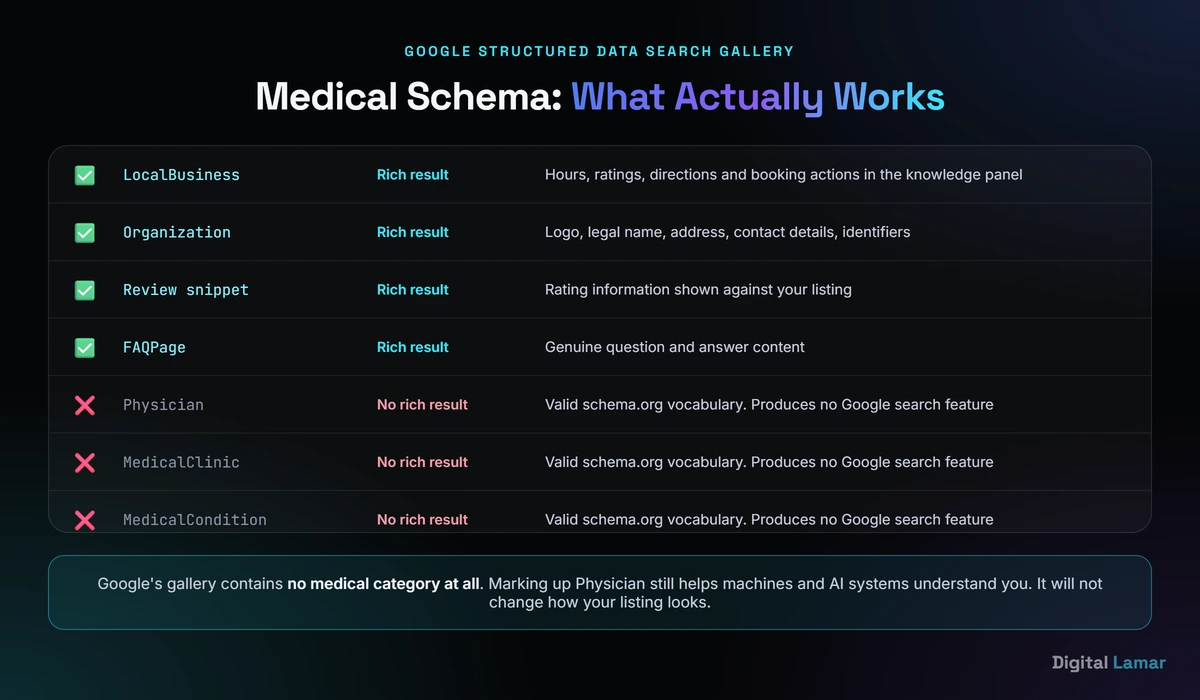
Marking up a type Google does not support produces exactly nothing.
The thing most guides get wrong
Google’s structured data search gallery lists every markup type that can produce a rich result. There is no Physician rich result. There is no MedicalClinic rich result. There is no medical category at all. Practices told to “add medical schema” are frequently marking up types that generate no search feature whatsoever.
This matters because schema is sold to practices constantly, and the version being sold often does not do what the seller implies.
Schema.org contains a rich vocabulary of medical types, including Physician, MedicalClinic and MedicalCondition. Those types are valid vocabulary and machines can read them. What they do not do is trigger a rich result in Google Search, because Google supports a specific and published list of features, and nothing medical is on it. The distinction is between markup that helps machines understand your page and markup that changes how your listing looks. Only the second one is a rich result, and medicine has none.
What actually earns you something is narrower.
LocalBusiness markup drives the business details that appear in a knowledge panel, covering hours, ratings, directions and booking actions. Organization markup carries your logo, legal name, address and contact details. Review snippet markup can surface rating information. FAQ markup remains available for genuine question and answer content. That is the practical list for a medical practice, and it is worth implementing properly rather than broadly.
Adding Physician markup alongside LocalBusiness is not harmful, and it does help AI systems and other consumers of structured data understand who you are. Just do not expect it to change anything visible in Google, and do not pay anyone who says it will. If the underlying site has crawling or indexing problems, structured data will not rescue it either, which is the territory our guide to technical SEO covers in depth.
E-E-A-T and YMYL: Why Health Content Is Judged Hardest
Every SEO article mentions E-E-A-T. Very few explain what a practice should actually change because of it.
The framework stands for Experience, Expertise, Authoritativeness and Trust, and for health topics Google’s own guidance is unambiguous that content should come from people with genuine subject-matter expertise and should align with established expert consensus. The practical translation for a medical practice is mostly about attribution and evidence rather than about writing style. Content should carry a named clinician as its author, with credentials visible on the page and a linked biography that establishes their training. Claims should reference recognised sources. Pages should show when they were last reviewed and by whom.
Almost no practice does the last one, and it is close to free.
A line reading “medically reviewed by Dr. Ayesha Khan, MBBS, FCPS, March 2026” does something a paragraph of confident prose cannot. It names a responsible human, it dates the information, and it signals a review process exists. This is the cheapest credibility signal available in health content, and it happens to be exactly what large medical publishers do on every article they run.
The mistake to avoid is the opposite of thin content. Some practices respond to YMYL by publishing enormous volumes of general health writing that competes directly with Mayo Clinic and Healthline on their own ground. You will not win that fight and you do not need to. Your advantage is specificity: the conditions you actually treat, in the city where you actually practise, explained by a doctor a patient can go and see. That combination is defensible in a way that general health content never is.
Reviews: A Conversion Filter and a Local Signal
Reviews do two separate jobs in medical search, and practices tend to think about only one of them.
The threshold that decides it
In rater8’s 2026 Patient Choice Report, a survey of nearly 1,000 US adults published in June 2026, 75% said they would not book with a provider rated below 4.0 stars. Asked to name their biggest deal-breakers in a review, patients put rude or unhelpful staff and doctors who did not listen joint top at 52% each, with substandard care behind them at 45%.
The first job is ranking. Review volume, recency and rating all feed local search performance, and a profile gathering steady reviews outperforms an equivalent one that gathered thirty reviews two years ago and stopped.
The second job is the filter, and it operates before anything else you have built gets evaluated. Below four stars, three quarters of patients never reach the stage of assessing your training, your outcomes or your availability. Every hour spent on content and technical work sits behind a gate that a rating opens or closes. That ordering is worth internalising, because it means a practice with a 3.6 rating should fix the rating before it commissions anything else.
Two operational notes. Most review damage originates at the front desk rather than in the consulting room, which the deal-breaker data makes fairly clear, so the fastest improvement usually comes from how appointments and phones are handled rather than from anything clinical. And every review reply has to be written as though the reviewer is not your patient, because confirming that they are, in public, without written authorisation, is a HIPAA problem regardless of how positive the review was.
Why One SEO Playbook Doesn’t Fit Every Specialty
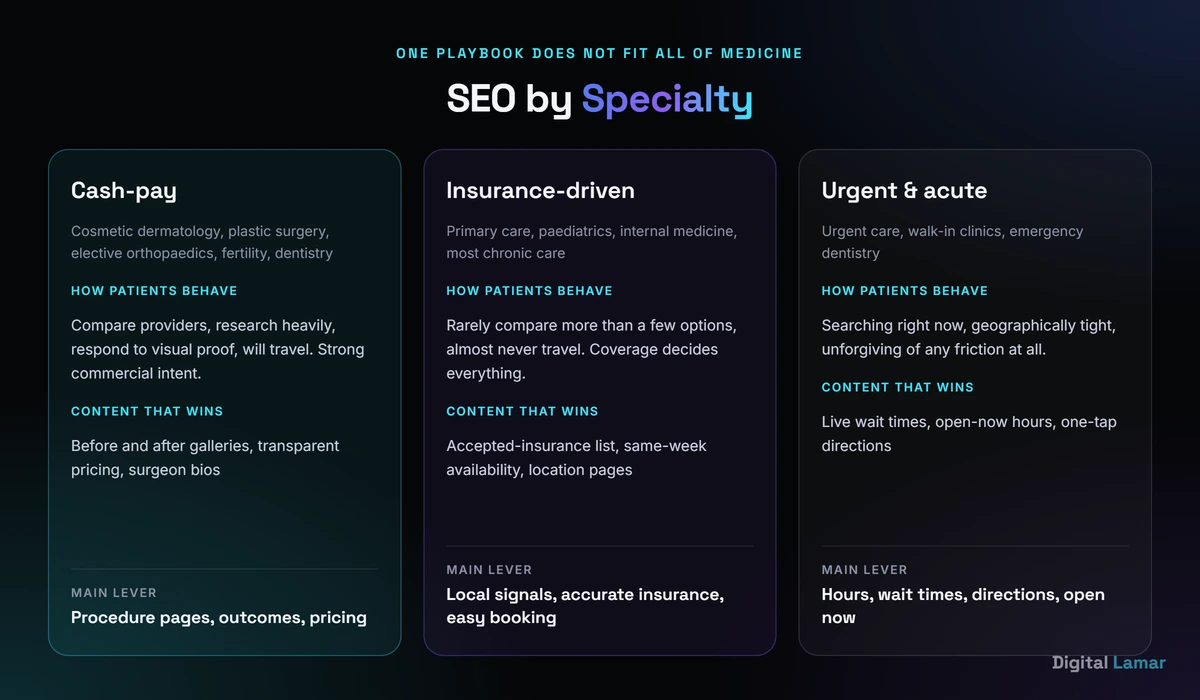
Cash-pay specialties and insurance-driven ones play completely different games.
Nearly every guide on this topic writes a single playbook and implies it applies to all of medicine. The search data says otherwise. Semrush’s US database in August 2026 puts “seo for surgeons” at 1,000 searches a month with a difficulty score of 10, while “seo for doctors” sits at 3,600 with a difficulty of 19. Specialty-level demand exists precisely because specialty-level strategy differs.
The dividing line that matters most is how the procedure gets paid for. Cash-pay work such as cosmetic dermatology, plastic surgery, elective orthopaedics, fertility and much of dentistry behaves like ordinary consumer commerce. Patients compare providers, research extensively, respond to visual proof, travel further, and search with strong commercial intent. Cost-per-click on those terms runs high for the same reason, with “seo medical clinic” reaching $50.75 in current Semrush data. Content that shows outcomes and explains pricing does the heavy lifting.
Insurance-driven primary care is close to the opposite.
Patients rarely compare more than a handful of options, they almost never travel, and the constraint that decides everything is which providers their plan covers. Search intent is dominated by “near me” and by insurance qualifiers, so the winning strategy leans heavily on local signals, accurate insurance information and booking friction rather than on content depth. A practice that pours budget into condition articles when its actual problem is that its accepted-insurance list is out of date has optimised the wrong thing entirely.
Urgent and acute care is a third pattern again, where searches are immediate, geographically tight and unforgiving about anything that slows a patient down. Hours, wait times, directions and whether you are open right now outrank everything else. Long-form content plays almost no role.
Getting Cited by AI, and Where SEO Ends
Search results are no longer the only surface where a practice gets recommended, and the rater8 data puts numbers on how quickly that shifted. Asked which part of a Google results page they trust most for healthcare decisions, patients chose the AI Overview at 37%, ahead of organic blue links at 20% and the local map pack at 13%.
Most of what earns a citation in an AI answer is work you are already doing for SEO. Consistent structured information across the web, content that answers real patient questions in plain language, verifiable credentials appearing in more than one place, and a substantial review profile all feed both systems. This is why the two disciplines are complementary rather than competing, and why SEO (Search Engine Optimization) remains the foundation rather than something being replaced.
Where they diverge is worth understanding, and it is the subject of our guide to generative engine optimization. Traditional SEO optimises for a ranked list a human scrolls. AI systems assemble an answer from sources they judge credible, which rewards factual consistency across the entire web rather than on-page optimisation of a single URL. A practice whose hours differ between its website, its Business Profile and three directories will rank acceptably and get cited badly, because the inconsistency itself is the problem.
Digital Lamar built its AI search optimization practice around exactly that gap, and for medical practices the accuracy dimension carries a weight it does not carry in other industries. Wrong hours cost a restaurant a cover. Wrong hours cost a clinic a patient who needed care that day.
How to Measure It, and How Long It Takes
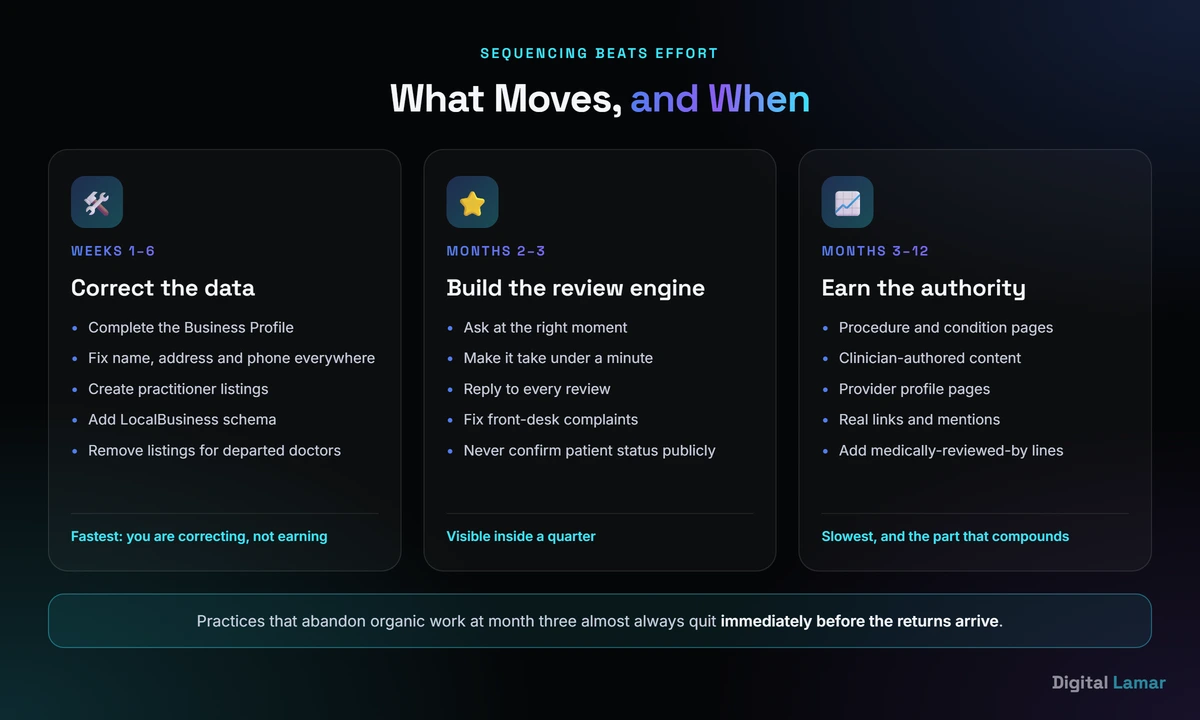
Local work moves first. Content and authority compound later.
Expectations kill more SEO programmes than execution does, so it is worth being blunt about sequencing.
Local work moves fastest. A properly completed Business Profile, corrected directory data and newly created practitioner listings can shift local visibility within weeks, because you are correcting information rather than earning authority. Reviews follow next, improving over two to three months once collection becomes systematic rather than occasional. Content and organic authority are the slow layer, typically taking three to six months to move meaningfully and six to twelve to compound. Practices that abandon organic work at month three almost always do so immediately before the returns arrive.
Measurement should follow the same order rather than fixating on rankings.
Rankings are a proxy, and a noisy one, since local results vary by the searcher’s exact position. The numbers that actually describe a medical SEO programme are these: Business Profile actions, meaning calls, direction requests and website clicks generated directly from your listings; organic new patient appointments, which requires asking new patients how they found you and recording the answer; the ratio of enquiries to booked appointments, which is usually a front-desk metric wearing a marketing costume; and patient acquisition cost measured against patient lifetime value, because a primary care patient worth several thousand dollars over a decade justifies an acquisition cost that looks absurd against one visit.
Without lifetime value in the calculation, every investment in medical SEO looks overpriced. With it, most look obviously worthwhile.
Key Takeaways
- Google supports no Physician or MedicalClinic rich result. Its structured data gallery contains no medical category at all, so practices adding “medical schema” for rich results are getting nothing visible in return. LocalBusiness, Organization, Review snippet and FAQ are the practical list.
- Individual doctors at a multi-practitioner location can hold their own Business Profile alongside the practice, per Google’s representation guidelines. A six-physician clinic is entitled to seven profiles. Naming rules are strict: practitioner name only, no organisation name, credentials permitted.
- Patients arrive through five distinct query types (symptom, condition, procedure, local, name), and each needs a different page. Most practices build for one.
- 75% of patients will not book a provider rated below 4.0 stars (rater8, 2026, n=992), so a poor rating gates every other investment you make.
- The top review deal-breakers are rude staff and doctors who did not listen, at 52% each, ahead of substandard care at 45%. Most review damage starts at the front desk.
- Cash-pay specialties and insurance-driven primary care need opposite strategies. “seo for surgeons” sits at 1,000/KD 10 against “seo for doctors” at 3,600/KD 19 (Semrush, US, August 2026) because the demand really is specialty-specific.
- HIPAA requires written authorisation before protected health information is used in marketing (45 CFR 164.508), which rules out unauthorised testimonials and confirming patient status in public review replies.
- Local corrections move in weeks, reviews in two to three months, content and authority in six to twelve. Measure Business Profile actions and organic new patients, not rankings.
Want to know how many practitioner listings your practice is entitled to, and whether your current schema is doing anything at all? Digital Lamar audits both.
Book a free 30-min strategy callFrequently Asked Questions
What is SEO for doctors?
SEO for doctors is the practice of making a medical practice visible in search when patients look for the care it provides. It differs from general SEO in three ways: health content is held to Google’s strictest quality standard, HIPAA restricts which marketing tactics are legal, and results are almost entirely local because patients rarely travel for routine care. In practice it centres on Google Business Profile optimisation, a site built around the query types patients actually use, correct structured data and a systematic review programme.
Is there a medical schema type for SEO?
Schema.org includes medical vocabulary such as Physician and MedicalClinic, but Google’s structured data search gallery lists no Physician or MedicalClinic rich result. There is no medical category in it at all. Marking those types up helps machines understand your page and can help AI systems, but it will not change how your listing appears in Google. The types that produce visible results for a practice are LocalBusiness, Organization, Review snippet and FAQ.
Can each doctor in a practice have their own Google Business Profile?
Yes, if they are public-facing and can be contacted directly at the verified location. Google’s guidelines allow individual practitioners a profile separate from the organisation’s, and state that where multiple practitioners work at one location the organisation should hold its own profile separately. Where several practitioners share a location, each profile should carry only the practitioner’s name without the organisation’s name; titles and degree certifications such as Dr. or MD are permitted. A practitioner may not hold multiple profiles for different specialisations.
How long does SEO take for a medical practice?
It depends which layer you mean. Local corrections such as completing your Business Profile, fixing directory inconsistencies and creating practitioner listings can move visibility within weeks, because you are correcting data rather than earning authority. Review improvement typically shows over two to three months. Content and organic authority take three to six months to move meaningfully and six to twelve months to compound. Practices that stop at month three usually quit right before the returns arrive.
Does SEO work differently for different medical specialties?
Substantially. The main dividing line is how care is paid for. Cash-pay specialties such as cosmetic dermatology, plastic surgery and much of dentistry behave like consumer commerce, with patients comparing providers, travelling further and responding to visual proof and pricing. Insurance-driven primary care is close to the opposite, dominated by “near me” searches and insurance qualifiers, where accurate coverage information and easy booking matter far more than content depth. Urgent care is different again, driven by hours, wait times and immediacy.
Should a medical practice hire an SEO agency or do it in-house?
Review collection, review responses and routine Business Profile maintenance belong in-house permanently, because they depend on staff behaviour no vendor can replicate. Technical work, structured data, practitioner listing structure and AI visibility auditing are the pieces that usually justify outside help, since they change constantly and mistakes such as merged or suspended listings are much harder to fix than to avoid. Healthcare experience matters more than in most sectors, specifically because of HIPAA and the business associate agreements it requires.