
On this page
- Vague Pricing, Hidden Fees, and Marked-Up Costs
- No Case Studies, and Results You Can’t Independently Verify
- The Same Strategy for Every Client
- Who Actually Does the Work After You Sign
- Who Owns Your Website, Domain, and Ad Accounts If You Leave
- Reports Full of Impressions, Empty of Revenue
- The Red Flags on Your Side of the Table
- Key Takeaways
- Frequently Asked Questions
In short
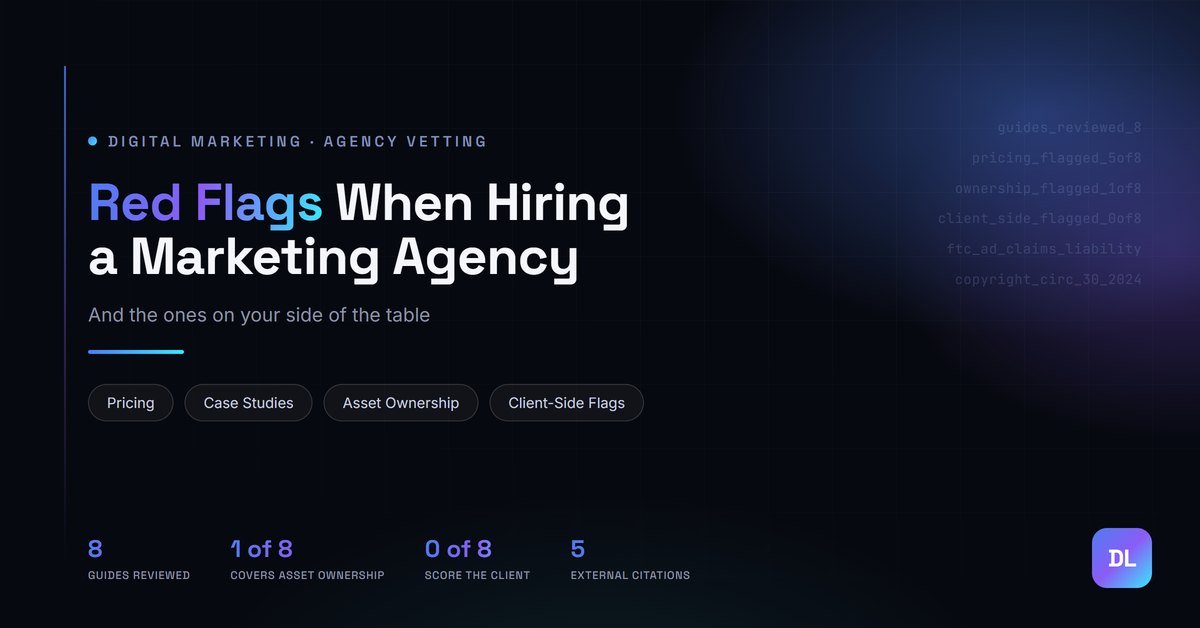
We reviewed eight published guides on hiring a marketing agency for this post. Five cover hidden pricing, four cover case studies you can’t verify, but only one mentions who owns your website when you leave, and none score the red flags that sit on your own side of the relationship. This guide covers the standard warning signs properly, then adds the two gaps: what actually happens to your domain, CMS and ad accounts when a contract ends, grounded in what US copyright law says about commissioned work, and the behaviors on the client’s side that sour a partnership just as often as a bad agency does.
Eight published guides on hiring a marketing agency turned up in the research for this post. Seven of them never mention who owns your website once the contract ends. That single gap causes more damage than any of the softer red flags the other guides cover well: vague pricing, a templated strategy, reports stuffed with numbers that mean nothing.
At Digital Lamar we sit on both sides of this conversation. We pitch new clients in Karachi, Dubai and the US, and we’ve also cleaned up after agency relationships that went wrong. The pattern is consistent. Guides to hiring an agency almost always treat the relationship as one-directional, here’s what to watch for in them, and almost never ask what a client brings to a bad partnership. This guide covers the standard red flags properly, because you need them, then spends real space on what nearly everyone skips.
Vague Pricing, Hidden Fees, and Marked-Up Costs
Ask an agency for a number and watch how long it takes to get a straight answer.
Five of the eight guides we reviewed flag this, and for good reason. A proposal that won’t name a figure without three more discovery calls, a retainer that grows once you’re signed, a media budget with an unexplained markup baked in, these are not oversights. Agencies that plan to charge you more later have a reason to keep the number vague now. The honest version looks different: a breakdown that separates ad spend from management fees from creative production, stated as a range if the scope genuinely isn’t fixed yet, with every add-on named before you sign rather than discovered in month two.
What to ask for instead: a written breakdown of every line item, whether that’s SEO (Search Engine Optimization), paid ads, or content, and a straight answer about what happens if your ad spend or scope changes mid-contract. If the answer wanders, that’s the answer.
No Case Studies, and Results You Can’t Independently Verify
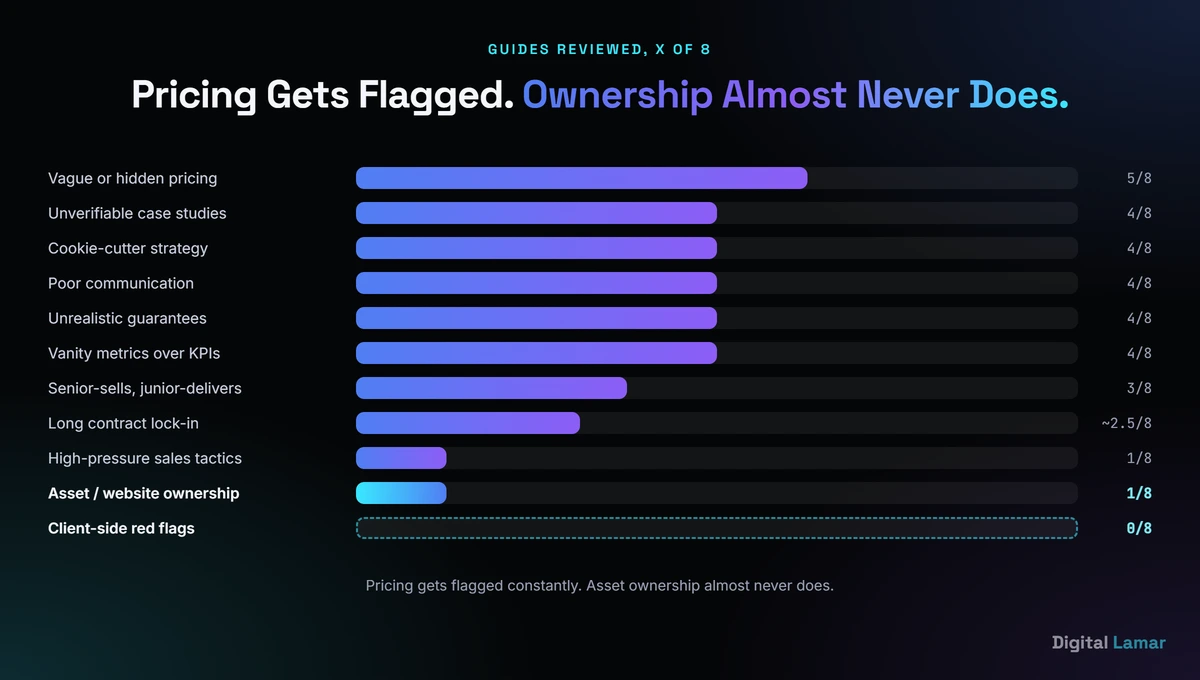
Pricing gets flagged constantly. Asset ownership almost never does.
A case study with no way to check it is a marketing claim, not evidence.
Four of the eight guides call out missing or vague case studies, the second most common red flag in the set after pricing. The pattern to watch for isn’t a thin portfolio page, most small agencies have those early on, it’s confident claims with no way to verify them: hundreds of brands served, massive growth delivered, client names withheld for reasons that never quite add up. The Better Business Bureau’s guidance on vetting a service provider makes the same point outside marketing entirely: comparing quotes and checking a track record independently matters more than trusting the pitch, because a sales conversation is built to reassure you, not to show you what a bad month looks like (BBB, 2025).
There’s a second layer worth checking, and search-engine-optimisation claims get scrutinised for it specifically. Under FTC guidance for small businesses, sellers and their advertising agencies are both responsible for substantiating the claims they make (FTC, 2024). An agency can’t simply repeat a number it hasn’t verified and call that due diligence. If an agency can’t show you where a stated result actually came from, whether that’s a past case study or a projected outcome, that’s worth pressing on before you sign, not after.
The FTC’s own guides on endorsements and testimonials set a similar bar for what a case study should be: it has to reflect the genuine, current opinion or experience of the person behind it, not a cherry-picked snapshot pulled out of context (16 CFR 255.0). And the stakes for a guaranteed-results claim aren’t hypothetical. In 2010 the FTC shut down a company that had promised small businesses its “search optimization service” would substantially increase their traffic, a promise it never delivered on, and froze the defendants’ assets while the case was pending (FTC, 2010). For a plainer sense of what a legitimate agency actually does day to day, our guide to what an SEO agency does is a useful baseline to compare any pitch against.
Ask to speak with a current client, not a curated reference, and ask them one specific question: what did month three actually look like.
The Same Strategy for Every Client
A pitch deck that could belong to any business in any industry is not a strategy. It’s a template with your logo pasted on.
Four of the eight guides flag this pattern, and it shows up early if you know what to look for. An agency that jumps straight to tactics, run these ads, post this often, publish this much content, without asking what your margins look like, who your actual buyer is, or what’s already been tried and failed, is selling you their process, not solving your problem. The right partner brings the full range of digital marketing services to bear where it genuinely helps, not just the one channel they happen to sell hardest. A good starting point for spotting this before the first proposal lands is our own guide to how to choose a digital marketing agency, which walks through the questions worth asking upfront.
Who Actually Does the Work After You Sign
The person who impressed you in the pitch is often not the person who touches your account.
Three of the eight guides describe some version of this: senior staff run the sales process, then a junior team takes over execution once the contract is signed. It’s worth being precise about what the actual problem is here, because the reflex response, watch out for salespeople, misses it. A dedicated sales function isn’t itself a red flag. Closing deals is a real skill and a real job. The problem is what happens after the signature: nobody explicitly owns the account, the handoff is informal, and the person who made commitments during the pitch is no longer accountable for keeping them. That’s a process failure, not a personality type.
Ask by name, before you sign, who will manage your account week to week, and ask to meet them.
Who Owns Your Website, Domain, and Ad Accounts If You Leave
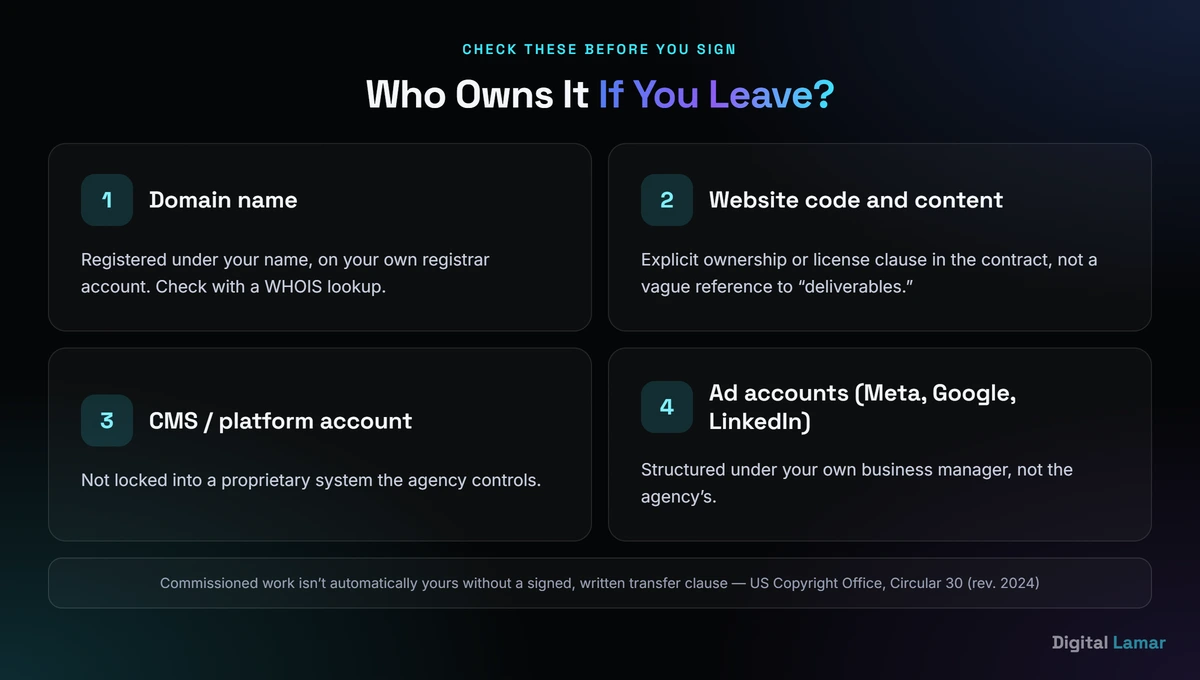
Four things to check before you sign, not after you leave.
The finding that prompted this section
Only 1 of the 8 guides we reviewed mentions who owns your website, domain or ad accounts when the relationship ends. Every guide covers pricing. Almost none covers the asset you’re actually paying to build.
It matters because the legal default surprises most business owners. Under US copyright law, the person or company that creates a work generally owns it unless there’s a signed agreement transferring that ownership. Commissioning someone to build something for you does not automatically make it yours. The US Copyright Office’s own guidance on works made for hire is explicit on this: a commissioned work only counts as a work made for hire, with the client treated as the legal author and owner, if the arrangement falls into specific categories and the parties expressly agree to it in a signed, written instrument (US Copyright Office, Circular 30, rev. 2024). Without that clause, the agency that built your site may retain the legal rights to it even after you’ve paid in full.
In practice this shows up in four places, and it’s worth checking all four before you sign. Your domain name, registered under your name and your own registrar account, not the agency’s. Your website’s code and content, with an explicit ownership or license clause in the contract, not a vague reference to deliverables. Your CMS or platform account, so you’re not locked into a proprietary system the agency controls. And your ad accounts, Meta, Google, LinkedIn, structured under your own business manager, not theirs, so the audience data and campaign history you paid to build actually leaves with you.
This is the first thing Digital Lamar walks a prospective client through before any proposal goes out, because it’s the cheapest problem to prevent and the most expensive one to fix after the fact.
A five-minute WHOIS lookup on your own domain will tell you who’s actually listed as the registrant. If it isn’t you, that’s a conversation to have this week, not when you’re ready to switch agencies.
Reports Full of Impressions, Empty of Revenue
Impressions and likes are easy to make look good. Revenue is harder to fake.
Vanity metrics show up in some form across most of the guides we reviewed, framed as a report that tracks reach and engagement without ever tying back to leads, conversions or revenue. It’s an easy trap because the numbers aren’t false, they’re just disconnected from the question that actually matters: is this producing business results. A report that can’t answer what a lead or a sale cost you, and how that’s trending month over month, is measuring activity, not performance.
For the fuller picture on what a legitimate agency relationship should look like day to day, why hire a digital marketing agency covers the honest math on agency versus in-house, worth reading before you’re deep into a contract with either.
The Red Flags on Your Side of the Table
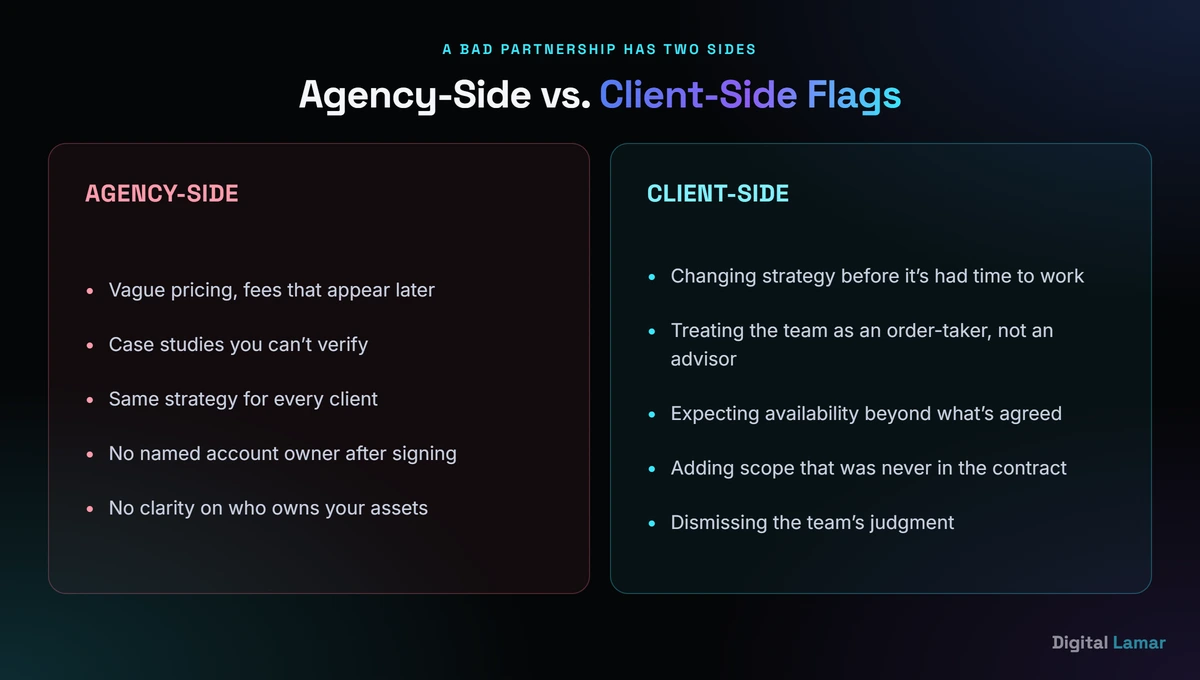
A bad partnership rarely has just one author.
None of the eight guides we reviewed mention a single red flag that belongs to the client. That’s not because clients are never the problem.
An agency relationship fails in both directions, and it’s worth being honest about the half nobody writes about. Changing strategy every few weeks, before the current one has had time to work, then blaming the agency for inconsistent results. Treating a specialist team as a pair of hands that executes exactly what you say, rather than a partner you hired for judgment you don’t have in-house. Expecting availability outside agreed hours and calling anything less a service failure. Adding tasks and scope that were never in the agreement, then treating pushback as unhelpfulness. And, less measurable but just as corrosive, talking to the team doing the work as though they’re beneath the relationship rather than an extension of it.
None of this excuses an agency that deserves the red flags earlier in this guide. But a partnership that’s failing usually has two contributors, and a client who never asks whether they’re one of them tends to repeat the same bad outcome with the next agency too.
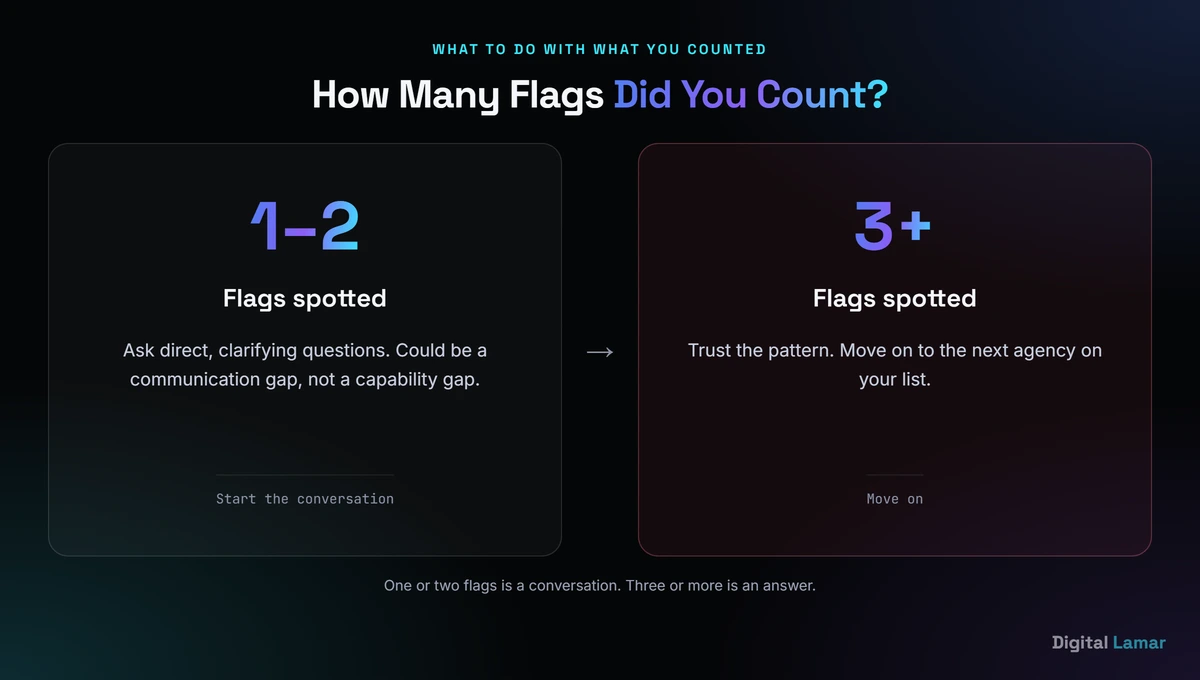
One or two flags is a conversation. Three or more is an answer.
If you’re weighing whether outside help makes sense at all before you get this far, are digital marketing agencies worth it walks through the honest ROI math.
If you’d rather talk through your specific situation, Digital Lamar offers a free strategy call where we’ll tell you plainly whether an agency is the right move before you commit to one.
Key Takeaways
- Of the 8 published guides on hiring a marketing agency we reviewed, only 1 mentions who owns your website, domain or ad accounts if you leave.
- None of the 8 guides score red flags on the client’s own side of the relationship, even though a bad partnership is rarely one-directional.
- Under US Copyright Office guidance, commissioned work like your website is not automatically yours without a signed, written clause naming you as owner.
- 5 of 8 guides flag vague or hidden pricing, and 4 of 8 flag unverifiable case studies, the two most common red flags in the set.
- Under FTC guidance, agencies themselves, not just the advertiser, are responsible for substantiating the claims they make about results.
- Check who’s listed as your domain’s registrant, and who controls your CMS and ad accounts, before you sign, not after you leave.
Not sure whether your current agency, or a new one you’re evaluating, checks out on the points that actually matter? Digital Lamar will walk through it with you, no obligation.
Book a free 30-min strategy callFrequently Asked Questions
What are the most common red flags when hiring a marketing agency?
The most common are vague or hidden pricing, case studies you can’t independently verify, a strategy that looks the same for every client, and reports built around impressions and engagement rather than leads or revenue. Of the eight guides we reviewed while researching this post, these four appeared most often. The two red flags almost none of them mention are who owns your website and ad accounts if you leave, and the behaviors on the client’s own side of the relationship.
Who owns my website if I leave my marketing agency?
It depends on your contract, and the legal default may not be what you expect. Under US copyright law, a commissioned work like a website is not automatically owned by the person who paid for it. The US Copyright Office’s guidance on works made for hire states that ownership only transfers to the client if the agreement falls into specific categories and both parties sign an express written agreement to that effect. Without that clause, check who’s listed as your domain’s registrant and confirm your contract explicitly transfers the code, content and CMS access to you.
Is it a red flag if an agency guarantees results?
Yes, treat it as one. No agency can control every factor that affects a marketing outcome, your product, pricing, market conditions and competitors all play a role, so a flat guarantee is either overconfidence or a sign the agency is more focused on closing the deal than being honest with you. FTC guidance for small businesses notes that both advertisers and their agencies are responsible for substantiating claims they make. A guarantee with no data behind it doesn’t meet that bar.
What red flags should I watch for on my own side of the relationship?
Changing strategy repeatedly before it’s had time to work, treating a specialist team as an order-taker rather than an advisor, expecting availability beyond what’s agreed, adding scope that was never part of the contract, and dismissing the team’s judgment are all patterns that sour an agency relationship just as fast as a bad agency does. None of the published guides we reviewed for this post score the client’s side of the table, but it’s worth being honest about before you sign with anyone.
How do I verify an agency’s case studies are real?
Ask to speak directly with a current client, not a curated reference the agency selects for you, and ask what month three of the relationship actually looked like. Checking a company’s track record independently, rather than relying on the references it hands you, is standard advice from consumer protection resources like the Better Business Bureau for any service provider, not just marketing agencies.
Should I sign a long-term contract with a new marketing agency?
Be cautious of any agency that pushes for a long commitment before it’s proven anything. A contract that locks you in for six to twelve months before you’ve seen real results protects the agency’s revenue more than it protects your outcomes. A confident agency is generally willing to earn your business month to month, or on a shorter initial project, before asking for a longer term.