

On this page
In short
Are digital marketing agencies worth it? For most businesses, yes, and the math is checkable: Google’s own economic model puts Google Ads returns at $8 in profit per $1 spent (Google, 2025), Litmus benchmarks email at $36 per $1 (Litmus, 2025), and a competent agency exists to capture returns like these on your behalf. But “most businesses” is not all businesses. The honest answer depends on three things: whether your offer already sells, whether you can commit at least a quarter, and whether results are actually being measured against revenue. This guide works through the real numbers, the break-even equation, and the three situations where the answer is no.
Somewhere right now, a business owner is staring at a proposal for a $2,500-a-month marketing retainer and doing quiet mental math: that’s $30,000 a year. For that money, what exactly comes back?
It’s the right question, and it deserves a better answer than the one most agency blogs give. Search this topic and you’ll find listicle after listicle explaining that agencies bring “expertise” and “scalability.” All true, and all beside the point. Nobody spends $30,000 on expertise. They spend it on the expectation that more than $30,000 comes back. So this post does what the others skip: the actual return math, channel by channel, with sources you can check, followed by the equally honest list of situations where the math does not work.
One note before the numbers. We’ve already covered why hire a digital marketing agency from the cost side: what agencies cost versus in-house teams. This post is the other half of the ledger, the return side. Together they answer the full question.
The ROI Benchmarks Nobody Shows You
The published, sourced return benchmarks for the channels agencies actually run.
Digital marketing is one of the few business investments where the major platforms publish their own return math. Start with the two most widely documented numbers.
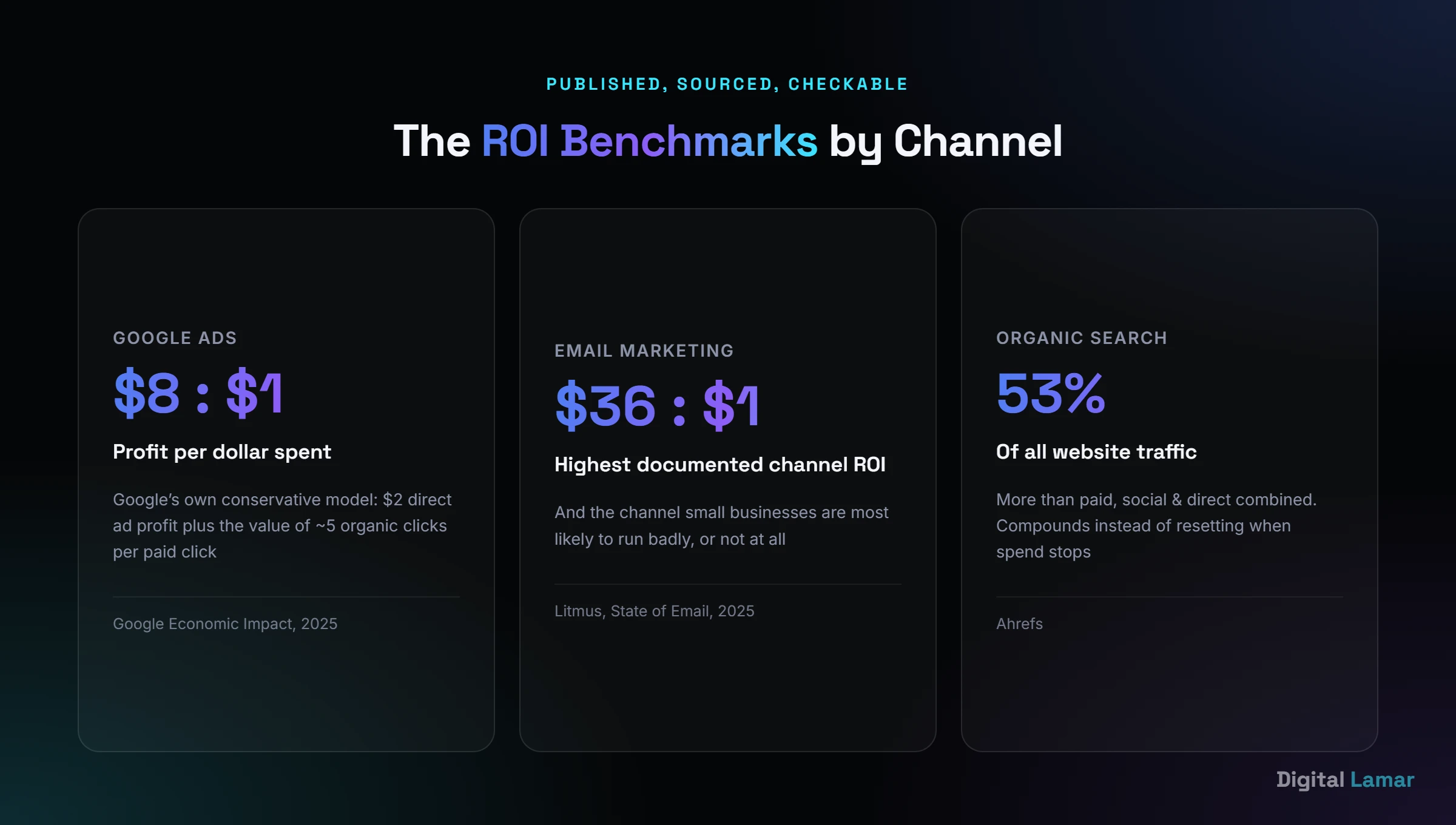
Google’s Economic Impact methodology estimates that businesses earn an average of $8 in profit for every $1 spent on Google Ads, a figure Google’s economists build conservatively: $2 of direct ad profit per $1 spent, plus the value of the roughly five organic clicks that come alongside every paid click, discounted to 70% of ad-click value (Google, 2025). You can argue with the assumptions, and analysts do. Even skeptics who cut the number in half are still describing a return most investments can’t touch.
Email is stronger still.
Did you know
Email marketing returns an average of $36 for every $1 spent, the highest documented ROI of any digital channel. It’s also the channel small businesses are most likely to run badly or not at all.
Source: Litmus, State of Email survey, 2025Then there’s organic search, where the return compounds instead of resetting. Roughly 53% of all website traffic comes from organic search (Ahrefs), more than paid, social, and direct combined. SEO spending doesn’t buy impressions that vanish when the budget stops; it builds an asset that keeps producing after the work is paid for. That’s the channel where agencies earn their keep most visibly over a 12-month window, and the one where doing nothing quietly costs the most.
Here’s the part that connects those numbers to the “worth it” question. Those returns are averages across businesses that execute well and businesses that execute badly. A competent agency’s entire job is to move you from the second group into the first: the right channels for your market, tracking that actually attributes revenue, and the experience to skip the expensive first-year mistakes. When an agency is worth it, this is the specific thing you’re paying for. Not access to the channels. Everyone has access. You’re paying to capture the documented returns instead of donating your budget to the platforms while learning.
The Break-Even Math, Worked Out
One equation tells you what your agency has to produce to justify itself.
Benchmarks are other people’s numbers. What decides whether an agency is worth it for you is a calculation you can do on the back of a receipt, using two figures you already know: what the agency costs per year, and what a customer is worth to you in profit. The break-even equation for any agency engagement is one line:
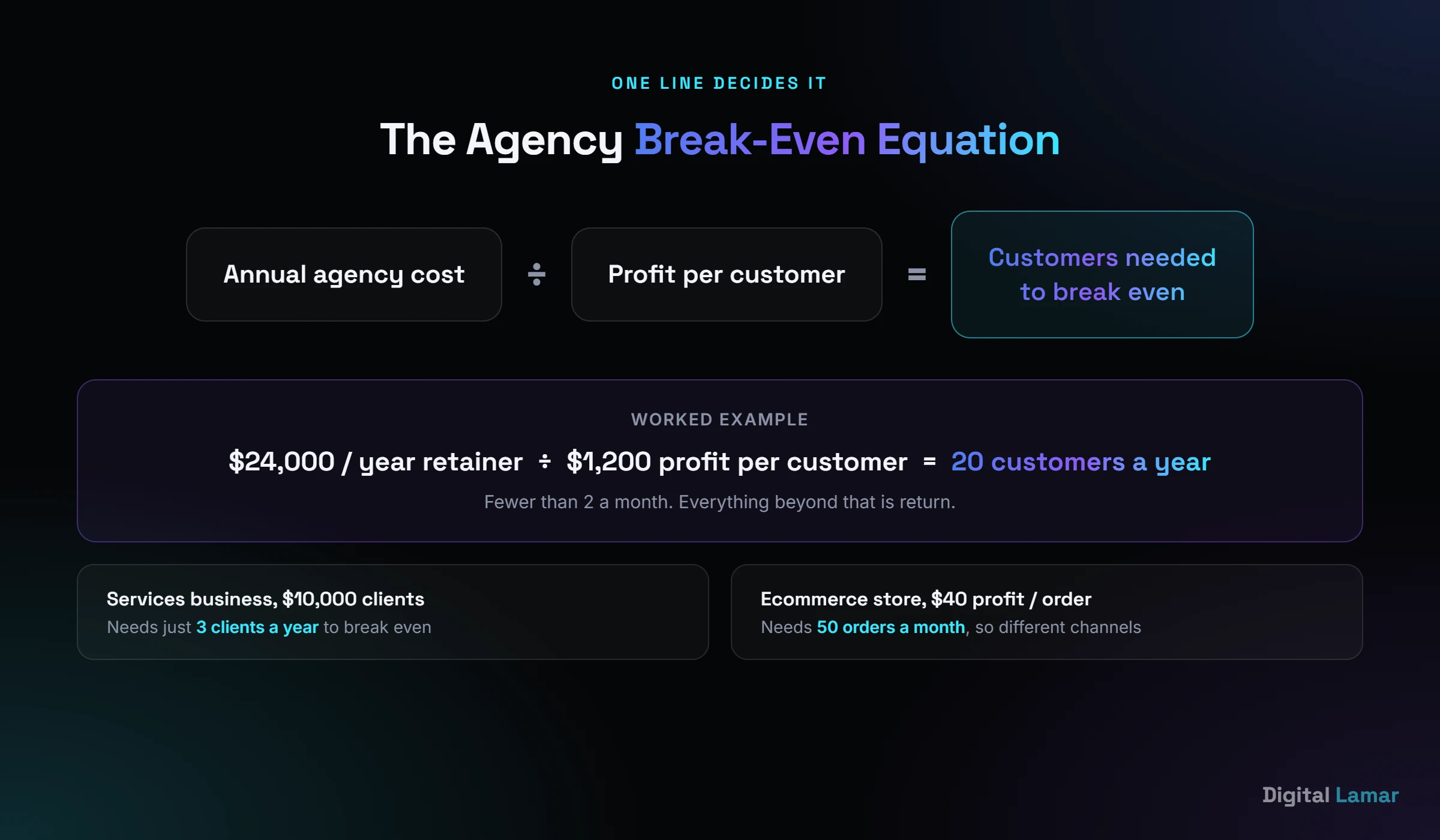
Annual agency cost ÷ profit per customer = customers the agency must generate per year to break even.
Take a concrete example. Say the retainer is $2,000 a month, so $24,000 a year, and your average customer is worth $1,200 in profit over their relationship with you. The agency needs to produce 20 customers a year, fewer than 2 a month, for the engagement to pay for itself. Everything beyond that is return. Now run it with your real numbers: a services business whose average client is worth $10,000 needs the agency to land 3 clients a year. An ecommerce store with $40 average profit per order needs 600 orders, or 50 a month, which is a very different ask and points toward different channels.
Two things about this equation decide most “worth it” outcomes.
First, customer lifetime value changes everything. If a customer buys once for $50, the math is hard. If they stay for three years of repeat purchases, the same acquisition suddenly justifies ten times the spend. Businesses that know their lifetime value make good agency decisions almost automatically; businesses that don’t are guessing on both sides of the equation. Second, the time axis matters as much as the numbers. Paid channels can hit break-even in the first quarter. SEO typically cannot, and Google’s own guidance says four months to a year is normal. A fair evaluation window mixes the two: paid performance judged early, organic judged at month six and beyond.
Market context shifts the retainer but not the logic. A Pakistani SMB might run this equation on a PKR retainer a fraction of the US number, a Dubai firm somewhere in between, and the arithmetic behaves identically. Only the break-even count changes.
What “Worth It” Actually Depends On
The benchmarks say the channels pay. The equation says the bar is usually low. So why does anyone come away burned?
Because three variables sit between the published averages and your outcome, and none of them is luck. The first is agency quality, which is the single biggest one. The gap between a good agency and a bad one isn’t 20%; it’s the difference between compounding returns and a year of invoices with nothing behind them. We wrote a complete vetting framework in how to choose a digital marketing agency, and every dollar of the ROI discussed above depends on getting that step right.
The second is your own input. Agencies amplify; they don’t conjure. The clients who see the strongest returns answer questions fast, grant access early, and treat the agency like a team they hired rather than a vendor they’re auditing. The third is patience calibrated to channel: judging an SEO program at week six produces exactly as much useful information as judging a gym membership at day four.
There’s also a market-level signal worth weighing. In Deloitte’s 2024 Global Outsourcing Survey, 80% of executives said they planned to maintain or increase their outsourcing investment. Companies that measure these engagements professionally, quarter after quarter, keep buying more of them. That’s revealed preference from the businesses with the best measurement tools, and it’s hard to square with the idea that external teams don’t pay for themselves.
When an Agency Is Not Worth It
Three honest disqualifiers. An agency that ignores these is selling, not advising.
We’re an agency saying this in writing: sometimes the answer is no.
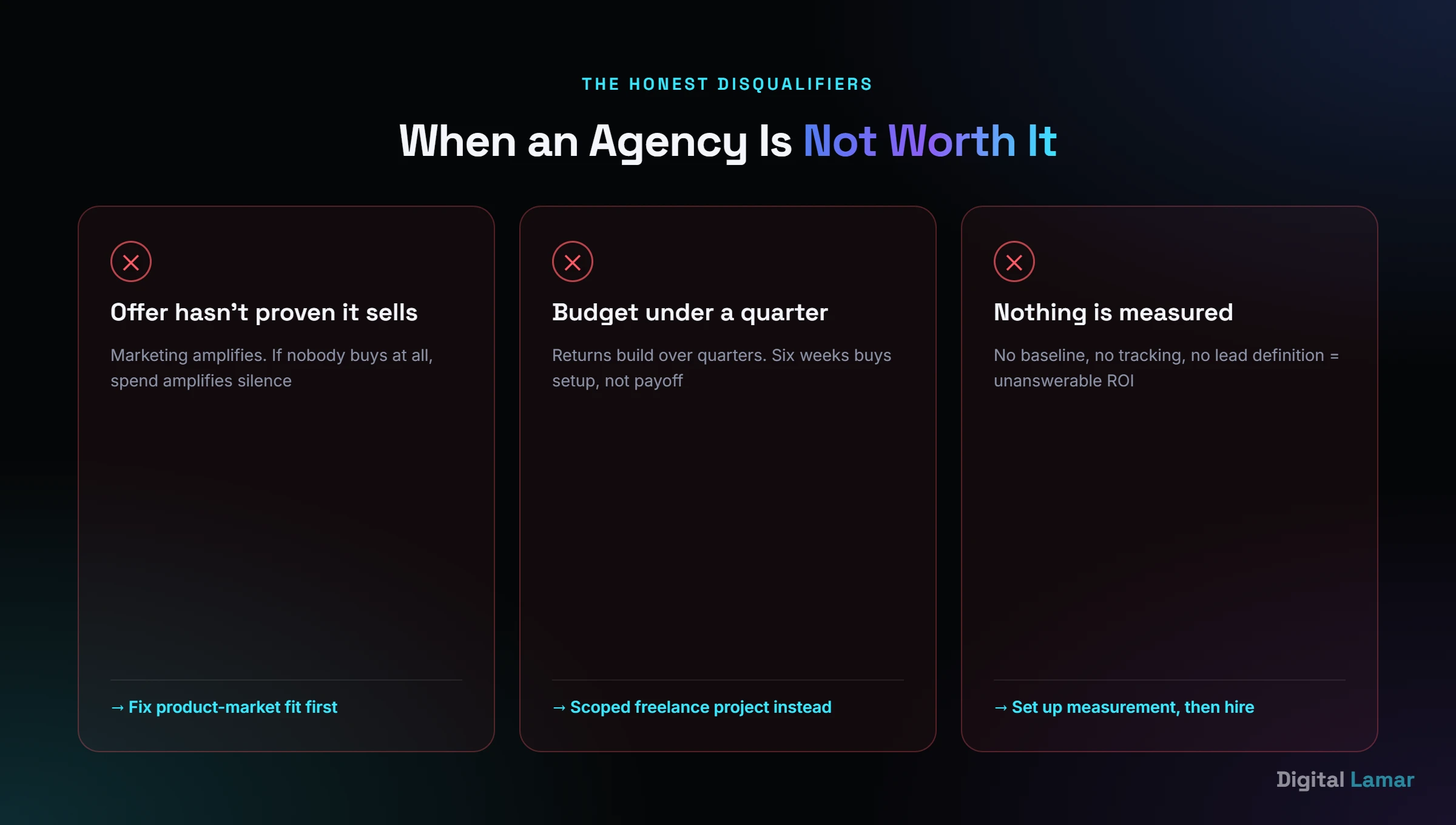
- Your offer hasn’t proven it can sell. If nobody is buying at all, not “too few people” but nobody, marketing spend amplifies silence. The problem lives in the product, the pricing, or the market fit, and no retainer fixes it. Fix that first; the marketing math only works on something that already converts occasionally.
- You can’t commit at least a quarter. The returns in this post are built over quarters, not weeks. Six weeks of budget buys the setup phase of a real program and none of the payoff. If the cash only exists for a short sprint, a scoped freelance project is the honest purchase.
- Nothing is being measured. If there’s no tracking, no baseline, and no agreed definition of a lead, “worth it” becomes unanswerable by construction. You’ll end a year with opinions instead of an ROI figure. Measurement isn’t the boring part of the engagement; it’s the part that makes every other part evaluable.
Notice what’s not on this list: “your business is too small.” Small businesses often see the fastest break-even, precisely because their baseline is furthest from the documented benchmarks and their markets are less saturated.
How to Make Sure Yours Is Worth It
Assuming you’re past the three disqualifiers, whether an agency ends up worth it is substantially decided in the first month, by how the engagement is set up.
Insist on a measured baseline before work begins: current traffic, current leads per month, current cost per lead if you’re running ads. Agree in writing on what a qualified lead means for your business. Set the reporting cadence to monthly, with numbers tied to leads and revenue rather than impressions and rankings. Then give the engagement a fair window, judged by channel: paid results reviewed from month one, organic results from month four onward. This is the same operating discipline we described in what an SEO agency does month by month, and any agency worth hiring will recognize it rather than resist it.
One more filter that costs nothing: ask a prospective agency to walk you through the break-even math above using your numbers. The good ones will have done a version of it before you asked, and the conversation itself tells you whether they think in results or just in deliverables. If you want that conversation with us, our digital marketing services run exactly on this measurement-first model.
Key Takeaways
- The channel returns are documented and public: $8 profit per $1 on Google Ads (Google, 2025), $36 per $1 on email (Litmus, 2025), and organic search driving roughly 53% of all traffic (Ahrefs).
- The break-even equation is one line: annual agency cost ÷ profit per customer = customers needed per year. For most service businesses the bar is surprisingly low.
- Customer lifetime value is the hidden variable; businesses that know theirs make good agency decisions almost automatically.
- An agency is not worth it if your offer hasn’t proven it sells, your budget can’t survive a quarter, or nothing is being measured.
- 80% of executives plan to maintain or increase outsourcing investment (Deloitte, 2024): the businesses with the best measurement keep buying.
- Set the engagement up to be evaluable: baseline first, leads defined in writing, monthly revenue-tied reporting, channel-fair time windows.
Want to run the break-even math on your actual numbers? Bring them to a call and we’ll work through it together, honestly.
Book a free 30-min strategy callFrequently Asked Questions
Are digital marketing agencies worth it for small businesses?
Often more so than for large ones. Small businesses sit furthest below the documented channel benchmarks, so competent execution moves their numbers fastest, and their break-even count is usually low. The three disqualifiers above matter more than business size: a validated offer, a quarter of committed budget, and real measurement.
Is hiring a marketing agency worth it compared to doing it yourself?
DIY costs less cash and more time, and the hidden price is the learning curve: the platforms’ published returns are averages that well-executed campaigns pull up and first attempts pull down. If your time has a high opportunity cost and your break-even math clears at realistic conversion numbers, the agency route usually wins. If budget genuinely doesn’t exist yet, start DIY with email and basic SEO.
What ROI should I realistically expect from a digital marketing agency?
Judge against the channel benchmarks with a discount for ramp-up: paid campaigns approaching platform averages within a quarter, email quickly if your list has any size, and SEO building from roughly month four onward per Google’s own timeline guidance. Any agency promising a specific multiple in the first month is quoting fiction.
How do I measure whether my agency is worth the investment?
Three numbers, tracked monthly against a pre-engagement baseline: qualified leads, cost per lead, and revenue attributed to marketing channels. If those aren’t in your monthly report, ask for them; if they can’t be produced, that’s your answer.
Are marketing agencies worth the investment during a slow economy?
The equation doesn’t change; the inputs do. If customers are still buying and your lifetime value holds, downturns often lower acquisition costs because competitors cut spend. If your market has genuinely stopped purchasing, that’s disqualifier number one, and pausing is rational.
How long before an agency engagement pays for itself?
Channel-dependent. Paid advertising can reach break-even inside the first quarter. SEO-led programs typically cross over between months six and twelve, then keep compounding. Blended programs usually see paid results carrying the early months while organic builds underneath.