On this page
- What Is AEO (Answer Engine Optimization)?
- What Are Answer Engines in AEO?
- Why Does AEO Matter in 2026?
- AEO vs SEO: Key Differences
- How Do Answer Engines Choose Which Sources to Cite?
- How to Do AEO for Your Website: 6 Steps
- How Do You Measure AEO Results?
- AEO in Pakistan, the US and the UAE
- Can You Do AEO Yourself or Should You Hire Help?
- Key Takeaways
- Frequently Asked Questions
In short
Answer engine optimization (AEO) is structuring content so featured snippets, Google’s AI Overviews, ChatGPT search and similar tools can lift it as a direct answer and cite you. Google says its AI features need nothing beyond normal SEO. What changes is the shape of the page: a clear question, a short self-contained answer, consistent facts and crawlers allowed in.
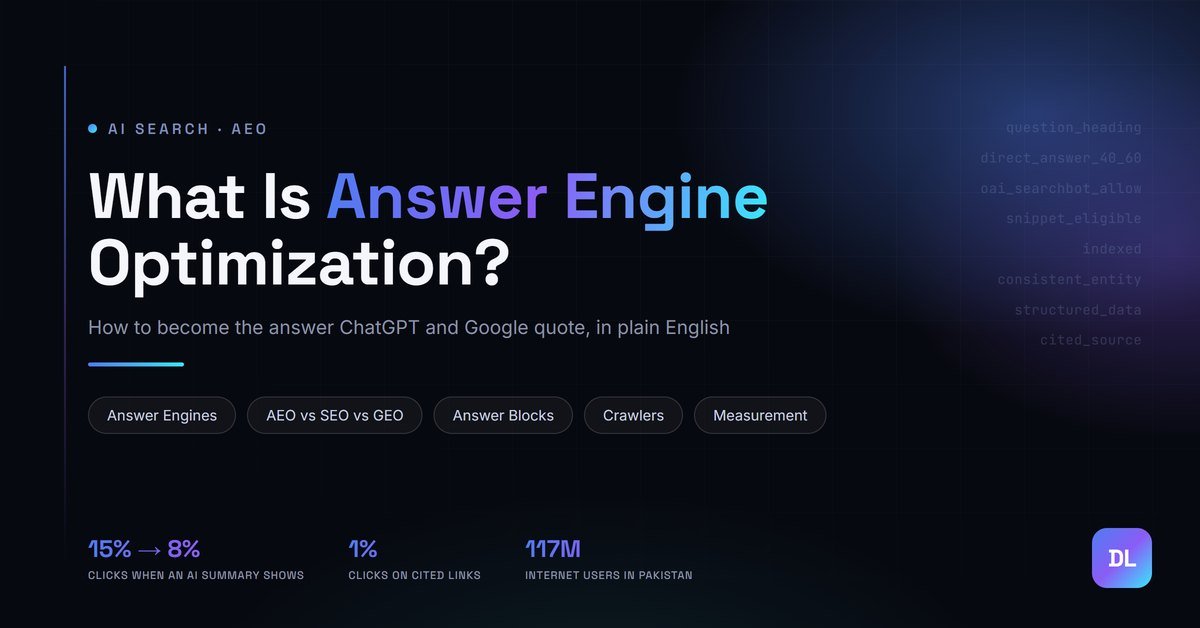
When Google shows an AI summary at the top of the results, people click a regular search result on just 8 percent of visits. Without the summary, they click on about 15 percent. That is what Pew Research Center found after tracking the real browsing of 900 US adults across 68,879 Google searches (Pew Research Center, 2025). The answer is now often the destination.
So the question for a business is changing. It used to be “do we rank on page one?” Now it is also “when someone asks, are we the answer, or the source the answer quotes?” Digital Lamar works with businesses in Pakistan, the US and the UAE on this shift, and the labels alone cause confusion. AEO, GEO, AI SEO, LLM optimization: four names, plenty of overlap, and little plain explanation of what you actually change on a page.
This guide is that plain explanation. If you are new to search, start with what SEO actually is.
What Is AEO (Answer Engine Optimization)?
Answer engine optimization (AEO) is the practice of making your content easy for answer engines to find, understand and quote. An answer engine is any search tool that replies with a direct answer instead of only a list of links. The goal of AEO is to be the answer, or the cited source behind it.
The term grew out of featured snippets and voice assistants. Both rewarded a page that states a clear answer to a clear question, near the top, in words a machine can lift without rewriting. Generative AI widened that pattern: ChatGPT search and Google’s AI Overviews now assemble answers from several sources and link to the ones they used. For Google’s own AI answers, see how to appear in Google AI Overviews.
In practice, AEO is mostly format and clarity.
What Are Answer Engines in AEO?
Answer engines are search tools that reply with a direct answer and cite sources instead of only listing links. Five matter for most businesses: Google featured snippets, Google AI Overviews and AI Mode, ChatGPT search, Perplexity and similar AI search tools, and voice assistants. Each one has its own entry requirement before it can quote you.
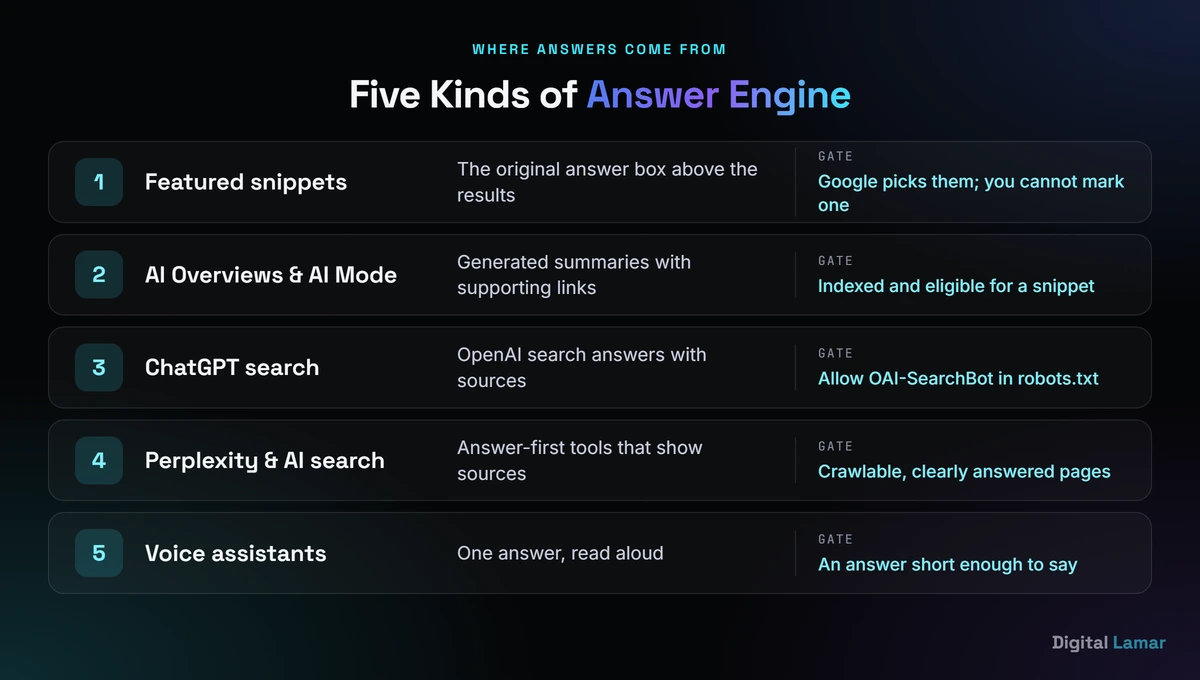
Each answer engine has its own gate. For Google it is indexing and snippet eligibility; for ChatGPT search it is letting OAI-SearchBot crawl you.
Google’s systems choose featured snippets; you cannot mark a page as one (Google Search Central, 2025). Voice assistants read one answer aloud, so only the best short answer wins.
Why Does AEO Matter in 2026?
AEO matters because answer engines now absorb attention that used to go to websites. On Google pages with an AI summary, people clicked a result on 8 percent of visits against 15 percent without one, and ended their session more often. If your business is not the cited answer, it is often not seen at all.
The Pew study measured real behavior, not opinions: 18 percent of the 68,879 searches its panelists ran in March 2025 produced an AI summary, and on those pages people ended their browsing session 26 percent of the time, against 16 percent on pages without one (Pew Research Center, 2025).
The number that should change how you write
On Google results pages with an AI summary, users clicked a link inside the summary on just 1 percent of visits. Being cited is about visibility and trust first, traffic second. Source: Pew Research Center, 2025.
That 1 percent is the honest starting point for AEO. A citation in an AI answer will not behave like a number one ranking did in 2015. What it buys is presence at the moment of the question: your name and your framing of the answer, seen by someone who may never scroll further. For a buyer comparing options, that is often where a shortlist begins.
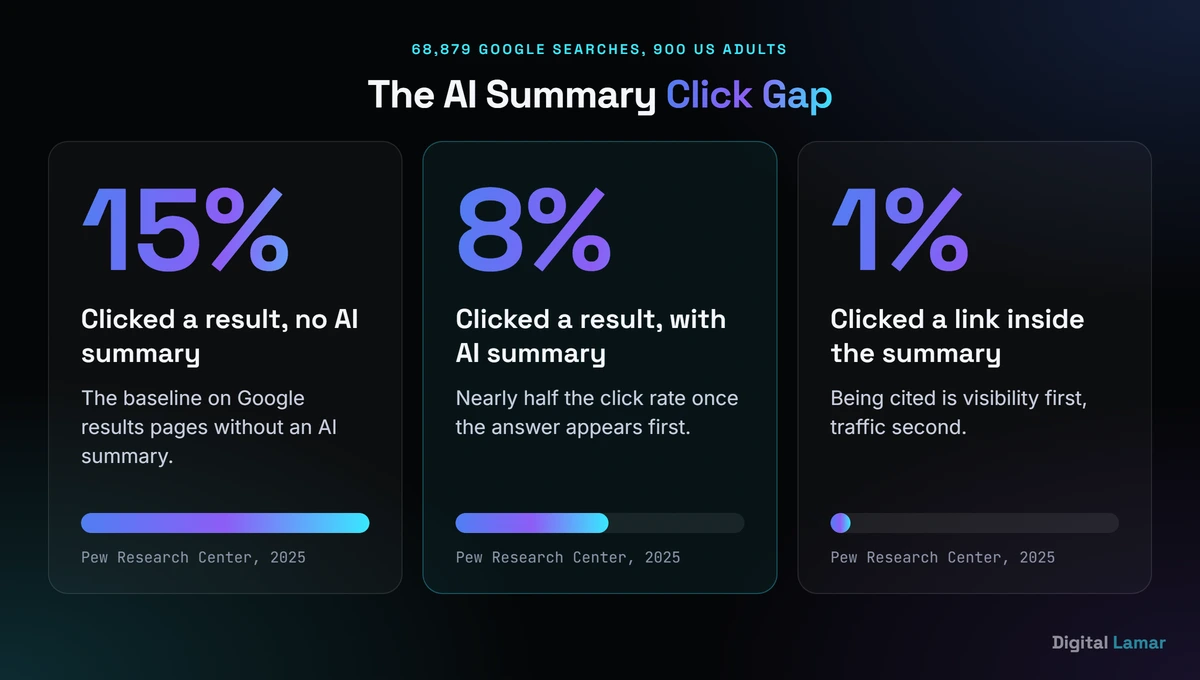
The click gap Pew measured in 2025. The answer box takes the attention that used to go to the first few results.
AEO vs SEO: Key Differences
SEO gets a page ranked. AEO gets a passage quoted. GEO, short for generative engine optimization, gets a brand recommended inside AI-generated answers, which leans more on reputation and mentions across the web than on any single page. For the full three-way comparison, see GEO vs SEO.
The foundation is shared. Google says there are no additional requirements to appear in AI Overviews or AI Mode, no special schema.org markup, and no new “AI text files” needed (Google Search Central, 2025). Its best practices are ordinary SEO ones.
| SEO | AEO | GEO | |
|---|---|---|---|
| Main goal | Rank a page | Get a passage quoted as the answer | Get the brand named and recommended |
| Unit that wins | The page | The answer block | The entity (your brand) |
| Where it shows | Blue links | Snippets, AI Overviews, voice, AI search | ChatGPT, Gemini, Perplexity replies |
| Main lever | Relevance, links, technical health | Structure and direct answers | Consistent facts and third-party mentions |
| Success signal | Position and clicks | Citations and answer presence | Brand mentions in AI answers |
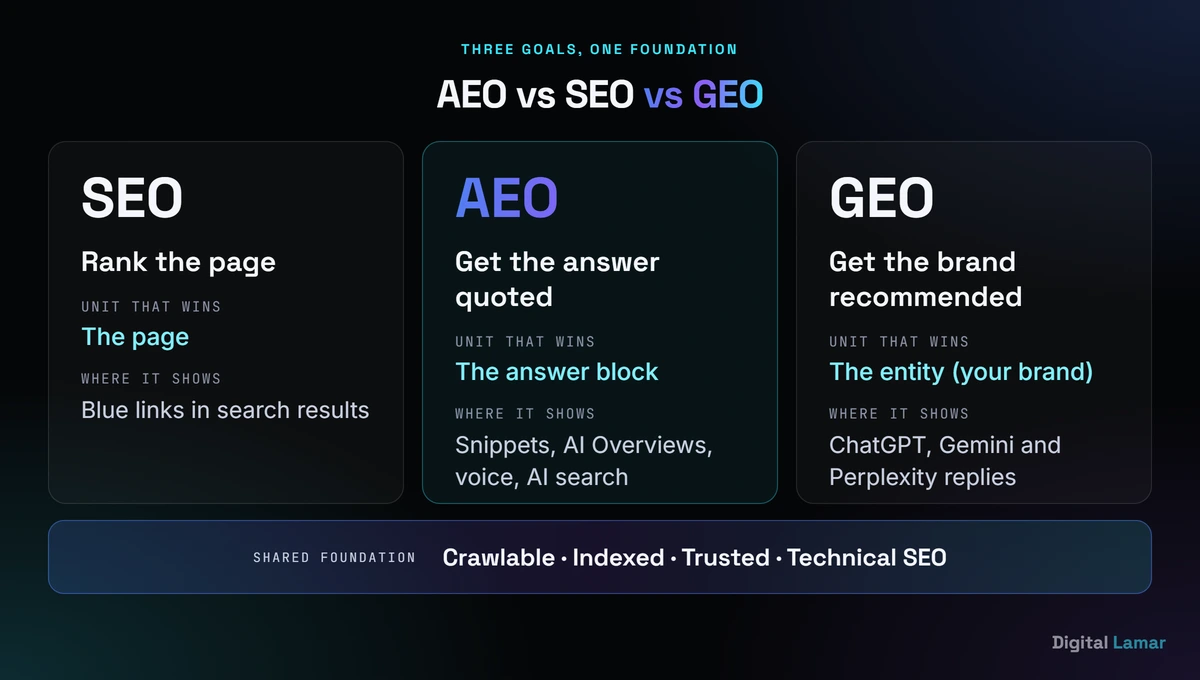
Three goals, one foundation. Skip the SEO base and neither AEO nor GEO has anything to stand on.
Is AEO Replacing SEO?
No. AEO is a writing and structure layer on top of SEO, not a replacement for it. A page that is not crawlable, indexed or trusted will not be ranked, quoted or recommended, so solid technical SEO remains the base that both AEO and GEO depend on.
How Do Answer Engines Choose Which Sources to Cite?
Nobody outside these companies publishes the full selection logic, but two gates are documented. Google needs a page indexed and eligible for a snippet; ChatGPT search needs OpenAI’s crawler allowed in. Past those gates, in our judgment, engines favor passages that answer in the first sentence, stand on their own and match facts found elsewhere.
Here is what each documented gate looks like in practice.
What Does Google Require for AI Overviews and AI Mode?
Google says a page must be indexed and eligible to show a snippet before it can appear as a supporting link in AI Overviews or AI Mode, and even then nothing is guaranteed (Google Search Central, 2025). Anything that blocks a snippet, such as a nosnippet rule left in an old template, also blocks you from AI features.
What Does ChatGPT Search Require to Cite a Website?
ChatGPT search finds pages through OpenAI’s OAI-SearchBot crawler. OpenAI recommends allowing it in robots.txt and says sites opted out of it will not appear in ChatGPT search answers (OpenAI crawler documentation, 2026). It is separate from GPTBot, which collects training data, so you can block training and still allow search.
Both gates take minutes to check, which is why step 5 below covers them.
How to Do AEO for Your Website: 6 Steps
To do AEO, rewrite your key pages around the questions customers ask, answer each in the first 40 to 60 words, give every question one home, keep business facts consistent, let answer-engine crawlers in, and keep structured data accurate. The first three steps are writing changes you can make on existing pages this week.
Step 1: Answer Each Question in the First 40 to 60 Words
Write the heading as the question people actually ask, then answer it in plain language before any context or caveats. Read that block in isolation. If it still makes sense with nothing around it, a machine can lift it.
Step 2: Write Headings That Match Real Search Queries
Autocomplete shows how people phrase a topic. Here it suggests “what is aeo in marketing” and “aeo vs seo”. Use those as headings.
Step 3: Give Each Question One Page on Your Site
If three pages on your site half-answer the same question, none of them is the obvious source. Pick the best page, answer it fully there, and link to it from the others. Those internal links tell search engines which page you consider the main answer.
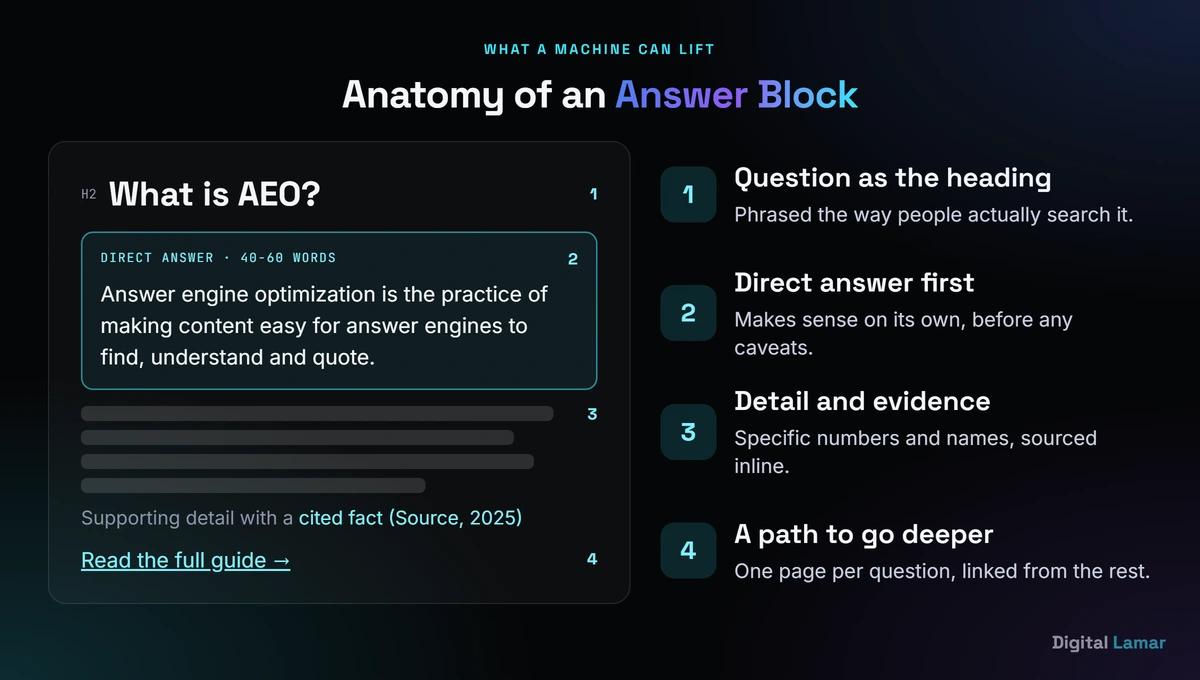
The answer block pattern. Everything a machine needs to quote you sits in the first few lines under the heading.
Step 4: Keep Your Business Facts Consistent Across the Web
Name, services, locations, price ranges, hours. Answer engines cross-check, and contradictions between your site, Google Business Profile and directories give them a reason to quote someone else.
Step 5: Allow OAI-SearchBot and Remove Snippet Blocks
Check robots.txt for blocks on OAI-SearchBot, and check page templates for stray nosnippet or very low max-snippet settings. Google notes that lowering max-snippet makes a featured snippet less likely, and nosnippet removes the snippet entirely (Google Search Central, 2025). It is a ten-minute check.
Step 6: Use Structured Data for Accuracy, Not AEO Shortcuts
Structured data helps machines understand a page, but it is no cheat code. Since August 2023, Google shows FAQ rich results only for well-known, authoritative government and health websites, and says unused markup causes no problems but has no visible effect (Google Search Central, 2023). Adding FAQ markup to every post in the hope of a citation is effort better spent on the answers themselves. Keep schema accurate and matched to the visible text.
If you would rather have someone check your key pages against these six steps, Digital Lamar offers a free 30-minute call where we look at how answer-ready your site is and tell you plainly what to fix first.
How Do You Measure AEO Results?
Measure AEO with three signals, because no tool isolates it cleanly: Search Console impressions for question-style queries, a monthly manual check of who gets cited for your buyers’ top ten questions in ChatGPT search, Perplexity and Google, and trends in AI referral traffic and branded search in your analytics.
Search Console mixes AI Overviews and AI Mode into Web search data (Google Search Central, 2025), so the AI share stays hidden.
None of these is precise. Together they show direction, which is enough to decide what to write next.
AEO in Pakistan, the US and the UAE
Pakistan had 117 million internet users at the end of 2025, a 45.6 percent penetration rate (DataReportal, Digital 2026: Pakistan). More than half the country is not yet online, so many future searchers will arrive on phones, already used to getting a single answer. In our judgment, that makes clear, short answers a practical advantage for Pakistani businesses now, not a trend to watch.
The US has the click data. In Pakistan and the UAE, many local categories still have thin information online, so one clear page can become the answer when few local sources answer well.
Digital Lamar’s view, with Pakistan as its home market, is that AEO lets a smaller local business compete with much bigger ones, because answer engines quote the clearest answer they can verify, not the biggest advertiser. It works alongside what an SEO company in Pakistan does for local rankings, not instead of it.
Can You Do AEO Yourself or Should You Hire Help?
You can do much of AEO yourself. Rewriting headings and answers on your top ten pages is writing work most owners can finish in an afternoon. Get help when crawler rules, templates and business listings need technical changes, or when nobody has time to repeat the monthly checks.
Before hiring, read our guides on how to choose a digital marketing agency and what an SEO agency does. Our own approach sits in our AI search optimization services.
Key Takeaways
- AEO means structuring content so answer engines can quote and cite you.
- With an AI summary on the page, Google users clicked a result 8 percent of the time versus 15 percent without (Pew Research Center, 2025).
- Google says AI Overviews and AI Mode need nothing beyond normal SEO (Google Search Central, 2025).
- ChatGPT search relies on OAI-SearchBot. Blocking it in robots.txt keeps you out of ChatGPT search answers (OpenAI, 2026).
- Use question headings, answer in the first 40 to 60 words, and keep business facts consistent everywhere.
- FAQ rich results now show only for authoritative government and health sites (Google, 2023).
Want to know whether ChatGPT and Google can actually quote your site? Digital Lamar will check your key pages and show you what to fix first, no obligation.
Book a free 30-min strategy callFrequently Asked Questions
What does AEO stand for?
AEO stands for answer engine optimization. It means structuring content so tools that reply with a direct answer, such as featured snippets, AI Overviews, ChatGPT search and voice assistants, can find it and quote it with a citation. The goal is to be the answer itself, not just one of the links below it.
What is AEO in marketing?
In marketing, AEO is the part of search strategy aimed at being the answer people see when they ask a question, rather than one of many links. It covers page structure, crawler access and consistent brand facts, so that AI tools describe your business accurately when customers ask about your category.
How long does AEO take to work?
There is no published benchmark. Some fixes are quick: OpenAI’s crawler documentation says robots.txt changes for OAI-SearchBot take about 24 hours to apply. Rewritten pages depend on when Google recrawls them, and citations depend on competition for each question, so judge progress monthly, not weekly.
What are common AEO mistakes?
Burying the answer under a long introduction, blocking OAI-SearchBot or leaving nosnippet rules in templates, splitting one question across several thin pages, listing inconsistent business details in directories, and adding FAQ schema expecting rich results Google now limits to government and health sites.
Do I need special schema or an llms.txt file for AEO?
Not for Google. Google says no special schema.org markup and no new machine-readable or AI text files are needed to appear in AI Overviews or AI Mode. Accurate structured data that matches the visible page is still good practice, but it is not a shortcut to being quoted.
Is AEO only for big brands?
No. Answer engines quote the clearest answer they can verify, not the biggest advertiser. In markets like Pakistan and the UAE, where many local categories have thin information online, one well-structured page from a small business has a real chance of becoming the cited answer.