
On this page
- What Is the Difference Between GEO and SEO?
- GEO vs SEO: 7 Key Differences
- Where Do GEO and SEO Overlap?
- Is GEO Replacing SEO?
- GEO vs SEO vs AEO: How the Three Relate
- Which Do You Need: GEO, SEO or Both?
- How to Do GEO and SEO Together: 6 Steps
- GEO vs SEO in Pakistan, the US and the UAE
- Common Mistakes When Adding GEO to an SEO Strategy
- Key Takeaways
- Frequently Asked Questions
In short
SEO gets your pages ranked in search results. GEO (generative engine optimization) gets your brand quoted and cited inside AI answers from ChatGPT, Perplexity, Gemini and Google’s AI Overviews. They share most of their foundations, so GEO is a layer on top of SEO, not a replacement. Most businesses need both, with SEO first and GEO added as AI answers start showing up for their customers’ questions.
Ask ChatGPT to recommend an SEO agency, a dentist or a payroll tool, and it will name three or four businesses without showing you a single search result. More than 800 million people now use ChatGPT every week, according to OpenAI CEO Sam Altman at the company’s October 2025 Dev Day (TechCrunch, 2025). None of those answers has a page two.
That’s the tension behind “GEO vs SEO.”
For twenty years, being found online meant ranking on Google. Now a growing share of questions get answered by an AI model that reads the web, writes a reply, and cites a handful of sources. Being one of those sources takes some of the same work as ranking, and some different work. Digital Lamar runs both SEO and AI search work for businesses in Pakistan, the US and the UAE, and the most common question we hear is a simple one: do I need to change what I’m doing?
This guide answers it, difference by difference, and ends with a plain way to decide where your effort should go. If you want the full definition first, start with our guide to generative engine optimization.
What Is the Difference Between GEO and SEO?
The difference between GEO and SEO is the destination. SEO (search engine optimization) aims to rank your pages in a list of search results so people click through. GEO (generative engine optimization) aims to get your content quoted, summarized or cited inside an AI-generated answer, where the reader may never click at all.
Both start from the same raw material: pages a machine can crawl, understand and trust. A search engine hands the user ten links and lets them choose. A generative engine reads the sources itself and writes one answer. In SEO you compete for the click. In GEO you compete for the sentence.
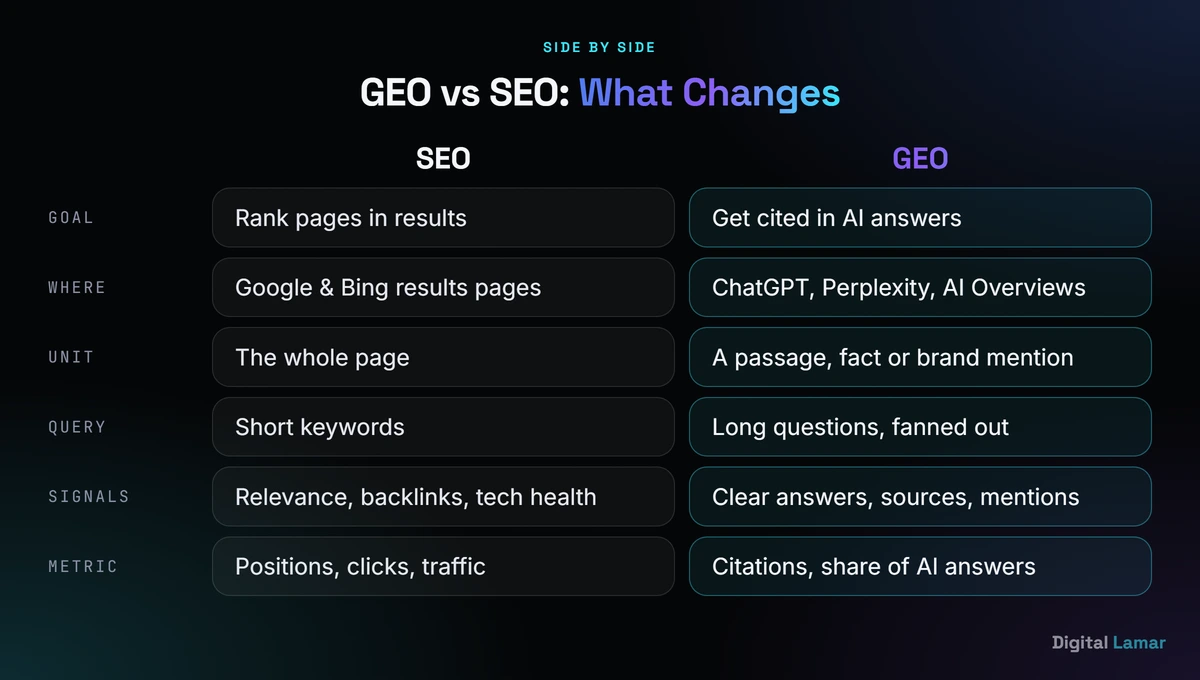
Same foundations, different finish line: SEO competes for the click, GEO competes for the citation.
| Factor | SEO | GEO |
|---|---|---|
| Goal | Rank pages in search results | Get cited or named in AI answers |
| Where it shows | Google and Bing results pages | ChatGPT, Perplexity, Gemini, Google AI Overviews and AI Mode |
| Unit that competes | The whole page | A passage, fact or brand mention |
| Query shape | Short keywords | Long, conversational questions split into sub-queries |
| Main trust signals | Relevance, links, technical health | Clear answers, named sources, statistics, mentions across the web |
| Success metric | Positions, clicks, organic traffic | Citations, brand mentions, share of AI answers |
| Measurement | Google Search Console, rank trackers | Manual prompt testing, AI visibility trackers |
What Is SEO?
SEO is the practice of improving a website so it ranks higher in unpaid search results on Google and Bing. It covers three areas: technical health (crawling, indexing, speed), content that matches what people search, and authority signals such as links from other trusted websites. Success is measured in rankings, clicks and leads.
If you want the longer version, we’ve written a full explainer on what SEO actually is.
What Is GEO?
GEO, short for generative engine optimization, is the practice of shaping your content and online reputation so AI systems like ChatGPT, Perplexity, Gemini and Google’s AI Overviews quote, cite or recommend you in their answers. The term comes from a 2023 research paper by a team from Princeton and IIT Delhi.
That paper matters because it’s one of the few controlled tests of what works. The researchers built a benchmark of 10,000 queries and tested different ways of rewriting content. Adding citations, quotations and statistics lifted a source’s visibility in generative engine answers by 30 to 40 percent, and the best method improved on the baseline by up to 41 percent (Aggarwal et al., KDD 2024). Keyword stuffing, the oldest SEO shortcut, did little, and on Perplexity it performed about 10 percent worse than the original text.
Does “GEO SEO” Mean Generative or Geographic?
In 2026, “GEO SEO” almost always means generative engine optimization, the AI search discipline. A few agencies still use “geo” for geographic or location-based SEO, which is better called local SEO: Google Business Profile, map pack rankings and city pages. If someone pitches you “GEO,” ask which one they mean before you sign anything.
The mix-up shows in Google’s autocomplete, where “geo seo meaning” sits right beside “geo seo aeo.” This guide uses the generative sense throughout.
GEO vs SEO: 7 Key Differences
GEO and SEO differ in seven practical ways: where the answer appears, what counts as a win, how queries are phrased, which trust signals carry weight, how content is read, how traffic behaves, and how you measure results. The first four change how you write. The last three change how you report and budget.
1. Where the Answer Appears: Results Page vs AI Answer
SEO competes on a results page with ten blue links, ads, maps and snippets around it. GEO competes inside a written answer. On a results page, position three still gets seen. Inside an AI answer, a brand that isn’t named simply doesn’t exist for that reader.
2. What Counts as a Win: Rankings vs Citations
An SEO win is a position. A GEO win is a mention, a quoted number or a cited link, counted as a share of test prompts (“cited in 6 of 20 this month”) because there’s no fixed rank.
For realistic timelines by site age and market, see how long SEO takes.
3. How Queries Look: Keywords vs Conversations
People type three or four words into Google. They type full questions into ChatGPT, often with their situation attached: budget, city, industry. AI systems then break that question into smaller searches. Google describes this “query fan-out” openly, saying its AI features may run multiple related searches across subtopics and data sources to build one response (Google Search Central, 2025). That’s why a page that answers the follow-up questions clearly has more ways to be picked than a page built around one keyword.
4. Which Signals Matter: Links vs Evidence and Mentions
Backlinks remain one of SEO’s strongest signals. GEO leans harder on the content itself: a clear claim, a named source, a specific number. Brand mentions on trusted sites, such as industry publications and review platforms, also shape what AI models “know” about you, even without a link.
5. How Content Is Read: Whole Pages vs Passages
Search engines rank pages. Generative engines lift passages. A 3,000-word guide can rank well on Google while only one paragraph of it ever gets quoted by an AI. This is why GEO writing puts the answer in the first 40 to 60 words under each heading, names the subject in full instead of saying “it,” and keeps each section understandable on its own. A passage that only makes sense in context is a passage the AI skips.
6. How Traffic Behaves: Clicks vs Zero-Click Answers
Here is the gap that worries most business owners. Pew Research Center tracked the real browsing of 900 US adults in March 2025. When a Google search showed an AI summary, users clicked a traditional result on 8 percent of visits, compared with 15 percent when no summary appeared. They clicked a link inside the summary itself just 1 percent of the time (Pew Research Center, 2025).
Visits with a click on a traditional Google result
15% to 8%
Clicks on a traditional result nearly halved when an AI summary sat on top of the page (Pew Research Center, 2025).
So GEO value often shows up as awareness, not sessions. A buyer reads your name in an AI answer, then searches for you directly a week later.
7. How You Measure: Search Console vs Prompt Tracking
SEO has mature tools. Google Search Console shows impressions, clicks and positions for every query, and Google counts traffic from its AI features inside that same Performance report. GEO measurement is younger. Most teams build a list of 20 to 30 prompts their buyers would ask, run them monthly in ChatGPT, Perplexity, Gemini and Google, and log who gets named and cited.
Where Do GEO and SEO Overlap?
GEO and SEO overlap on almost every foundation: crawlable and indexable pages, fast and clean technical setup, helpful content written by people who know the subject, clear structure, and a trusted brand. Google says outright that SEO best practices remain relevant for its AI features and that no special optimization is needed to appear in them.
Its documentation says there are “no additional requirements to appear in AI Overviews or AI Mode” (Google Search Central, 2025). Indexed and snippet-eligible is the whole technical bar.
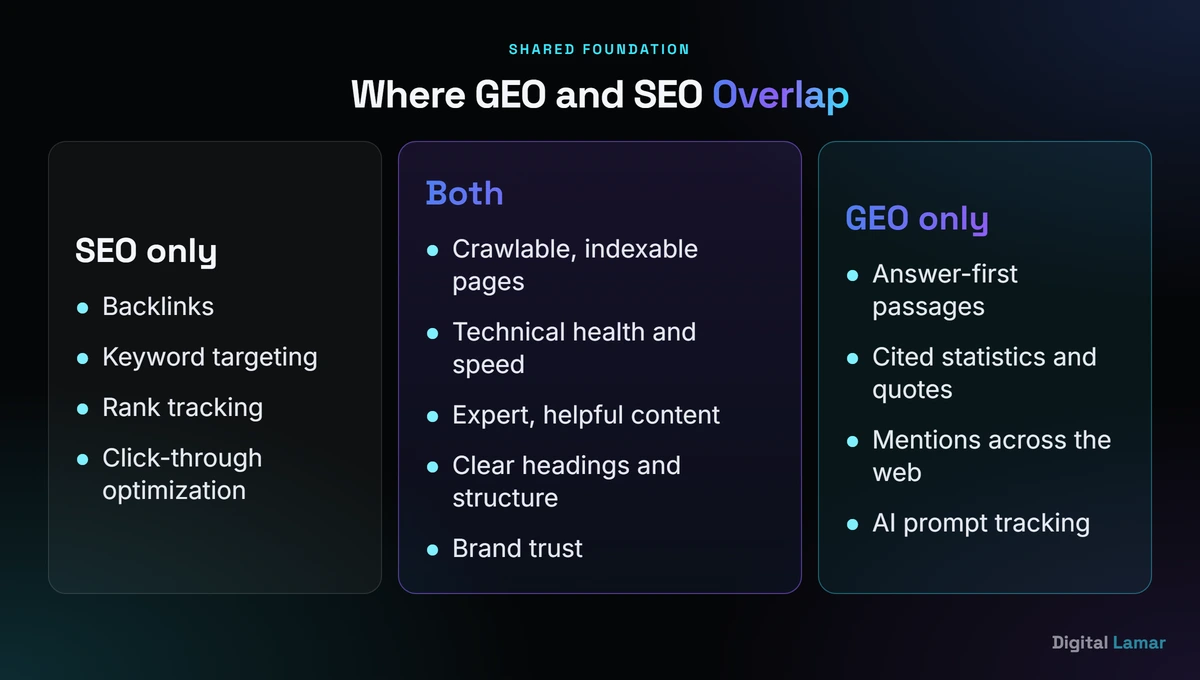
The shared middle is most of the work. The edges are where SEO and GEO each need their own effort.
The overlap is not total, though, and the data has moved. Ahrefs analyzed 863,000 keyword results and 4 million URLs cited in AI Overviews and found that only about 38 percent of cited pages also ranked in Google’s top 10 for that query (Ahrefs, 2026). Ranking well still helps you get cited. It no longer guarantees it, and a page outside the top 10 can still earn the citation if it answers one sub-question better than anyone else.
Is GEO Replacing SEO?
No, GEO is not replacing SEO. Generative engines pull their answers from content that search engines already crawl and index, so a site that fails at SEO gives AI systems little to cite. GEO extends SEO into AI answers. Search volume on Google is still enormous, and in many markets it’s almost the only search engine people use.
Pakistan is a good example. Google held 95.1 percent of the search engine market there in September 2026, with Bing at 3.75 percent (StatCounter, 2026). For a Lahore or Karachi business, classic Google rankings are still where most demand gets captured. Meanwhile, AI Overviews appear inside those same Google results, which means GEO and SEO now compete on the same page rather than on separate platforms.
What’s changing is the payoff per ranking. When fewer people click, the business that is both ranked and cited gets the attention.

Search still dominates, AI answers are growing fast, and the two now share the same results page.
GEO vs SEO vs AEO: How the Three Relate
SEO, AEO and GEO are three layers of the same goal. SEO earns rankings in search results. AEO (answer engine optimization) earns the direct answer, such as a featured snippet, voice answer or People Also Ask box. GEO earns citations in fully AI-written responses. Each builds on the one before it.
In practice, the techniques blur. The short, answer-first paragraph that wins a featured snippet is the same passage an AI model likes to quote. Our guide to answer engine optimization covers the snippet and voice side in depth, and our piece on LLM optimization covers how to format content so language models can read and reuse it. Some people also use “AIO” or “LLMO” for the same family of work. The labels matter less than the habit: write so both a person and a machine can pull out the answer in seconds.
Which Do You Need: GEO, SEO or Both?
Most businesses need both, in order. Start with SEO if your site has technical problems, little content, or no rankings yet, because GEO depends on that base. Add GEO once you’re indexed and ranking, especially if your buyers research with ChatGPT or see AI Overviews on your main queries.

A quick way to read your own situation. Most businesses land in the middle two rows.
When Should SEO Come First?
SEO should come first when your website isn’t fully indexed, loads slowly, has thin or missing service pages, or doesn’t rank for your own brand name. In those cases GEO work has nothing solid to stand on. Fix the base, publish the pages your buyers search for, and earn your first rankings.
Local service businesses such as clinics and contractors usually belong here too, since most of their “near me” demand runs through Google’s local results.
When Does GEO Deserve More Budget?
GEO deserves more budget when your buyers ask long, comparison-style questions before they buy, such as “best accounting software for a small business” or “which agency should I hire.” B2B services, SaaS, education, finance and other high-consideration purchases fit this pattern. Here, being named in the AI answer can shape the shortlist before anyone visits a website.
It also deserves attention when your own tests show competitors named in AI answers and you’re missing. That gap is visible today, with no traffic report needed.
Around this point, many business owners want an outside view. Digital Lamar offers a free 30-minute call where we run your key buyer questions through ChatGPT and Google together and show you who gets cited.
How Should You Split Effort Between GEO and SEO?
Most of the effort is shared, so the split is smaller than it sounds. Technical health, strong pages and a credible brand serve both. The GEO-specific layer is mainly answer-first rewriting, adding sourced numbers, earning mentions on trusted sites, and monthly prompt tracking. On an established site, that layer can run alongside existing SEO rather than replacing it.
If you’re weighing what this kind of work costs, our breakdown of how much does SEO cost covers typical pricing in Pakistan, the US and the UAE.
How to Do GEO and SEO Together: 6 Steps
To do GEO and SEO together, build one content system that serves both: fix the technical base, research questions as well as keywords, write answer-first sections, back claims with named sources, grow mentions beyond your own site, and track rankings and AI citations side by side every month. Each step helps both channels at once.
- Fix the shared technical base. Make sure your key pages are indexed, fast and eligible for snippets. Check that your robots.txt doesn’t block the search crawlers you want, including the ones AI search tools use.
- Research questions, not just keywords. Pull the phrasings people use from Google autocomplete, People Also Ask and your own sales calls. Map each one to a heading on a real page.
- Write answer-first sections. Put a complete 40 to 60 word answer directly under each question heading, then add the detail. Name the subject in full so the passage stands on its own.
- Back every claim with evidence. Add statistics with their source and year, short expert quotes and specific examples. This is the method the GEO research found most effective, and it also makes the page more trustworthy to human readers.
- Grow mentions beyond your website. Get listed and reviewed on the platforms your industry trusts, contribute to industry publications, and keep your business details consistent everywhere they appear.
- Track both scoreboards monthly. Watch rankings and clicks in Search Console, and run the same 20 to 30 buyer prompts in ChatGPT, Perplexity, Gemini and Google. Log who is named and cited, and re-check after each content update.
None of these steps needs special markup. Google is clear that structured data is not a requirement for its AI features, though it still helps with rich results in classic search.
GEO vs SEO in Pakistan, the US and the UAE
The balance between GEO and SEO depends on the market. In Pakistan, Google rankings still capture most demand, so SEO comes first. In the US, AI answers already shape many buying decisions, so GEO is close to essential. The UAE sits between the two, with a bilingual English and Arabic search landscape.
How Does GEO vs SEO Play Out in Pakistan?
With Google at 95.1 percent of search, Pakistani businesses win most organic demand through classic rankings and Google’s own AI Overviews, so strong SEO is the priority. GEO is the early-mover opportunity: a Pakistani brand that publishes clear, sourced answers now can become the name AI tools reach for in its category.
Businesses that want local search help can start with our SEO (Search Engine Optimization) service.
How Does GEO vs SEO Play Out in the US?
The US is where both the click data and the AI usage are clearest. The Pew findings above come from American users, and many AI search features, including Google’s AI Overviews, launched there first. For US businesses, especially in B2B, SaaS and professional services, GEO belongs in the plan from day one rather than as a later add-on.
How Does GEO vs SEO Play Out in the UAE?
UAE buyers research in both English and Arabic and often compare local and international providers side by side. So consistent brand information across languages matters for both channels: bilingual pages with clear answers give search engines and AI models the same facts.
Common Mistakes When Adding GEO to an SEO Strategy
The most common GEO mistakes are abandoning SEO, chasing tricks like hidden prompts or keyword stuffing, writing vague content with no numbers, ignoring what other sites say about your brand, and trying to measure GEO only through website traffic. Each one either breaks the foundation or measures the wrong thing.
- Dropping SEO for GEO. AI tools cite what search engines can find. Cutting SEO to fund GEO removes the base GEO depends on.
- Looking for shortcuts. The Princeton study found keyword stuffing did little and even hurt on Perplexity. There’s no hidden setting that makes an AI recommend you.
- Writing without evidence. “We offer flexible, affordable solutions” gives an AI nothing to quote. A sourced number, a named method or a clear process does.
- Ignoring off-site reputation. AI answers draw on reviews, directories, forums and press. A brand that only talks about itself on its own site is harder to recommend.
- Judging GEO by clicks alone. Many AI citations never send a visit. Track mentions and direct brand searches as well as sessions.
Bringing in outside help? Our guide on how to choose a digital marketing agency lists the questions to ask, including how an agency measures AI visibility.
Key Takeaways
- SEO ranks your pages in search results. GEO gets your brand cited inside AI answers.
- Both rest on the same foundation, and Google says SEO best practices still apply to its AI features with no special requirements.
- Adding citations, quotations and statistics raised visibility in AI answers by 30 to 40 percent in the original GEO research (Aggarwal et al., KDD 2024).
- Only about 38 percent of AI Overview citations also rank in Google’s top 10 (Ahrefs, 2026), so ranking helps but doesn’t guarantee a citation.
- Clicks on traditional results fell from 15 to 8 percent of visits when an AI summary appeared (Pew Research Center, 2025).
- GEO is not replacing SEO. Start with SEO, then layer GEO on top, weighting it higher for B2B and high-consideration purchases.
- Track rankings in Search Console and AI citations with a fixed set of buyer prompts, every month.
Not sure whether AI answers mention your business?
Book a free 30-minute strategy call with Digital Lamar. We’ll run your most important buyer questions through ChatGPT and Google with you, show which competitors get cited, and tell you whether SEO or GEO should get your next hour of effort. You can also see how our AI search optimization services work.
Book a free 30-min strategy callFrequently Asked Questions
What does GEO stand for in marketing?
In digital marketing, GEO stands for generative engine optimization: making your content and brand easy for AI systems such as ChatGPT, Perplexity, Gemini and Google AI Overviews to quote and cite. Some agencies still use “geo” for geographic or local SEO, so check which meaning someone has in mind.
Is GEO better than SEO?
Neither is better on its own, because they do different jobs and GEO depends on SEO. SEO captures searchers who click results, and GEO captures readers of AI answers. A business with strong rankings and no AI citations is missing part of its audience, and the reverse rarely happens.
Do I still need keywords for GEO?
Yes, but think of them as questions rather than short phrases. Keyword research still tells you what your buyers care about. For GEO, turn those keywords into the full questions people ask AI tools, use them as headings, and answer each one directly in the first few sentences.
How long does GEO take to show results?
There’s no official benchmark. AI search tools that browse the web can pick up a well-structured, indexed page within weeks, while changing what a model says about your brand from memory takes longer and depends on mentions across many sites. Track a fixed set of prompts monthly and judge progress over a few months.
Does schema markup help with GEO?
Schema markup isn’t required. Google says there is no special structured data needed to appear in AI Overviews or AI Mode. Schema still helps classic SEO through rich results, and it keeps your business facts consistent, so it’s worth having, but it won’t get you cited on its own.
Can a small business do GEO without an agency?
Yes. A small business can start by answering its customers’ top 20 questions clearly on its own website, adding real numbers and sources, keeping its Google Business Profile and directory listings accurate, and testing a few prompts in ChatGPT each month. An agency helps most when you need scale or technical fixes.