On this page
- What Is the Google November 2026 Core Update?
- The November Core Update and Google’s 2026 Updates
- Core Update vs Spam Update
- How to Check If the Update Affected Your Site
- What to Do If Your Rankings Dropped
- What It Means in the US, Pakistan and the UAE
- Does SEO Still Matter in 2026?
- Key Takeaways
- Frequently Asked Questions
In short
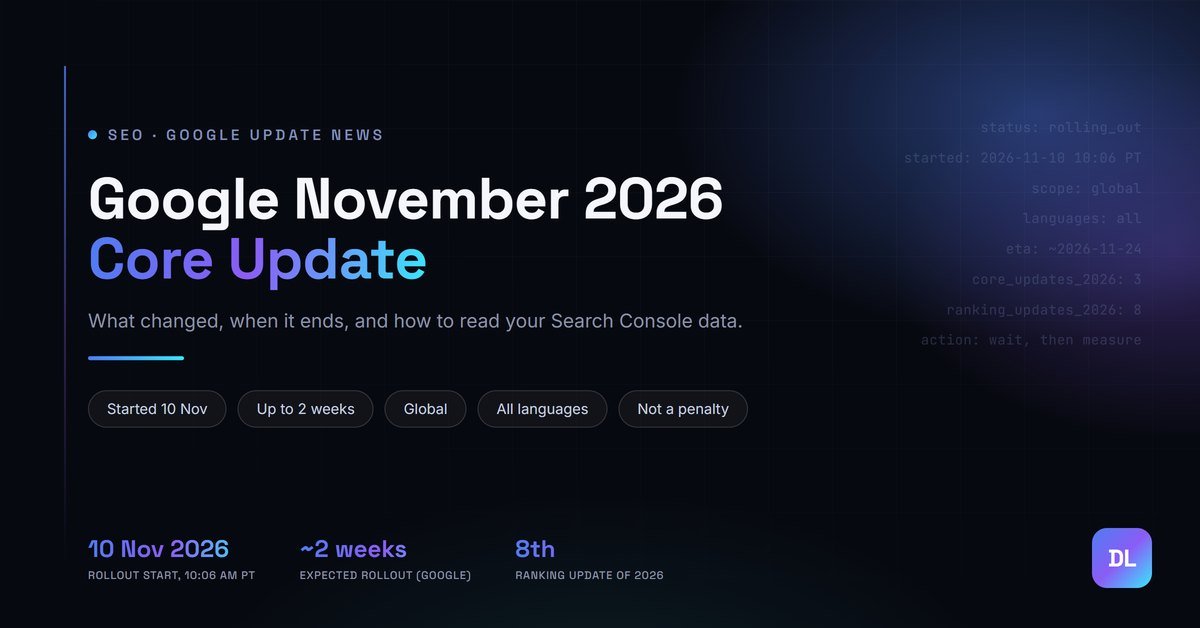
Google started rolling out the November 2026 core update on 10 November 2026 at 10:06 AM Pacific time. It applies to every country and language and may take up to two weeks, so expect it to finish around 24 November. It is Google’s third core update of 2026 and its eighth confirmed ranking update of the year. Don’t edit pages while it rolls out. Wait a full week after it finishes, then compare your Search Console data with the week before 10 November, and plan around Thanksgiving and Black Friday, which fall inside that comparison window.
If you opened Search Console on 11 November and saw your rankings swing, you weren’t imagining it. At 10:06 AM Pacific time on 10 November 2026, which was 11:06 PM in Pakistan and 10:06 PM in Dubai, Google announced the November 2026 core update.
Most sites will barely notice it.
Some will see pages climb, and some will watch a page that sat in the top three slide to page two. The worst move in either case is to start rewriting content in the middle of a rollout, because the numbers you would be reacting to are still moving. This Digital Lamar guide covers what Google has confirmed about the update, how it compares with the other seven ranking updates of 2026, exactly which dates to compare in Search Console (including a holiday problem most coverage only mentions in passing), and what to do if a page drops for good.
What Is the Google November 2026 Core Update?
The Google November 2026 core update is a broad change to Google’s core ranking systems, released on 10 November 2026. It applies globally and in all languages, according to the Google Search Status Dashboard. It does not target specific sites or pages. It reassesses how well every page answers searches.
A core update is different from the thousands of small tweaks Google makes every year. Google describes core updates as significant, broad changes to its search algorithms and systems, made several times a year to keep results helpful and reliable as the web changes (Google Search Central, core updates documentation). Google’s own analogy is a list of the top 20 restaurants: when the list is updated, a restaurant that moves down isn’t necessarily bad, there are simply others that now rank above it. That is why a drop after a core update rarely has a single technical cause you can fix in an afternoon.
When Did the November 2026 Core Update Start, and When Will It Finish?
The November 2026 core update started on 10 November 2026 at 10:06 AM Pacific time. Google says the rollout may take up to two weeks to complete, which points to a finish date around 24 November 2026. Google posts a completion note on the Search Status Dashboard when it ends, so check there rather than guessing from ranking trackers.
In other time zones, that was 1:06 PM in New York, 10:06 PM in Dubai and 11:06 PM in Pakistan.
What Did Google Say About the November 2026 Core Update?
Google said very little, which is normal for a core update. The Search Status Dashboard entry says the update “applies globally and to all languages” and may take up to two weeks. In a Google Search Central LinkedIn post, Google called it a regular update meant to surface relevant, satisfying content from all types of sites.
There was no Search Central blog post and no list of changes. Search Engine Journal noted the wording matches the March 2026 core update announcement (Search Engine Journal, 2026).
How the November 2026 Core Update Fits Into Google’s 2026 Updates
The November 2026 core update is Google’s third core update of 2026, after the March and May core updates, and its eighth confirmed ranking update of the year. The other five were a Discover update in February and spam updates in March, June, August and September. All dates below come from Google’s Search Status Dashboard.
| Update | Started | Finished | Rollout time |
|---|---|---|---|
| December 2025 core update | 11 Dec 2025 | 29 Dec 2025 | 18 days, 1 hour |
| February 2026 Discover update | 5 Feb 2026 | 27 Feb 2026 | 21 days, 17 hours |
| March 2026 spam update | 24 Mar 2026 | 25 Mar 2026 | 19 hours |
| March 2026 core update | 27 Mar 2026 | 8 Apr 2026 | 12 days, 4 hours |
| May 2026 core update | 21 May 2026 | 2 Jun 2026 | 11 days, 21 hours |
| June 2026 spam update | 24 Jun 2026 | 26 Jun 2026 | 2 days, 1 hour |
| August 2026 spam update | 18 Aug 2026 | 21 Aug 2026 | 2 days, 16 hours |
| September 2026 spam update | 24 Sep 2026 | 8 Oct 2026 | 13 days, 15 hours |
| November 2026 core update | 10 Nov 2026 | In progress | Up to 2 weeks |
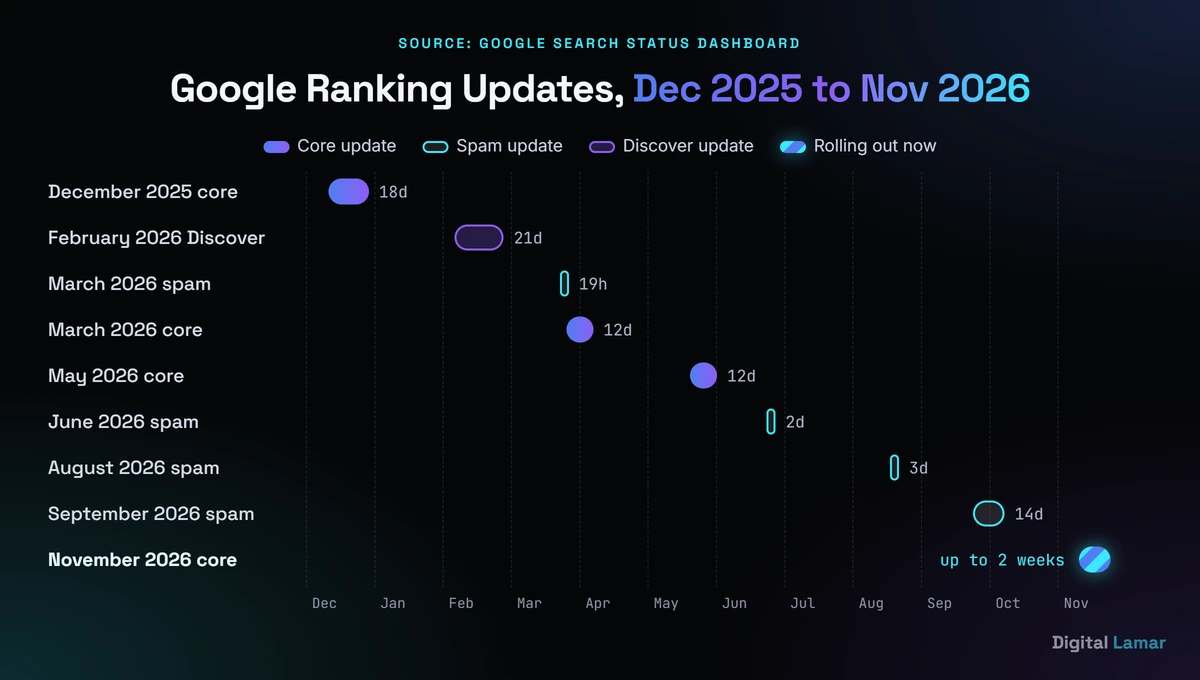
Google’s confirmed ranking updates since December 2025, from the Search Status Dashboard. Core updates take weeks; most spam updates take days.
8th confirmed ranking update of 2026, and the 3rd core update, is how the November 2026 core update sits in Google’s own Search Status Dashboard history. A site that lost traffic this year may have been hit by an earlier one.
Was There a Google Core Update in August 2026?
No. Google did not release a core update in August 2026. The August 2026 update was a spam update, which ran from 18 to 21 August. The 2026 core updates are March (27 March to 8 April), May (21 May to 2 June) and November, which started on 10 November. A ranking drop in August points to spam signals or normal volatility, not a core update.
The same applies to July, September and October searches for a “core update”: September brought a spam update that took nearly two weeks, which many site owners mistook for a core update, and neither July nor October had a confirmed ranking update.
How Long Do Google Core Updates Usually Take?
Most Google core updates take about two weeks to roll out. Across 23 core updates tracked since 2019, the median rollout was 14 days, according to Search Engine Roundtable’s update history (Search Engine Roundtable, 2026). The 2026 core updates were a little quicker, at about 12 days each.
Outliers happen: the March 2024 core update took 45 days, so don’t bank on 24 November.
Core Update vs Spam Update: What’s the Difference?
A core update reassesses how relevant and useful every page is, so pages can rise or fall without having broken any rule. A spam update targets sites that violate Google’s spam policies, such as scaled low-value content or link schemes. A core update drop is a relevance problem; a spam update drop is a policy problem.
The fix is different too. After a spam update, you find and remove the violation. After a core update there may be nothing to remove, only pages that now look weaker than the competing results. We covered the policy side in our breakdown of the Google June 2026 spam update.
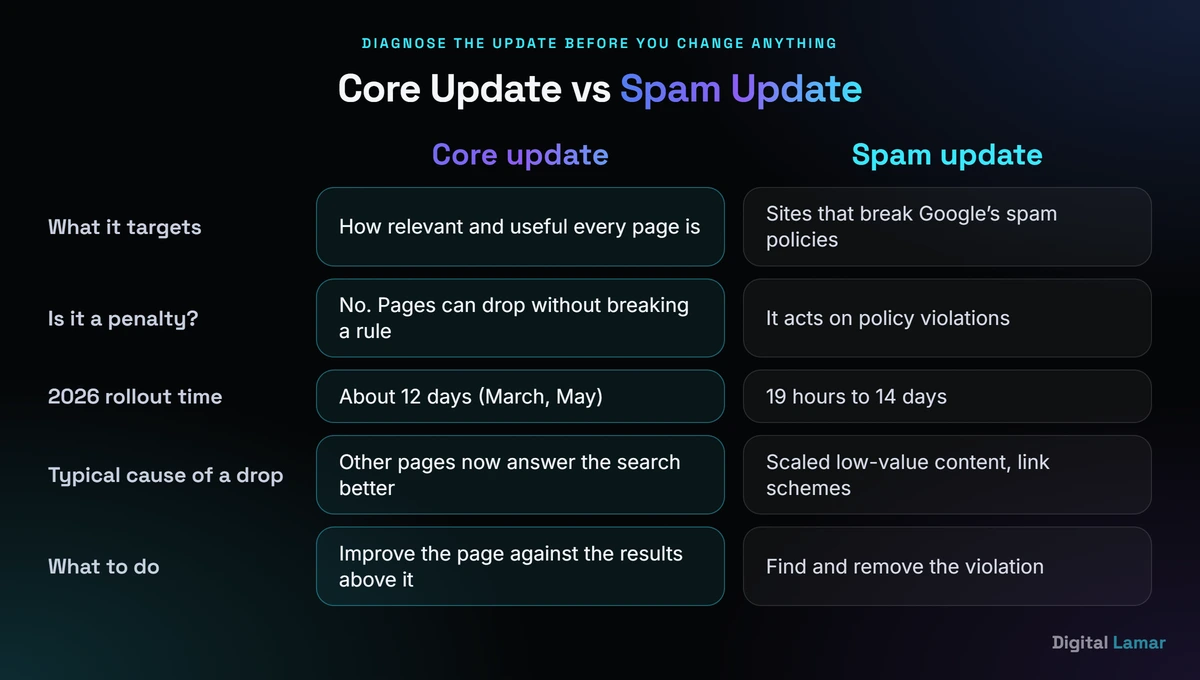
Same dashboard, different problems. Diagnose which kind of update hit you before you change anything.
How to Check If the November 2026 Core Update Affected Your Site
Check in Search Console, not in third-party rank trackers. Google’s advice is to wait until the rollout is confirmed complete, then wait at least one more full week, and compare that week with the week before the update started. For this update, that means comparing a week starting around 25 November with 3 to 9 November.
Look at the Performance report by page and by query, and analyse Web, Image, Video and News search types separately, because Google notes they can move differently. Ranking trackers such as Semrush Sensor and Mozcast are useful for spotting that something is happening, and Search Engine Roundtable (2026) reported big movements on several of them in the days before the announcement. They can’t tell you what happened to your site, though. Your own Search Console data can.
Which Dates Should You Compare in Search Console?
Compare the first full week after Google confirms the rollout is complete with 3 to 9 November 2026, the week before the update began. If the update finishes on time around 24 November, the comparison week runs into Thanksgiving (26 November), Black Friday (27 November) and Cyber Monday (30 November), which will distort clicks for many sites.
Holiday traffic changes demand, not rankings, so separate the two. Four practical fixes:
- Judge average position first, clicks second. Position reflects where Google ranks you; clicks also reflect how many people are searching that week.
- Add a year-over-year check. Search Console keeps 16 months of data, so compare the post-update week with the same week of 2025 as well as with early November 2026.
- Filter out seasonal queries. Exclude sale, gift and “Black Friday” terms, and look at how your informational and service pages moved.
- Check a second week. The week from 2 to 8 December gives a cleaner read for US-facing sites.
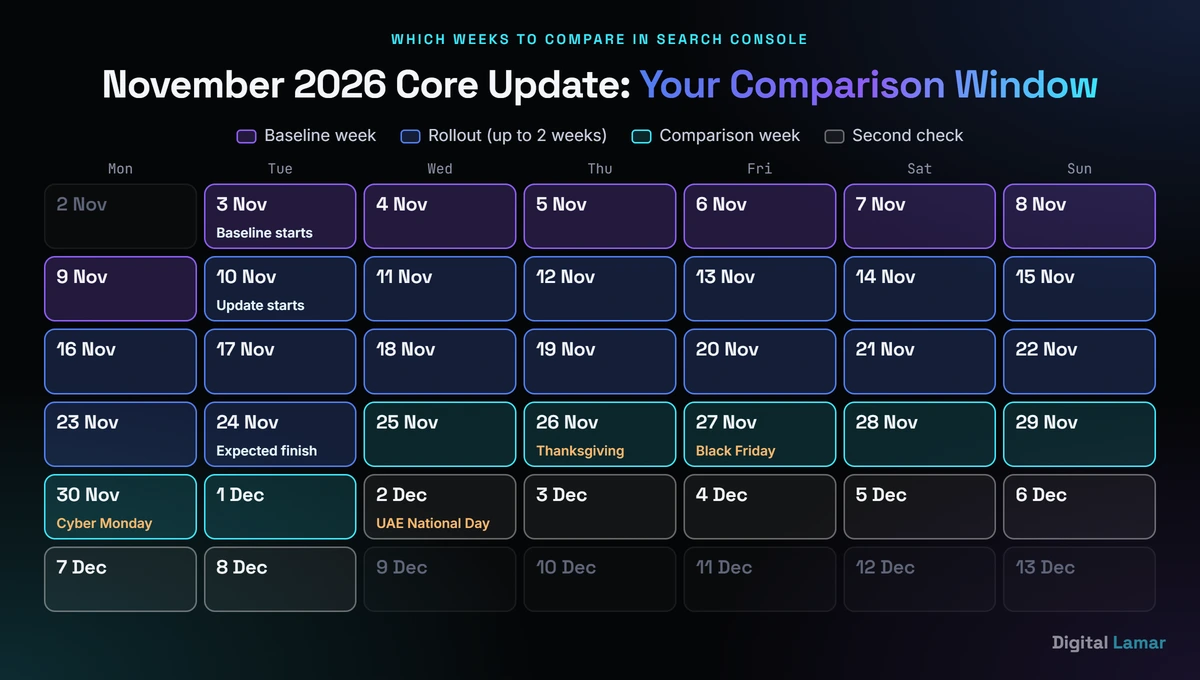
The baseline and comparison weeks for this update. Holiday demand lands right in the comparison window.
Is Your Ranking Drop Small or Large?
Google splits drops into two kinds. A small drop, such as a page moving from position 2 to position 4, needs no drastic action, and Google recommends not changing content that is already performing well. A large drop, such as position 4 to position 29, calls for a deeper look at whether the page still deserves to rank.
Look at the drop page by page, not just at the sitewide total. A site can lose 20% of its clicks because three strong pages fell while everything else held, and those three pages are where the work is.
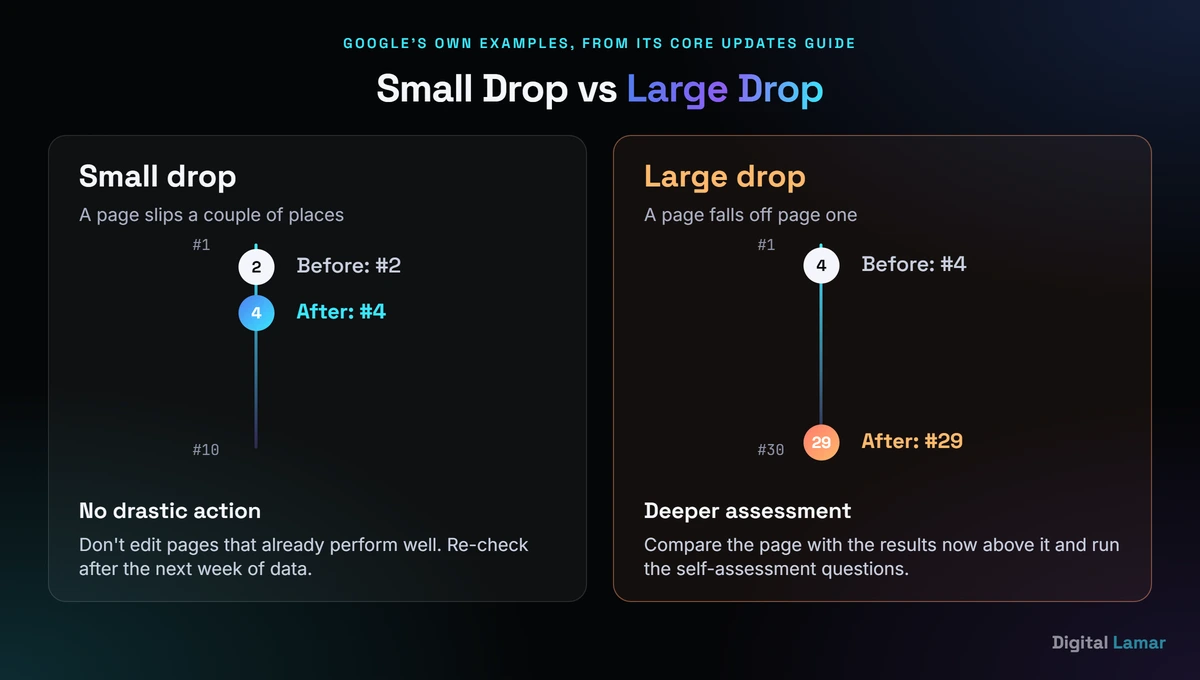
Google’s own examples: a two-place slip is noise, a fall off page one is a signal.
What to Do If Your Rankings Dropped After the November 2026 Core Update
First, do nothing until the rollout ends and you have a clean week of data. Then pick the pages with large, sustained drops, open the results that now outrank them, and judge honestly whether those results answer the search better. Improve the page for readers, not for the update. There is no switch to flip back.
The most common pattern behind a large drop is a page that answered the question less completely, less recently or less credibly than the pages that replaced it. Sometimes the competitor added original data, a clearer first answer or real first-hand experience. Sometimes Google decided a different type of page fits the search better, for example a product page instead of a guide. Neither shows up in a technical audit, though it is worth ruling out technical SEO problems such as accidental noindex tags or broken redirects that happened to land the same week.
If you would rather have a second pair of eyes on your Search Console data once the rollout ends, you can book a free 30-minute call with Digital Lamar and we will go through the affected pages with you.
What Are Google’s Self-Assessment Questions?
Google’s self-assessment questions are a checklist from its guide to helpful, reliable, people-first content that it recommends after a large core update drop. They ask whether a page offers original information, covers the topic completely, adds value beyond other results, shows clear expertise, and was made for people rather than to rank.
In short form, the questions worth asking about every page that dropped:
- Does it give original information, research or analysis, rather than rewriting other pages?
- Does it cover the topic completely enough that a reader doesn’t need to search again?
- Does it offer something the pages now outranking it don’t?
- Is it clear who wrote it and why they are qualified, with sources a reader can check?
- Are the title and headings descriptive, without exaggeration?
- Is it free of easy-to-verify factual errors and sloppy production?
- Would you bookmark it or send it to a friend?
Google also suggests asking someone unconnected to the site to assess it, because owners are rarely objective about their own pages. Mass-produced AI text published without review is one of the patterns Google’s guide describes as low effort.
How Long Does Recovery From a Core Update Take?
Recovery from a core update can take anywhere from a few days to several months. Google says some changes take effect quickly, but its systems may need months to confirm a site now produces helpful content, and a page sometimes only recovers at the next core update. Google also says improvements don’t guarantee a recovery.
So improve the affected pages properly once, then give them time. Rewriting a page every two weeks resets the clock. Our guide to how long SEO takes covers timelines by industry.
What the November 2026 Core Update Means for Businesses in the US, Pakistan and the UAE
The November 2026 core update applies to every country and language, so Google is not treating any market differently. What differs is timing. US sites face Thanksgiving inside the comparison window, UAE sites face National Day on 2 December, and Pakistani sites can read their data with the fewest holiday distortions of the three.
United States. Ecommerce and local service sites should expect the noisiest data. Judge rankings on positions and on non-seasonal pages, and save the full traffic verdict for the first week of December. If you sell during Black Friday, don’t let a rollout tempt you into changing product or category pages in the middle of your biggest sales week.
Pakistan. Pakistani results in both English and Urdu are inside the update. With no major holiday in the comparison window, a site serving Pakistan can usually run Google’s week-over-week comparison as written. If a page drops, check whether the new top results answer the question for a Pakistani searcher, with local prices, local examples and local regulations, because that local fit is often what sets the winning pages apart. Digital Lamar runs this same page-by-page review as an SEO company in Pakistan, and it works the same way wherever your customers are.
United Arab Emirates. UAE National Day falls on 2 December, the day after the first comparison week ends if the rollout finishes on time. Business traffic usually slows around public holidays, so if the rollout runs late, use the year-over-year check for UAE-facing pages.
Does SEO Still Matter in 2026?
Yes. Google keeps updating its core systems precisely because people still rely on it to find businesses, products and answers. What a core update changes is which pages deserve the top spots. Pages that answer a search completely, credibly and for a real reader keep earning that traffic, and AI search tools draw on the same kind of pages.
A core update is a reminder that SEO is not a one-time setup but an ongoing standard. If you are unsure what that standard covers, start with what SEO actually is, and for visibility in ChatGPT and Google’s AI answers, the same groundwork feeds generative engine optimization. When you want that work done for you, our SEO (Search Engine Optimization) service covers audits, content and technical fixes.
Key Takeaways
- Google started the November 2026 core update on 10 November 2026 at 10:06 AM Pacific time; it is global, covers all languages and may take up to two weeks.
- It is the third core update and the eighth confirmed ranking update of 2026, according to Google’s Search Status Dashboard.
- A core update is not a penalty. It reassesses relevance, so pages can drop without breaking any rule.
- Wait a full week after Google confirms completion, then compare with 3 to 9 November in Search Console.
- Thanksgiving, Black Friday and Cyber Monday fall in the comparison window, so judge positions before clicks and add a year-over-year check.
- Leave small drops alone. For large, sustained drops, compare the page honestly with the results that now outrank it and improve it once.
Not Sure What the Core Update Did to Your Site?
Book a free 30-minute call with Digital Lamar once the rollout finishes. We’ll read your Search Console data with you, separate holiday noise from real ranking changes, and tell you which pages, if any, need work, whether your customers are in the US, Pakistan or the UAE.
Book a free 30-min strategy callFrequently Asked Questions
What is the Google November 2026 core update?
It is a broad update to Google’s core ranking systems that started on 10 November 2026. It applies globally and in all languages, and Google says the rollout may take up to two weeks. It does not target specific sites; it reassesses how well pages answer searches.
Is the November 2026 core update finished?
Not yet as of 11 November 2026. Google expects the rollout to take up to two weeks from 10 November, so around 24 November. Google adds a completion note to the Search Status Dashboard when it ends, which is the reliable place to check.
Is a Google core update a penalty?
No. A core update reassesses relevance across the whole web. A page can drop because other pages now answer the search better, not because it broke a rule. Spam updates and manual actions are the ones tied to policy violations.
Should I change my content during a core update rollout?
No. Rankings keep moving until the rollout ends, so changes made mid-rollout are based on unsettled data. Wait until Google confirms completion, then a further full week, and only then decide which pages need work.
What Google updates are expected for the rest of 2026?
Google doesn’t announce core updates in advance. Its history shows two to four a year (Search Engine Roundtable, 2026), and it ran a core update in December 2025, so another update before the end of 2026 is possible but unconfirmed. Watch the Search Status Dashboard for official notices.
When was the last Google SEO update?
The latest confirmed update is the November 2026 core update, which started on 10 November 2026. Before it, Google ran the September 2026 spam update from 24 September to 8 October and the May 2026 core update from 21 May to 2 June.